
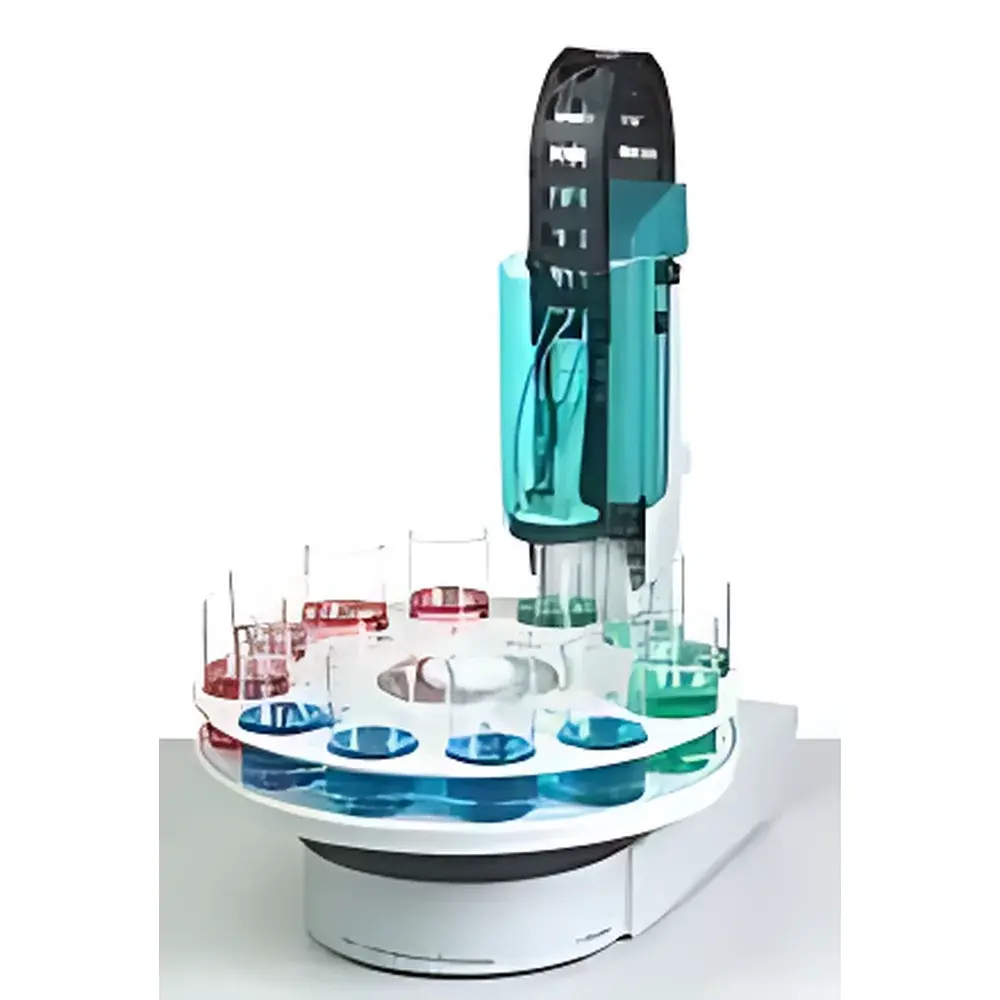
Metrohm 814/815 Automated Sample Processor
| Brand | Metrohm |
|---|---|
| Origin | Switzerland |
| Manufacturer Type | Original Equipment Manufacturer (OEM) |
| Product Category | Imported Instrument |
| Models | 814, 815 |
| Instrument Type | Electrochemical Sample Processor |
| Sample Capacity (814) | 12–48 positions (75 mL vials) |
| Sample Capacity (815) | 28–141 positions (75 mL vials) |
| Sample Volume Range (814) | 75–250 mL |
| Sample Volume Range (815) | 11–250 mL |
| Sample Tray Recognition | Optical cup identification sensor |
| Pump Configuration (814) | 1–2 peristaltic pumps |
| Pump Configuration (815) | 2–4 peristaltic pumps |
| Robotic Arm Configuration (814) | Single arm (left- or right-mounted) |
| Robotic Arm Configuration (815) | Dual arms (independently configurable left/right) |
| Dispensing Positions (814) | One external titration position |
| Dispensing Positions (815) | Two external titration positions |
| Method Storage | Up to 999 user-programmable methods |
| Method Structure | Three-phase architecture (Start → Sample Analysis → End), each phase supporting up to 99 programmable steps |
| Interface | USB 2.0 + 3× MSB (Metrohm Serial Bus) ports |
| Host Integration | Fully controlled by Titrando series titrators |
Overview
The Metrohm 814 and 815 Automated Sample Processors are precision-engineered electrochemical sample handling systems designed for integration with Metrohm’s Titrando series potentiometric and coulometric titrators. These processors operate on a modular robotic architecture governed by deterministic sequence logic, enabling unattended execution of complex liquid-handling workflows—including volumetric dispensing, aspiration, transfer, and Karl Fischer water determination—under full instrument control. Unlike generic autosamplers, the 814/815 platforms implement Metrohm’s proprietary MSB (Metrohm Serial Bus) protocol for real-time bidirectional communication with the host titrator, ensuring synchronized timing between electrode potential acquisition, reagent delivery, and endpoint detection. The system is engineered for reproducible operation in regulated laboratory environments where traceability, method integrity, and audit readiness are critical—supporting GLP-compliant data capture through timestamped method logs and hardware-level event tracing.
Key Features
- Optical sample cup recognition: Integrated photodiode-based sensor validates vial presence, orientation, and type (e.g., 75 mL polypropylene, 11 mL glass) prior to aspiration—eliminating positional ambiguity and preventing dry-run errors.
- Modular pump architecture: Peristaltic fluid paths (814: 1–2 pumps; 815: 2–4 pumps) support independent reagent, solvent, and titrant lines with pressure monitoring and flow calibration traceability per channel.
- Dual-arm coordination (815 only): Left- and right-mounted robotic arms execute parallel operations—e.g., simultaneous sample aspiration while delivering titrant to an active cell—reducing cycle time by up to 40% versus single-arm configurations.
- Three-tier method programming: Each stored method comprises Start (system initialization, cleaning, calibration), Sample Analysis (aspiration, dilution, reaction delay, titration), and End (rinse sequence, waste disposal, status reporting) phases; each phase supports up to 99 discrete command steps with conditional branching (e.g., IF moisture > 100 ppm THEN trigger secondary drying).
- Hardware-integrated Karl Fischer capability: Direct coupling with Metrohm’s Coulometric KF cells enables sub-1 µg water quantification without manual intervention—calibration verification, drift compensation, and endpoint validation are fully automated per sample.
Sample Compatibility & Compliance
The 814/815 accommodates standard Metrohm vial formats (11 mL, 25 mL, 75 mL, 250 mL) across chemically resistant materials including PP, PTFE-lined caps, and borosilicate glass. Sample volume flexibility (11–250 mL) permits direct analysis of viscous oils, aqueous solutions, and suspensions without pre-dilution. All fluidic components comply with USP and ISO 10993-5 for extractables testing. System firmware adheres to IEC 62304 Class B software lifecycle requirements, and method execution records—including timestamps, operator ID, instrument serial number, and environmental sensor readings (if connected)—are stored in tamper-evident binary format compliant with FDA 21 CFR Part 11 Annex 11 requirements for electronic records and signatures.
Software & Data Management
Control and configuration are performed via tiamo™ software (v3.3+), which provides role-based access control (RBAC), electronic signature enforcement, and full audit trail functionality. All method modifications generate immutable log entries referencing the user, timestamp, and delta changes. Raw data—including pump actuation events, optical sensor triggers, and MSB handshake acknowledgments—are archived alongside titration curves in .mtd binary format, convertible to ASTM E1382-compliant CSV for third-party statistical analysis. Data export supports secure SFTP and encrypted USB transfer; no cloud synchronization or remote telemetry is enabled by default.
Applications
- Pharmaceutical QC: USP water content testing of lyophilized APIs using coulometric KF, with automatic recalibration between batches.
- Fuel analysis: ASTM D6304-compliant moisture determination in jet fuel, diesel, and biodiesel blends with integrated phase separation handling.
- Electrolyte characterization: High-throughput acid number titration of lithium-ion battery electrolytes (IEC 62620), including inert-atmosphere vial handling.
- Food & beverage: AOAC 982.23 fat acidity titration with temperature-controlled sample staging and auto-dilution.
- Academic research: Multi-step redox titration sequences involving sequential reagent addition, timed incubation, and potentiometric endpoint confirmation.
FAQ
Can the 814/815 operate independently of a Titrando titrator?
No—the 814/815 lacks standalone firmware or UI; it functions exclusively as a peripheral under real-time command from a Titrando unit via MSB interface.
Is method transfer between different Titrando models supported?
Yes—tiamo™-compiled methods are hardware-agnostic; a method created on Titrando 2.0 runs identically on Titrando 3.1 provided firmware versions are ≥ v3.2.
What maintenance intervals are recommended for the peristaltic pump tubing?
Metrohm specifies 1,000 cycles or 6 months (whichever occurs first) for standard silicone tubing; extended-life fluoropolymer options are available for aggressive solvents.
Does the optical cup sensor require periodic recalibration?
No—the sensor is factory-calibrated and sealed; performance verification is performed automatically during each tray initialization sequence.
How is sample carryover mitigated during high-concentration analyses?
The system executes a three-stage rinse protocol (solvent A → solvent B → air purge) between samples, with dwell time and volume programmable per method step.





