
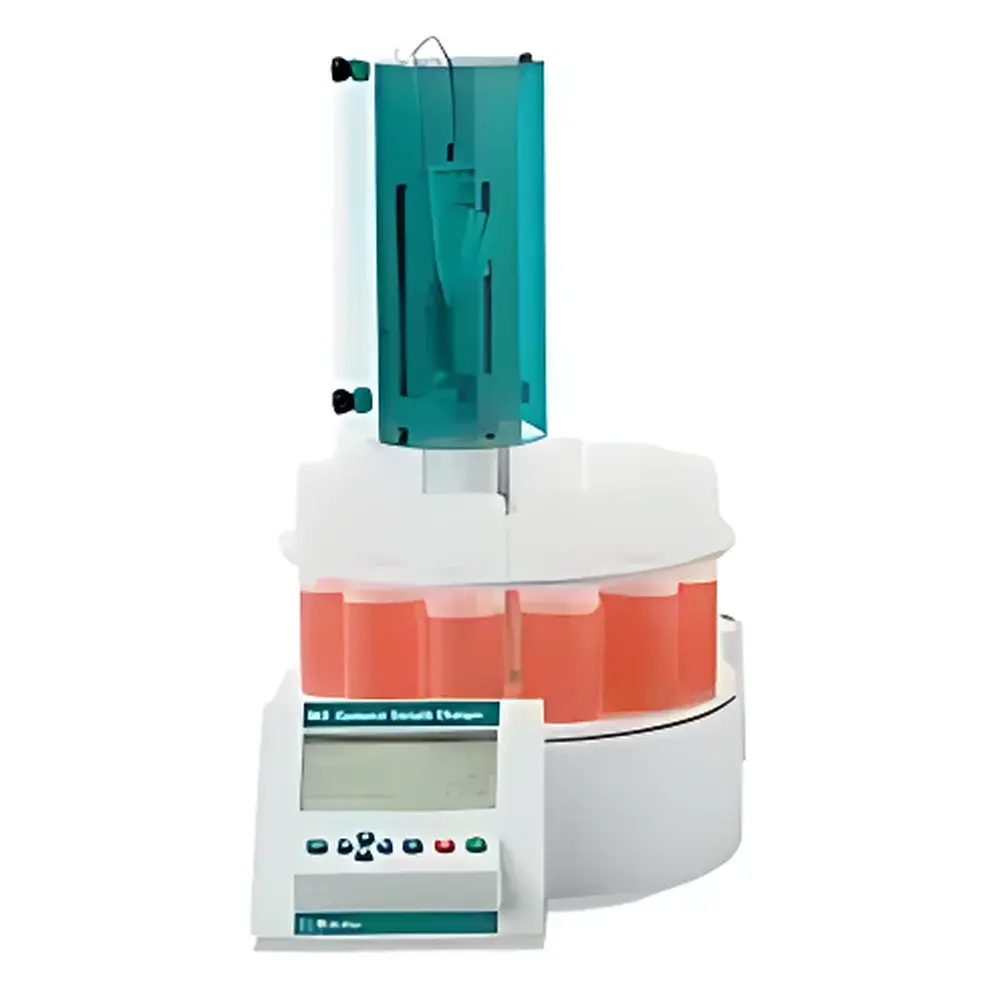
Metrohm 869 Compact Autosampler
| Brand | Metrohm |
|---|---|
| Origin | Switzerland |
| Manufacturer Type | Manufacturer |
| Origin Category | Imported |
| Model | 869 |
| Instrument Type | Electrochemical Sample Processor |
| Sample Positions | 12 (120 mL vials) |
| Built-in Method Storage | Up to 100 user-editable methods |
| Interface | USB |
| Compatibility | Titrino Plus series titrators (direct connection, no external controller or PC required) |
| Optional Accessory | 843 Pump Unit for automated rinsing and drainage |
| Emergency Sample Slot | Yes |
| Control Interface | Integrated membrane keypad with large LCD display |
Overview
The Metrohm 869 Compact Autosampler is an integrated electrochemical sample handling module engineered specifically for routine potentiometric and volumetric titration workflows. Designed in accordance with the modular architecture of Metrohm’s Titrino platform, it operates on a serial communication protocol (RS-232 over dedicated interface) to synchronize sample positioning, dosing sequence initiation, and endpoint confirmation directly with compatible titrators—eliminating reliance on external controllers, PCs, or intermediate interface hardware. Its mechanical design follows Couette-type sample carousel principles, ensuring repeatable positioning accuracy (±0.15° angular tolerance) and minimal carryover between cycles. The unit complies with IEC 61000-6-3 (EMC emissions) and IEC 61010-1 (safety requirements for laboratory electrical equipment), and supports GLP-compliant operation when used in conjunction with Titrino Plus instruments equipped with audit trail and electronic signature capabilities per FDA 21 CFR Part 11.
Key Features
- Ultra-compact footprint (220 × 290 × 310 mm H) optimized for benchtop integration in high-density analytical laboratories.
- Integrated 12-position sample carousel accommodating standard 120 mL polypropylene or glass titration cups; positions indexed via optical encoder feedback.
- Dedicated emergency sample slot enabling immediate insertion and prioritized processing without interrupting ongoing sequences.
- Onboard method memory stores up to 100 user-defined protocols—including titrant delivery volume, stir speed, waiting time, and endpoint criteria—editable via tactile membrane keypad and displayed on a 4-line backlit LCD.
- Native USB 2.0 interface supports direct export of method files (.met) to external storage or printing via PCL-compatible devices; no proprietary drivers required.
- Direct hardware handshake with Titrino Plus series titrators via proprietary 8-pin DIN connector—no additional control box, USB-to-serial adapter, or software layer needed.
- Optional 843 Pump Unit integration enables programmable post-measurement rinse cycles using up to two reagent channels, supporting automated cleaning between samples per ISO 8655-7 (piston burette maintenance standards).
Sample Compatibility & Compliance
The 869 accommodates standard cylindrical sample vessels conforming to Metrohm’s dimensional specifications (OD: 45 ± 0.2 mm; height: ≤ 110 mm), including certified traceable cups for ISO/IEC 17025-accredited testing. It supports aqueous, mildly acidic/basic, and low-viscosity organic matrices (e.g., ethanol/water mixtures up to 30% v/v) but is not rated for halogenated solvents or highly viscous samples (>20 mPa·s at 25 °C). When deployed in regulated environments, the system meets essential requirements for data integrity under EU Annex 11 and USP Analytical Instrument Qualification, provided instrument-specific IQ/OQ documentation is executed and method validation adheres to ICH Q2(R2). Mechanical durability is validated per ISO 9001:2015 production controls at Metrohm’s Herisau facility.
Software & Data Management
Method configuration occurs locally on the device—no host PC or proprietary software installation is necessary. Each stored method includes editable parameters: sample ID prefix, number of replicates, pause duration pre/post titration, magnetic stirrer RPM (50–600 rpm range), and automatic endpoint confirmation threshold (mV or pH slope-based). USB exports generate timestamped ASCII logs containing method metadata, sequence execution history, and error codes (e.g., “ERR-27: cup misalignment”). When paired with Titrino Plus instruments running tiamo™ firmware v3.3+, full audit trail capture—including user login, method modification timestamps, and result reprocessing events—is retained internally and exportable as encrypted .csv or PDF reports compliant with 21 CFR Part 11 Subpart B.
Applications
The 869 is routinely deployed in quality control laboratories performing standardized titrations per ASTM D664 (acid number of petroleum products), ISO 9001 clause 8.2.4 (monitoring of testing processes), and pharmacopeial monographs (e.g., USP for sodium hydroxide assay). Its deterministic sequencing reduces operator-induced variability in chloride determination (Mohr method), redox titrations (e.g., Fe²⁺ vs. KMnO₄), and Karl Fischer water content analysis when interfaced with appropriate coulometric or volumetric KF titrators. In academic teaching labs, its intuitive keypad interface and preloaded templates (three factory-default methods: acid-base, redox, precipitation) lower the barrier to automated titration instruction without requiring programming literacy.
FAQ
Does the 869 require a computer to operate?
No. All method editing, sequence initiation, and status monitoring occur via the built-in keypad and display. A computer is only needed if exporting method files via USB for archival or cross-instrument transfer.
Can the 869 be used with non-Metrohm titrators?
No. It communicates exclusively with Metrohm Titrino and Titrino Plus series instruments using a proprietary hardware-level handshake protocol—not generic RS-232 or Modbus.
Is the 120 mL cup capacity adjustable for smaller volumes?
The carousel geometry is fixed; however, Metrohm offers optional cup adapters (Art. No. 6.0221.100) to securely hold 15–50 mL vials without compromising positional repeatability.
What maintenance intervals are recommended for the 869?
Visual inspection of carousel alignment and keypad responsiveness every 200 operational hours; full mechanical calibration (encoder zero-point verification) annually or after physical impact, per Metrohm Service Bulletin SB-869-2023.
How is data integrity ensured during power interruption?
Non-volatile flash memory retains all stored methods and last-executed sequence state. Upon restart, the unit resumes from the last completed position without data loss or sequence corruption.




