
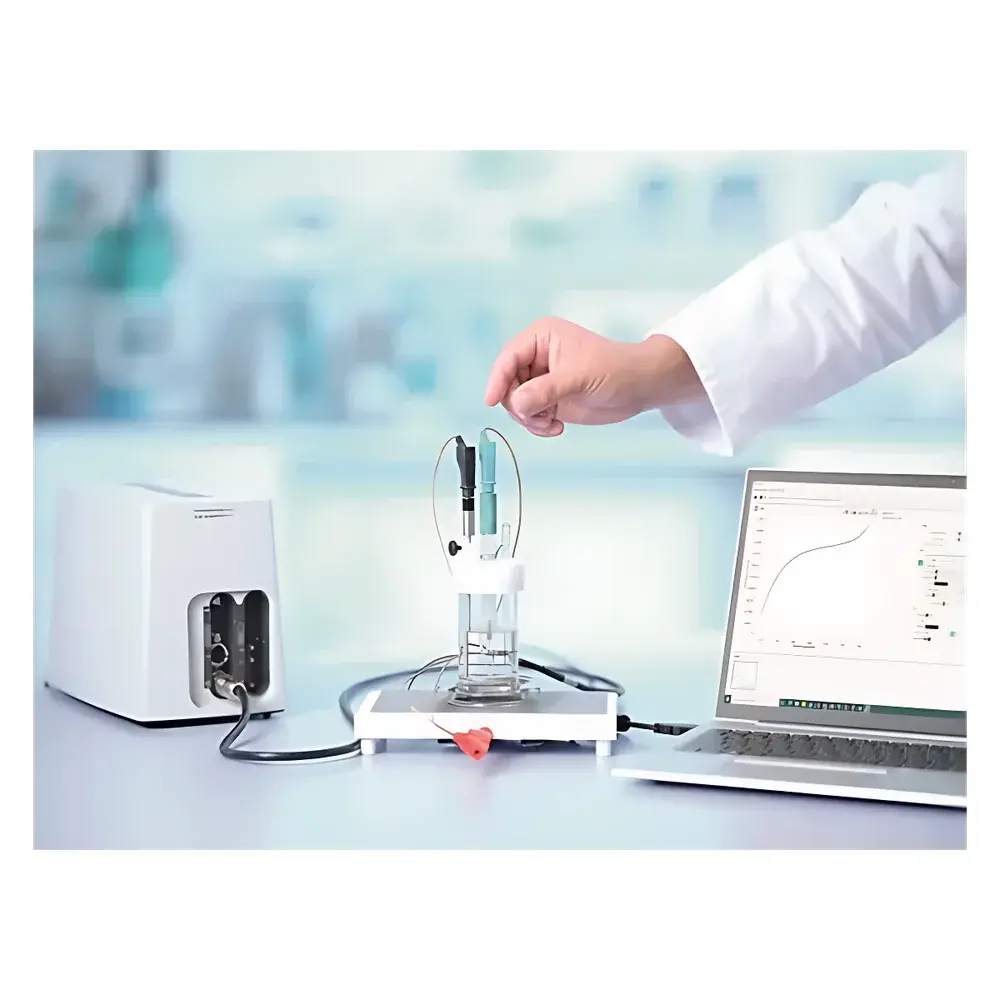
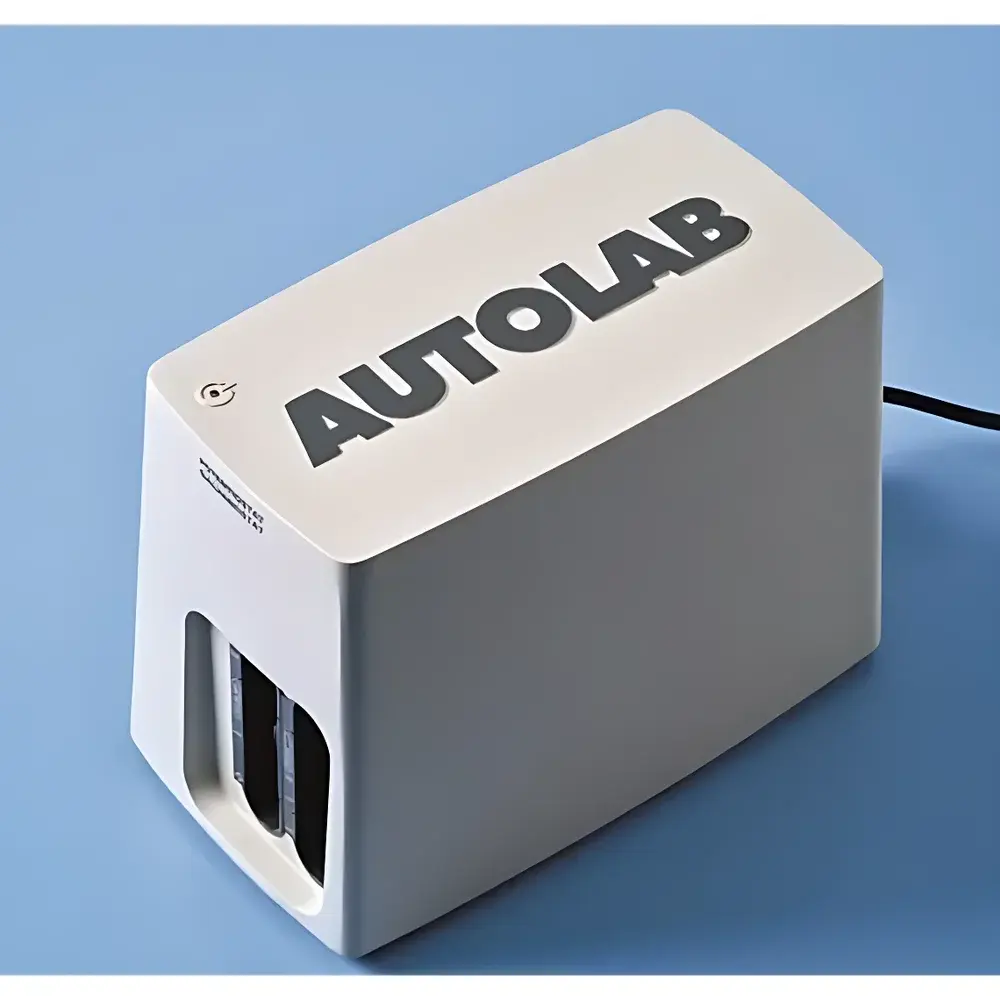
Metrohm Autolab IMP Electrochemical Workstation
| Brand | Metrohm |
|---|---|
| Origin | Netherlands |
| Manufacturer | Metrohm Autolab B.V. |
| Type | Single-Channel Electrochemical Workstation |
| Current Range | 1 nA to 100 mA |
| Current Accuracy | ±0.2% |
| Potential Accuracy | ±0.2% |
| Potentiostatic Range | ±10 V |
| EIS Frequency Range | 10 μHz to 1 MHz |
| EIS Measurement Accuracy | >99.7% |
| Software | NOVA 2.x |
Overview
The Metrohm Autolab IMP Electrochemical Workstation is a compact, high-fidelity single-channel potentiostat/galvanostat engineered for precision electrochemical characterization in academic research, industrial R&D, and teaching laboratories. Built upon Autolab’s legacy of robust electrochemical instrumentation, the IMP implements a true analog feedback control architecture with digital signal processing for stable, low-noise current and potential regulation. Its core measurement capability centers on potentiodynamic techniques (e.g., cyclic voltammetry, linear sweep voltammetry), galvanostatic methods, and—critically—high-resolution electrochemical impedance spectroscopy (EIS) across an exceptionally broad frequency span (10 μHz to 1 MHz). This wide dynamic range enables reliable modeling of interfacial processes spanning from slow diffusion-controlled reactions to fast charge-transfer kinetics and double-layer relaxation phenomena. The IMP is designed for compliance with fundamental electrochemical metrology standards, supporting traceable calibration protocols aligned with ISO/IEC 17025–accredited laboratory practices.
Key Features
- Single-channel architecture optimized for stability, minimal crosstalk, and rapid system setup—ideal for benchtop deployment in space-constrained labs.
- High-precision analog potentiostat with ±10 V compliance voltage and programmable current ranges from 1 nA (picoampere-level resolution) to 100 mA, ensuring accurate measurements across orders of magnitude in current density.
- Current and potential accuracy certified at ±0.2% of full scale—validated under controlled temperature and humidity conditions per IEC 61000-4-30 guidelines.
- Dedicated EIS engine with <99.7% measurement fidelity across the full 10 μHz–1 MHz spectrum; supports multi-sine and single-sine acquisition modes with automatic frequency stepping and adaptive averaging.
- Integrated analog integrator for real-time charge integration during transient experiments (e.g., chronoamperometry, pulse techniques), eliminating post-acquisition numerical integration errors.
- Galvanic isolation and electromagnetic interference (EMI) shielding compliant with EN 61326-1 for operation in electrically noisy environments typical of shared analytical facilities.
Sample Compatibility & Compliance
The IMP interfaces seamlessly with standard three-electrode electrochemical cells (working, reference, counter), rotating disk electrodes (RDE), and microelectrode configurations via universal BNC and banana-jack connectors. It supports aqueous and non-aqueous electrolytes, corrosion media, battery slurries, and conductive polymer films. All hardware and firmware conform to CE marking requirements and meet essential safety provisions of IEC 61010-1. For regulated environments—including pharmaceutical QC, battery materials qualification, and corrosion testing in energy infrastructure—the IMP supports audit-ready data integrity through NOVA’s optional GLP/GMP-compliant mode, enabling electronic signatures, user access levels, and 21 CFR Part 11–compliant audit trails when paired with validated NOVA software configurations.
Software & Data Management
NOVA 2.x software serves as the unified control, acquisition, and analysis platform for the IMP. It provides a modular, scriptable interface with preconfigured experiment templates for CV, LSV, CA, CP, EIS, and Mott-Schottky analysis. Advanced features include real-time equivalent circuit fitting using nonlinear least-squares optimization (Levenberg-Marquardt algorithm), automated baseline correction, iR-drop compensation via current-interrupt or positive-feedback methods, and time-domain convolution for diffusion-layer modeling. Raw data are stored in vendor-neutral .txt and .csv formats; proprietary .aut files retain full metadata (instrument settings, calibration history, timestamp, operator ID). NOVA supports direct export to MATLAB, Origin, and Python (via Pandas-compatible readers), facilitating integration into automated data pipelines and machine learning workflows for electrode material screening.
Applications
- Battery and fuel cell R&D: SEI formation studies, Li-ion intercalation kinetics, PEMFC catalyst layer impedance mapping.
- Corrosion science: Polarization resistance quantification, coating degradation monitoring, localized pitting assessment via EIS time-series.
- Electrocatalysis: Turnover frequency (TOF) derivation, Tafel slope analysis, reaction mechanism discrimination via phase-angle dispersion.
- Biosensor development: Immobilized enzyme kinetics, DNA hybridization detection, redox-tagged immunoassays.
- Academic instruction: Hands-on EIS pedagogy, Faradaic vs. capacitive current separation, Nyquist/Bode interpretation exercises with built-in simulation modules.
FAQ
Is the IMP compatible with rotating ring-disk electrode (RRDE) systems?
Yes—the IMP supports dual-potentiostatic control via external synchronization signals and can be integrated with commercial RRDE rotators using TTL-triggered acquisition.
Does the IMP support differential pulse voltammetry (DPV) or square-wave voltammetry (SWV)?
Yes—NOVA includes fully parameterizable DPV, SWV, and normal pulse voltammetry (NPV) methods with adjustable pulse amplitude, width, and period.
Can EIS data be acquired under potentiostatic or galvanostatic control?
Both modes are supported; users may select either DC bias control (potentiostatic EIS) or DC current bias (galvanostatic EIS) depending on system constraints.
What calibration procedures are recommended before EIS measurements?
Autolab recommends daily open-circuit and short-circuit calibration using the supplied calibration kit, followed by 3-point impedance verification with certified RLC standards traceable to NIST.
Is remote operation possible via LAN or USB?
Yes—NOVA supports TCP/IP communication over Ethernet for networked lab environments and USB 2.0 for direct PC connection with latency <1 ms.



