
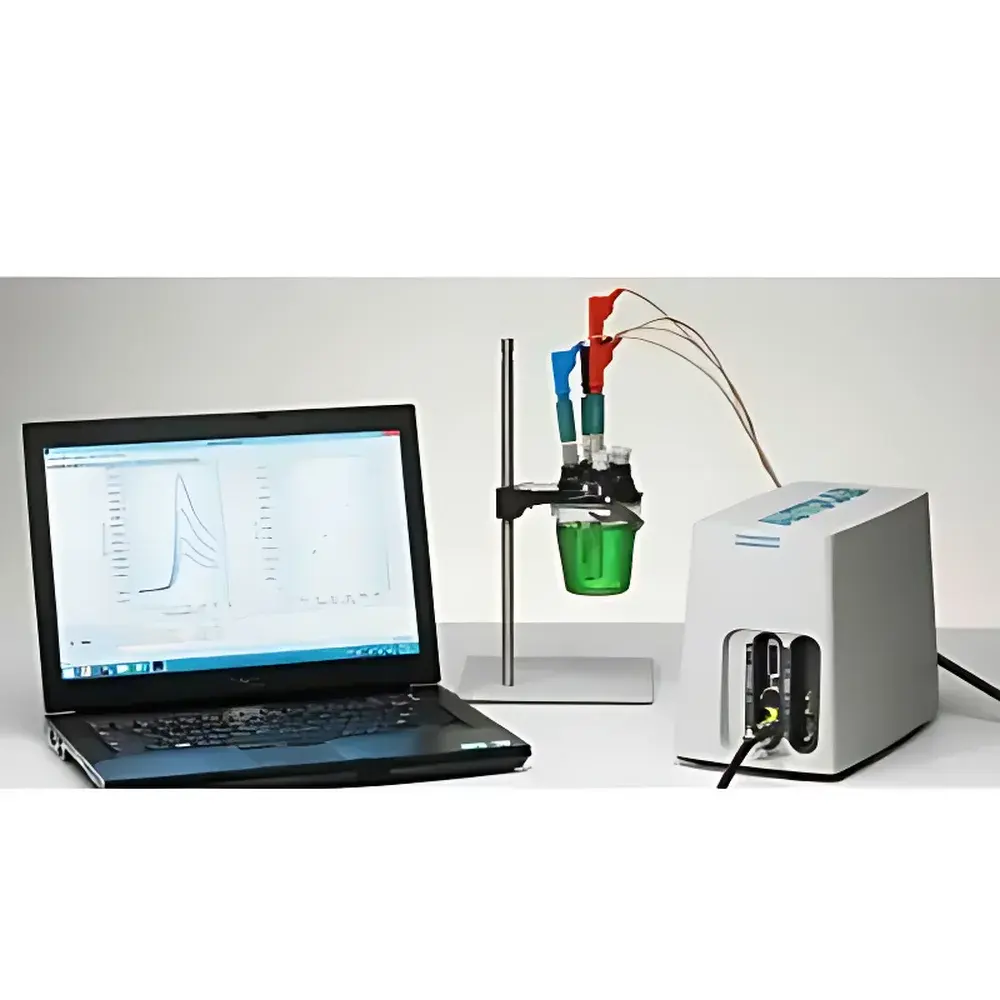
Metrohm Autolab PGSTAT204 Electrochemical Workstation
| Brand | Metrohm |
|---|---|
| Origin | Netherlands |
| Manufacturer | Metrohm Autolab |
| Type | Research-Grade Potentiostat/Galvanostat |
| Model | PGSTAT204 |
| Channel Configuration | Multi-Channel Workstation |
| Current Range | 10 nA – 100 mA (8 decades) |
| Current Accuracy | ±0.2% of reading |
| Potential Accuracy | ±0.2% of full scale |
| Potentiostatic Range | ±10 V |
| Maximum Output Current | ±400 mA |
| Compliance Voltage | ±20 V |
| EIS Frequency Range | 10 µHz – 1 MHz |
| Potential Resolution | 3 µV |
| Current Resolution (10 nA range) | 30 fA |
| Input Bias Current (@25°C) | <1 pA |
| Potentiostat Bandwidth | 1 MHz |
| Analog Integrator | Built-in, with integration times of 0.01 s, 0.1 s, 1 s, and 10 s |
| Electrode Configurations | 2-, 3-, or 4-electrode |
| Analog I/O | Bidirectional analog input/output for external signal synchronization |
| Expansion Slot | 1 × modular expansion slot (supports FRA32M, BA, pX1000, MUX, EQCM modules) |
| Interface | USB 2.0 |
Overview
The Metrohm Autolab PGSTAT204 is a high-performance, research-grade electrochemical workstation engineered for precision potentiostatic, galvanostatic, and electrochemical impedance spectroscopy (EIS) measurements. Based on the proven Autolab platform architecture, the PGSTAT204 integrates a wide compliance voltage (±20 V), high current capability (±400 mA), and sub-picoampere input bias current (<1 pA) to support demanding applications in energy storage, corrosion science, and interfacial electrochemistry. Its core measurement principle relies on real-time digital control of electrode potential or current using a 24-bit DAC/ADC system, enabling stable, low-noise operation across eight decades of current (10 nA–100 mA) and a broad EIS frequency span (10 µHz–1 MHz). The instrument operates as both a potentiostat and galvanostat, with simultaneous analog integrator functionality for quantitative charge integration—critical for coulometric analysis, cyclic voltammetry charge balancing, and electrodeposition mass correlation.
Key Features
- High-fidelity analog front-end with 24-bit resolution and 1 MHz bandwidth for fast transient response and accurate waveform generation
- Built-in analog integrator supporting four fixed integration time constants (0.01 s, 0.1 s, 1 s, 10 s) for real-time charge accumulation and Faradaic efficiency evaluation
- Dual-mode operation: true potentiostatic and galvanostatic control with automatic switching and seamless transition between techniques
- Modular expansion architecture featuring one dedicated slot for optional hardware modules—including FRA32M (high-resolution frequency response analyzer), BA (battery analyzer), pX1000 (pH/mV interface), MUX (multiplexer for multi-cell screening), and EQCM (electrochemical quartz crystal microbalance)
- Full analog I/O capability: two analog outputs (potential and current) and one analog input for synchronized external triggering or feedback control (e.g., temperature, flow rate, or optical signal coupling)
- USB 2.0 interface compliant with Windows-based NOVA software (v2.1+), supporting automated method sequencing, real-time data visualization, and script-driven experiment control
Sample Compatibility & Compliance
The PGSTAT204 supports standard electrochemical cell configurations—including two-, three-, and four-electrode setups—enabling compatibility with rotating disk electrodes (RDE), microelectrodes, thin-film cells, and custom-designed flow cells. Its low input bias current and high input impedance ensure minimal interference during measurements of insulating or high-impedance systems (e.g., dielectric films, polymer electrolytes, and semiconductor/electrolyte interfaces). The instrument meets essential regulatory expectations for laboratory instrumentation: it supports audit-trail-enabled data logging and user-access controls within NOVA software, aligning with GLP principles. While not inherently FDA 21 CFR Part 11–certified, its data integrity framework—including timestamped raw data export (.txt/.csv), metadata embedding, and password-protected method libraries—facilitates compliance-ready documentation for ISO/IEC 17025-accredited laboratories and industrial R&D environments subject to internal QA/QC protocols.
Software & Data Management
Controlled exclusively via Metrohm’s NOVA software suite, the PGSTAT204 delivers an integrated environment for experiment design, execution, and post-processing. NOVA provides over 50 built-in electrochemical techniques—including cyclic voltammetry, chronoamperometry, pulse techniques (DPV, SWV), EIS with Kramers–Kronig validation, and hybrid methods such as galvanostatic intermittent titration (GITT). All data are stored in a hierarchical project structure with embedded experimental parameters, calibration records, and operator metadata. Raw datasets export in ASCII format for third-party analysis (e.g., MATLAB, Python, Origin), while NOVA’s built-in tools support baseline correction, peak deconvolution, equivalent circuit fitting (using ZView or embedded EC-Lab-compatible models), and statistical comparison across sample batches. Software updates are distributed through Metrohm’s secure customer portal, ensuring traceable version history and backward compatibility with legacy method files.
Applications
The PGSTAT204 is routinely deployed in academic and industrial laboratories for fundamental and applied studies across multiple domains: characterization of Li-ion battery electrode kinetics and SEI formation; charge storage mechanisms in supercapacitors and redox-active polymers; electron-transfer kinetics at dye-sensitized solar cell interfaces; passivation behavior and localized corrosion mapping of metallic alloys; growth dynamics and doping level assessment in conductive polymers and 2D materials; thickness and mass change monitoring via EQCM coupling; and catalytic activity quantification for oxygen evolution/reduction reactions (OER/ORR). Its flexibility in signal routing and modular expandability makes it particularly suitable for multi-parameter correlative experiments—for example, synchronizing electrochemical transients with in situ UV-Vis, Raman, or mass spectrometry signals.
FAQ
What is the maximum sampling rate supported during fast-scan cyclic voltammetry?
The PGSTAT204 achieves up to 100 kS/s effective sampling under optimized conditions, constrained by the selected current range and filter settings to maintain signal fidelity.
Can the PGSTAT204 perform true bipotentiostatic measurements?
No—it does not support independent dual-working-electrode control out-of-the-box; however, the MUX module enables sequential multi-electrode interrogation with shared reference/counter circuits.
Is the analog integrator compatible with non-standard scan rates or irregular waveforms?
Yes—the integrator operates independently of technique timing and accepts any continuous current signal, provided the integration window is manually or programmatically defined in NOVA.
Does the instrument include factory calibration certificates traceable to NIST standards?
Metrohm provides optional accredited calibration services with NIST-traceable documentation upon request; standard delivery includes internal self-calibration routines verified per IEC 61000-4-30 guidelines.
How is firmware updated, and what safeguards prevent corruption during update?
Firmware updates are performed via NOVA using signed binary packages; the bootloader implements dual-bank memory architecture to preserve operational integrity if power loss occurs mid-update.







