
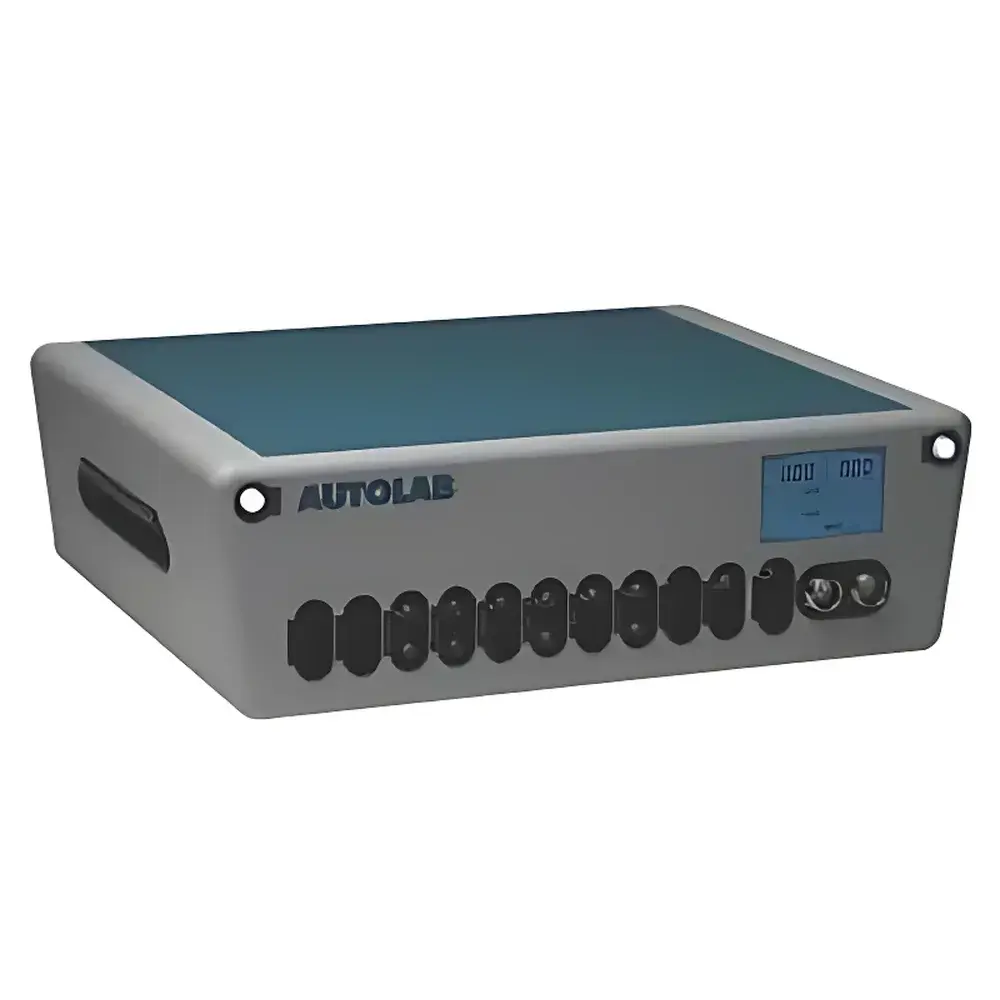
Metrohm Autolab PGSTAT302N Electrochemical Workstation
| Brand | Metrohm |
|---|---|
| Origin | Netherlands |
| Manufacturer | Metrohm Autolab B.V. |
| Type | Modular Bipotentiostat/Galvanostat |
| Channels | Dual-channel (expandable to multi-channel via MUX module) |
| Current Range | 10 nA – 1 A (9 auto-ranging decades) |
| Current Accuracy | ±0.2% of reading and ±0.2% of range |
| Potential Accuracy | ±2 mV + 0.2% of set value |
| Potentiostatic Range | ±10 V |
| Galvanostatic Range | ±2 A |
| Maximum Output Voltage | ±30 V |
| CV Scan Rate | up to 250 V/s |
| Input Impedance | >1 TΩ |
| Response Time | <250 ns |
| EIS Frequency Range | 10 µHz – 1 MHz |
| Sampling Rate | up to 50 kHz (standard), 10 MHz with ADC10M module |
| EIS Modes | 6 distinct impedance acquisition protocols including potential-frequency, time-frequency, current-frequency sweeps |
| Software Platform | NOVA 2.x (Windows-based, FDA 21 CFR Part 11 compliant with audit trail and electronic signature support) |
Overview
The Metrohm Autolab PGSTAT302N is a high-performance, modular bipotentiostat/galvanostat workstation engineered for precision electrochemical characterization across academic research, industrial R&D, and quality control laboratories. Built upon the proven Autolab platform, it operates on a true four-electrode configuration with independent control of working electrode potentials and current sourcing, enabling simultaneous dual-potentiostatic measurements (e.g., for rotating ring-disk electrode (RRDE) or bipolar cell studies). Its core architecture supports both potentiodynamic and potentiostatic techniques—including cyclic voltammetry (CV), linear sweep voltammetry (LSV), chronoamperometry (CA), chronopotentiometry (CP), pulse techniques (DPV, SWV, NPV), and full-spectrum electrochemical impedance spectroscopy (EIS)—with rigorous adherence to fundamental electrochemical principles such as Ohm’s law, Faraday’s laws, and Butler–Volmer kinetics. Designed for reproducibility under variable environmental conditions, the PGSTAT302N integrates low-noise analog front-end circuitry, galvanically isolated signal paths, and temperature-compensated reference electrode feedback loops—critical for long-duration stability in corrosion monitoring or battery cycling applications.
Key Features
- Modular hardware architecture supporting seamless integration of optional expansion modules: FRA2 (frequency response analysis), BOOSTER10A/20A (high-current output up to ±20 A), BA (dual bipotentiostat), ECN (electrochemical noise), ECD (low-current amplifier, down to sub-picoampere resolution), LOAD.INT (dynamic load interface), VOLT.MULT/HIGH.VOLT.DIV (voltage scaling), MUX (multi-channel sequential testing), ADC10M (10 MHz sampling), SCAN250 (ultrafast linear scan), FI20, and pX modules.
- Front-panel 3.5-inch high-brightness LED-backlit LCD display showing real-time potential, current, and status indicators without PC dependency.
- Dual analog I/O channels (±10 V range, 16-bit resolution) for synchronized external device control—fully compatible with RDE/RRDE rotators, VA663 polarographic stands, EQCM quartz crystal controllers, and fluidic actuators.
- Unified EIS engine capable of single-sweep full-range measurement from 10 µHz to 1 MHz, eliminating manual frequency segmentation. Supports amplitude modulation per frequency point and multi-sine waveforms (5- or 15-tone) to accelerate low-frequency acquisition.
- Advanced timing resolution: 100 ns per sample with ADC10M; standard 20 µs (50 kHz) sampling with programmable trigger logic and hardware-based start/stop conditions.
Sample Compatibility & Compliance
The PGSTAT302N interfaces with a broad spectrum of electrochemical cells and accessories—including standard three-electrode cells, corrosion test cells (ASTM G5/G59/G102 compliant), thin-layer and flow-through cells, rotating disk/ring-disk electrodes (Pine Instruments, BASi), screen-printed electrodes, microelectrodes, and EQCM-compatible quartz crystals (5–10 MHz). It meets IEC 61010-1 safety standards for laboratory electrical equipment and supports GLP/GMP workflows through NOVA software’s 21 CFR Part 11 compliance package (user access control, electronic signatures, immutable audit trails, and data integrity validation). All firmware and calibration routines are traceable to NIST-traceable references, ensuring metrological consistency across global laboratory networks.
Software & Data Management
NOVA 2.x software—developed by Metrohm Autolab and built on Microsoft .NET Framework—provides an integrated environment for method development, real-time visualization, post-acquisition analysis, and automated reporting. It supports concurrent execution of DC and AC techniques within a single experiment sequence, dynamic parameter adjustment during acquisition, and user-defined scripting for custom protocols (e.g., hybrid EIS-CV sequences or adaptive pulse trains). Data storage follows HDF5 binary format with embedded metadata (instrument settings, timestamps, environmental logs), enabling interoperability with MATLAB, Python (via h5py), and third-party chemometrics tools. USB mode allows standalone operation with up to 80,000 data points per measurement; external signal logging supports up to 16 auxiliary analog inputs. Graphical rendering includes fully customizable 2D/3D plots with export to SVG, EPS, and publication-ready TIFF/PNG formats.
Applications
- Battery and fuel cell R&D: SEI formation analysis, Li-ion cathode/anode degradation profiling, PEMFC catalyst layer impedance mapping, and solid-state electrolyte interfacial resistance quantification.
- Corrosion science: Electrochemical noise monitoring (ENM), electrochemical impedance spectroscopy (EIS) for coating defect detection, and potentiodynamic polarization per ASTM G5/G102.
- Electrocatalysis and sensor development: Kinetic modeling of oxygen reduction reaction (ORR), hydrogen evolution reaction (HER), and enzyme-modified biosensor transient response analysis.
- Photoelectrochemistry: IMPS (intensity-modulated photocurrent spectroscopy) and IMVS (intensity-modulated photovoltage spectroscopy) for dye-sensitized and perovskite solar cell characterization.
- Electroplating and electrosynthesis: Coulometric efficiency determination, bath composition monitoring, and pulse-reverse plating waveform optimization.
- Nanomaterial electrochemistry: Single-entity collision detection (SECCM), nanoparticle redox activity mapping, and graphene oxide reduction kinetics.
FAQ
Is the PGSTAT302N compatible with third-party electrochemical cells and electrodes?
Yes—it supports industry-standard BNC, banana, and LEMO connectors and is fully interoperable with commercially available RDEs, RRDEs, microelectrodes, and flow cells from major suppliers.
Can EIS measurements be performed without interrupting ongoing DC experiments?
Yes—using the superimposed small-amplitude AC technique (e.g., “EIS during CV”) enabled via NOVA’s multi-method sequencing engine.
Does the system support automated long-term stability testing (e.g., 72+ hours)?
Yes—hardware watchdog timers, uninterruptible power supply (UPS) handshake protocols, and automatic resume-after-interruption functionality ensure robust unattended operation.
How is calibration traceability maintained?
Factory calibration uses NIST-traceable voltage/current standards; users may perform periodic verification using certified reference resistors and potentiostatic check standards (e.g., Metrohm’s ECal kit).
What cybersecurity measures are implemented in NOVA software?
Role-based access control, encrypted local database storage, TLS-secured remote access (optional), and full audit trail logging meet ISO/IEC 27001-aligned laboratory IT security requirements.





