
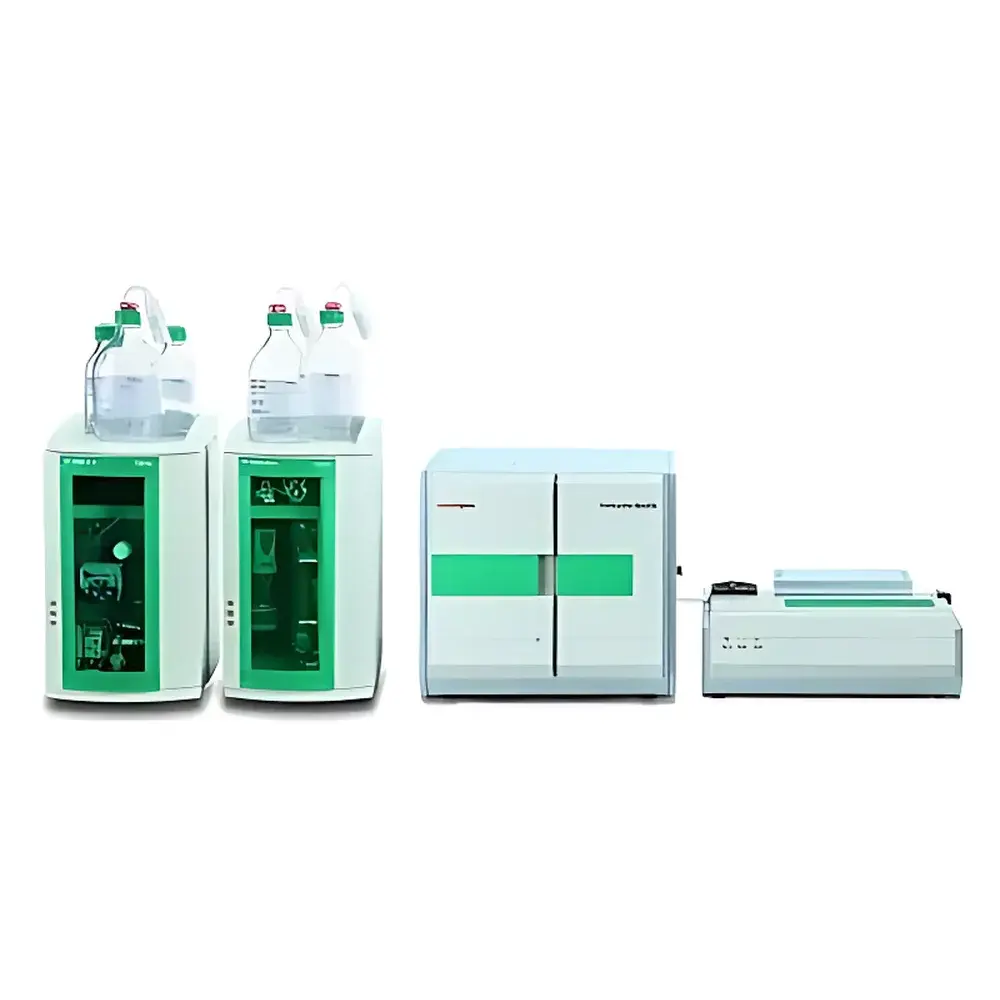
Metrohm Combustion Furnace–Ion Chromatography Coupling System (MCIC)
| Brand | Metrohm |
|---|---|
| Origin | Switzerland |
| Manufacturer | Metrohm AG |
| Product Type | Imported Laboratory Instrument |
| Model | MCIC |
| Pump Pressure Rating | 0–50 MPa |
| Flow Rate Range | 0.001–20.000 mL/min |
| Eluent Flow Rate Range | 0.001–20.000 mL/min |
| Maximum Operating Pressure | 50 MPa |
| Temperature Range | 0–80 °C |
| Temperature Reproducibility | ±0.2 °C |
| Eluent Concentration Range | 0–100% |
Overview
The Metrohm Combustion Furnace–Ion Chromatography Coupling System (MCIC) is an integrated analytical platform engineered for the quantitative determination of halogens (F⁻, Cl⁻, Br⁻, I⁻) and sulfur species (SO₄²⁻, SO₃²⁻) in solid, viscous, or non-aqueous matrices. It combines high-temperature oxidative combustion under inert (Ar/He) and oxidizing (O₂) atmospheres with post-combustion absorption and subsequent ion chromatographic separation and detection. Unlike classical oxygen bomb calorimetry or wet digestion methods—which require manual handling, multi-step reagent addition, and extensive operator intervention—the MCIC system automates the entire workflow from sample introduction to final quantification. This architecture enables trace-level elemental speciation without matrix interference, delivering robust data for regulatory compliance, quality assurance, and R&D applications across diverse industrial sectors.
Key Features
- Full automation of combustion, absorption, and IC analysis—eliminating manual transfer and cross-contamination risks
- Simultaneous quantification of total fluorine, chlorine, bromine, iodine, and sulfur in a single run
- Independent quantification of individual halide species via suppressed conductivity detection with chemical suppression
- Integrated flame sensor feedback control ensures complete and reproducible combustion kinetics across heterogeneous samples
- Metrohm’s proprietary Multi-Point Calibration with a Single Standard (MiPT) technology reduces calibration workload while maintaining NIST-traceable linearity
- Universal sample introduction: accommodates solids (powders, pellets, films), liquids (oils, solvents), and semi-solids (resins, polymers, pastes) using one unified autosampler module
- Compliance-ready architecture supporting 21 CFR Part 11 audit trails, electronic signatures, and GLP/GMP data integrity requirements
- Thermostatically controlled reaction zone with ±0.2 °C temperature reproducibility ensures consistent oxidation efficiency and analyte recovery
Sample Compatibility & Compliance
The MCIC system accepts any combustible material—including polymeric insulators, catalysts, fossil fuels, pharmaceutical excipients, electronic substrates, and environmental solids (soil, sediment, activated carbon). Sample mass ranges from 0.1 mg to 500 mg, depending on expected halogen/sulfur load. All combustion gases are quantitatively trapped in aqueous absorbents (e.g., H₂O₂/NaOH or dilute HNO₃), followed by direct injection into the IC system. The methodology conforms to multiple international standards, including IEC 60502-1 (halogen content in cable materials), DIN EN 228 (sulfur in automotive fuels), RoHS Directive 2011/65/EU Annex II (Br/Cl limits), WEEE Directive 2012/19/EU, and ASTM D7359–21 (total halogens in petroleum products). Method validation documentation supports ISO/IEC 17025 accreditation pathways.
Software & Data Management
Control, acquisition, and reporting are fully managed through MagIC Net™ v4.x software—a validated, 21 CFR Part 11-compliant chromatography data system. MagIC Net™ provides real-time monitoring of furnace temperature profiles, gas flow rates, pressure stability, and IC baseline behavior. All raw data—including combustion thermograms, eluent gradient logs, peak integration parameters, and calibration metadata—are stored in encrypted, tamper-evident format. Integrated report generation consolidates combustion parameters, IC chromatograms, peak tables, and uncertainty estimates into a single PDF or Excel export. Audit trail functionality records user actions, method modifications, and result approvals with timestamps and digital signatures.
Applications
The MCIC platform serves as a reference-grade solution for regulated halogen and sulfur testing in:
• Electronics manufacturing: Halogen screening of PCB laminates, solder masks, and insulation polymers per IEC 61249–2–21
• Petroleum refining: Sulfur speciation in crude oil, distillates, and catalysts per ASTM D5453 and ISO 20846
• Pharmaceutical development: Residual halogen quantification in APIs and intermediates (e.g., S-benzyl thiourea hydrochloride)
• Environmental monitoring: Total fluorine/chlorine in soils, sediments, and fly ash per EPA Method 3020B adaptations
• Polymers & plastics: Compliance verification of “halogen-free” claims in PE, PP, PVC, and engineering resins
• Energy materials: Sulfur content in coal, biofuels, and battery electrode binders
FAQ
What types of samples can be analyzed without derivatization or pre-treatment?
Solid, liquid, and semi-solid organic and inorganic matrices that undergo complete oxidative combustion at ≤1150 °C—no acid digestion or solvent extraction required.
Does the system support both gravimetric and volumetric calibration approaches?
Yes—MiPT enables single-standard multi-point calibration; optional external standard addition (ESA) mode supports matrix-matched calibration for complex samples.
How is carryover minimized between high-concentration and trace-level samples?
Automated high-temperature furnace purging (≥1000 °C), dual-stage absorption traps, and IC column regeneration protocols ensure <0.1% carryover for Cl⁻ at 100 µg/g levels.
Is method transfer possible between different MCIC installations?
Yes—MagIC Net™ method files include full instrument configuration, combustion parameters, IC gradients, and processing templates, enabling seamless inter-laboratory reproducibility.
Can the system quantify organically bound versus inorganic halogens separately?
No—the MCIC measures total extractable halogens and sulfur after complete oxidative mineralization; speciation requires complementary techniques (e.g., GC-MS or XPS).





