
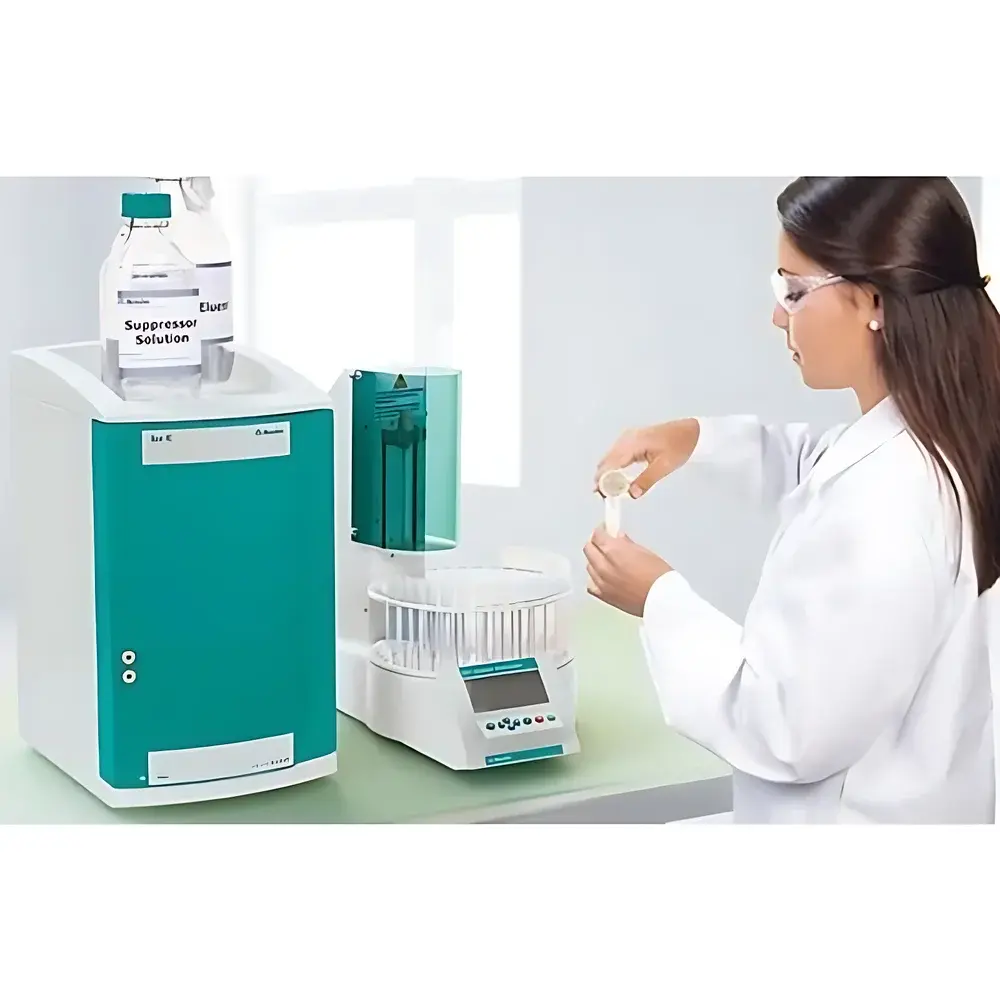
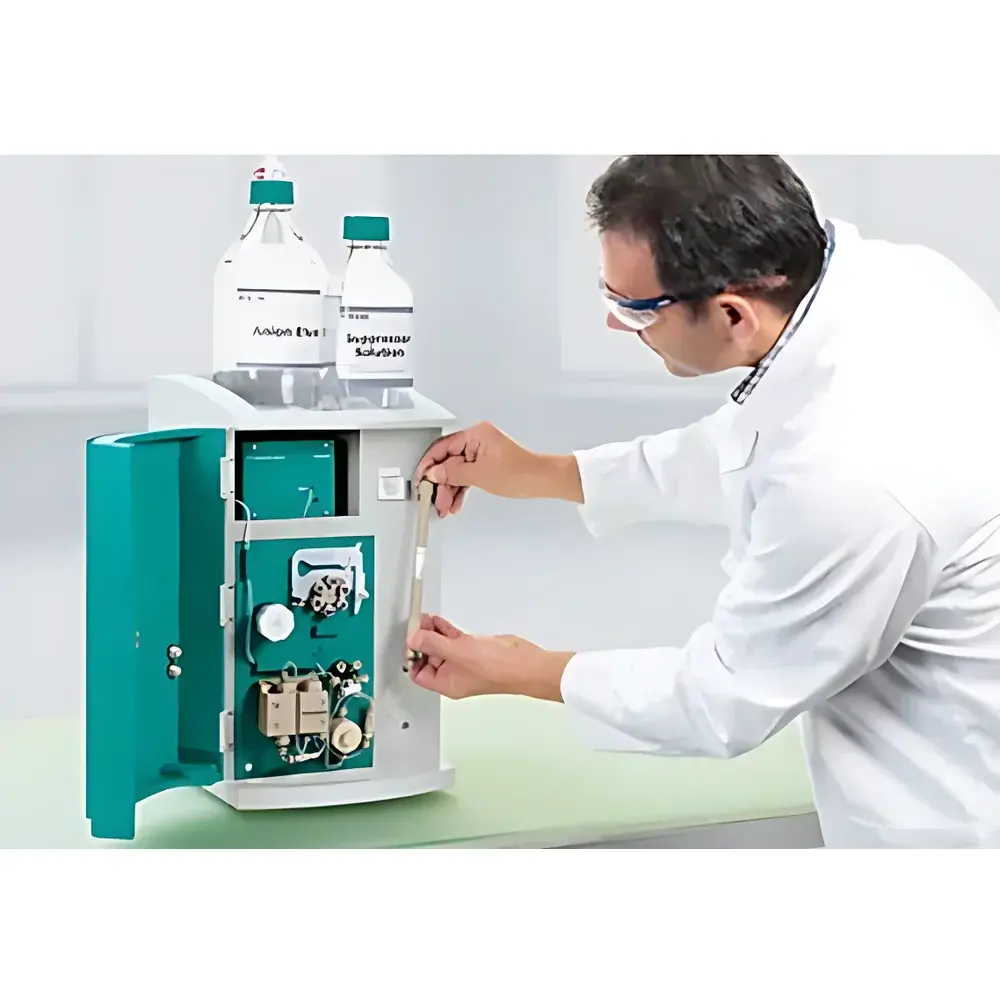
Metrohm ECO IC Ion Chromatograph
| Brand | Metrohm |
|---|---|
| Origin | Switzerland |
| Manufacturer Type | Original Equipment Manufacturer (OEM) |
| Origin Category | Imported |
| Model | ECO IC |
| Instrument Type | Laboratory Benchtop System |
| Application Scope | General-Purpose Ion Analysis |
| Maximum Pump Pressure | 50 MPa |
| Flow Rate Range | 0.001–20.000 mL/min |
| Eluent Flow Rate Range | 0.001–20 mL/min |
| Maximum Operating Pressure | 35 MPa (5000 psi) |
| Operating Temperature Range | 20–50 °C |
| Temperature Reproducibility | ±0.2 °C |
| Eluent Concentration Range | 0–100% |
Overview
The Metrohm ECO IC Ion Chromatograph is a compact, entry-level benchtop ion chromatography system engineered for precision, reliability, and operational simplicity in routine anion, cation, and polar compound analysis. Based on suppressed conductivity detection and high-efficiency eluent generation, the ECO IC employs a dual-piston high-pressure pump with pulse-dampened flow delivery to ensure stable gradient and isocratic elution across its full flow range (0.001–20.000 mL/min). Its modular architecture integrates a thermostatically controlled column oven (20–50 °C, ±0.2 °C reproducibility), a high-capacity chemical suppressor, and a low-noise digital conductivity detector—all calibrated and validated per ISO 17025-accredited procedures at Metrohm’s Swiss manufacturing facility. Designed for laboratories requiring regulatory-compliant data integrity without the complexity of high-end platforms, the ECO IC meets core requirements for GLP and ISO/IEC 17025 environments when operated with audit-trail-enabled software and documented calibration protocols.
Key Features
- Compact benchtop design optimized for space-constrained labs and teaching facilities
- Integrated dual-piston high-pressure pump rated to 50 MPa, delivering stable flow from 0.001 to 20.000 mL/min with <±0.1% RSD
- Thermostatically controlled column compartment (20–50 °C) with ±0.2 °C temperature stability for retention time reproducibility
- Chemical suppression module enabling low-noise, high-sensitivity conductivity detection for trace-level anions and cations
- Real-time system monitoring of critical parameters—including backpressure, flow rate, column temperature, and suppressor status—to prevent column overloading or system failure
- Modular expandability: compatible with Metrohm 863 Automatic Sample Processor (36-position capacity) and Inline Ultrafiltration (iUF) technology for automated particulate removal prior to injection
- Pre-configured method templates for common water matrixes (e.g., drinking water, wastewater, boiler feedwater) aligned with ASTM D4327, ISO 10304-1, and EPA Method 300.1
Sample Compatibility & Compliance
The ECO IC supports direct aqueous injection of filtered or ultrafiltered samples (0.45 µm or 0.22 µm membrane filtration recommended). With optional iUF integration, it accommodates raw surface water, municipal effluent, and industrial process streams without manual pre-filtration. The system complies with key international standards for ion analysis, including ISO 10304-1 (determination of dissolved anions by liquid chromatography), ISO 14911 (cation analysis in water), and ASTM D4327 (anion determination in water by IC). When paired with Metrohm MagIC Net™ software configured for 21 CFR Part 11 compliance (electronic signatures, audit trails, user access control), the ECO IC satisfies data integrity requirements for regulated QC/QA laboratories under FDA, EMA, and national drinking water directives.
Software & Data Management
Controlled via Metrohm MagIC Net™ software (v3.3 or later), the ECO IC provides full method development, sequence management, real-time chromatogram visualization, peak integration, and report generation. MagIC Net™ supports instrument qualification documentation (IQ/OQ/PQ), automatic calibration curve generation, and customizable reporting templates compliant with ISO/IEC 17025 Annex A. Audit trail functionality logs all user actions—including method edits, calibration events, and result approvals—with timestamps and operator IDs. Raw data files are stored in vendor-neutral .mcd format, ensuring long-term archival compatibility and third-party data reprocessing capability. Software maintenance includes five years of version updates and technical support under standard warranty terms.
Applications
The ECO IC delivers robust performance in environmental, educational, and industrial quality control settings. Typical applications include quantification of major anions (F⁻, Cl⁻, NO₂⁻, NO₃⁻, PO₄³⁻, SO₄²⁻) and cations (Li⁺, Na⁺, NH₄⁺, K⁺, Mg²⁺, Ca²⁺) in drinking water, groundwater, wastewater, and desalination brines. It also supports analysis of organic acids (acetate, formate, oxalate), amines, and carbohydrates in food extracts, pharmaceutical excipients, and electroplating baths. For academic use, the system serves as a pedagogical platform for chromatographic theory, detector principles, and method validation exercises—fully supported by Metrohm’s open-access training modules and certified instructor-led workshops.
FAQ
What column types are compatible with the ECO IC?
The system is fully compatible with Metrohm’s Metrosep A Supp 17 series (for anions) and Metrosep C 4–150 (for cations), as well as all Metrohm high-capacity columns requiring ≤35 MPa operating pressure. Column selection must align with eluent chemistry and analyte valence.
Can the ECO IC operate unattended overnight?
Yes—when coupled with the 863 Auto Sampler and MagIC Net™ scheduling functions, the system supports fully automated multi-day sequences with automatic shutdown, leak detection alerts, and pressure fault recovery protocols.
Is hardware-based data encryption available?
While the ECO IC does not feature on-board hardware encryption, MagIC Net™ supports Windows-native BitLocker encryption for local data storage and TLS 1.2–secured remote access when deployed on networked servers.
What is the expected lifetime of the chemical suppressor?
Metrohm guarantees 10 years of functional performance for the anion suppressor under normal operating conditions (≤35 MPa, pH 4–12, ≤20 µS/cm background conductivity), subject to routine regeneration and documented maintenance logs.







