
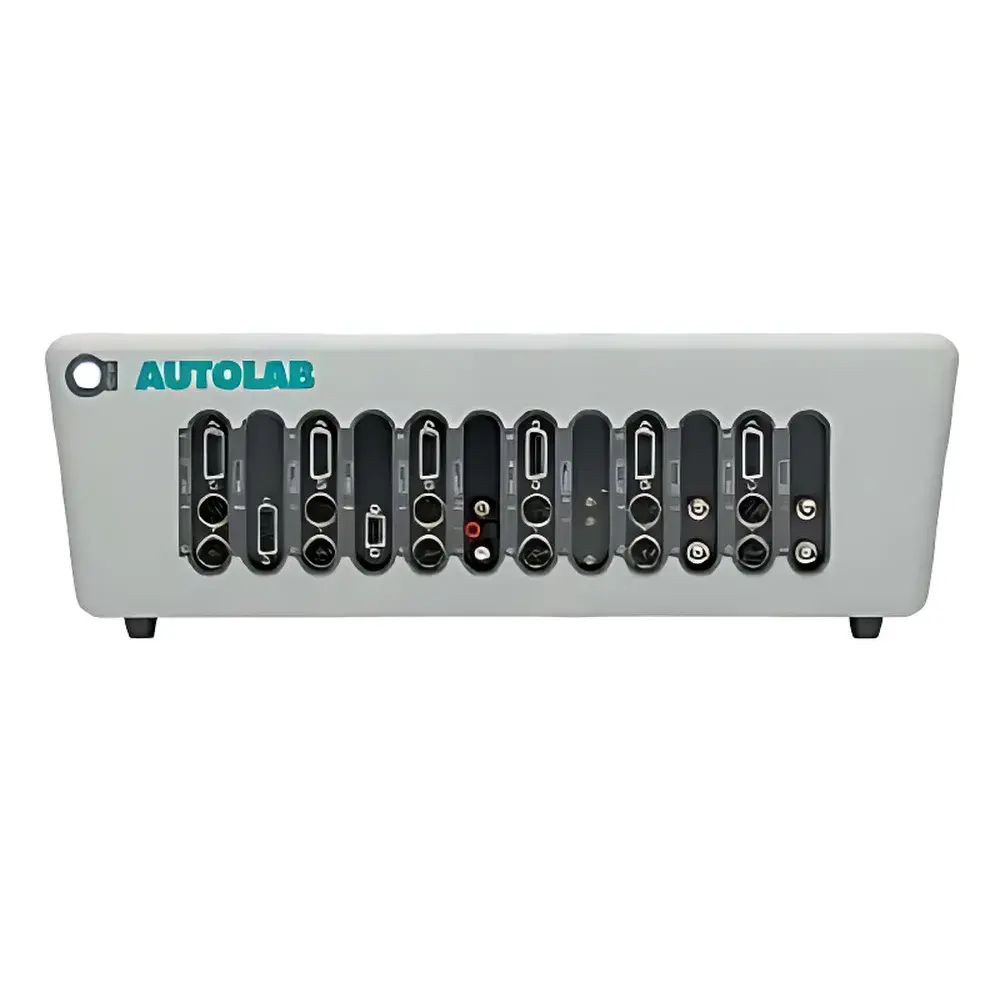
Metrohm Multi Autolab/M204 Multi-Channel Electrochemical Workstation
| Brand | Metrohm |
|---|---|
| Origin | Netherlands |
| Manufacturer Type | Original Equipment Manufacturer (OEM) |
| Import Status | Imported |
| Model | Multi Autolab/M204 |
| Instrument Type | Electrochemical Workstation |
| Number of Channels | Up to 12 independent channels |
| Current Range | 10 mA to 10 nA (7 decades) |
| Current Accuracy | ±0.2% of reading |
| Potential Accuracy | ±0.2% of full scale |
| Potentiostatic Range | ±10 V |
| EIS Frequency Range | 10 µHz to 1 MHz |
Overview
The Metrohm Multi Autolab/M204 is a modular, high-precision multi-channel electrochemical workstation engineered for advanced research and industrial R&D applications requiring parallel electrochemical characterization. Built upon the proven architecture of the PGSTAT101 and PGSTAT204 platforms, it integrates up to twelve fully independent potentiostat/galvanostat modules—each operating simultaneously with full autonomy in control, data acquisition, and signal processing. This architecture enables true concurrent measurements across multiple electrochemical cells, eliminating sequential testing bottlenecks and significantly accelerating experimental throughput in battery development, corrosion studies, sensor validation, and electrocatalysis screening. The system operates on the fundamental principles of controlled-potential and controlled-current electrochemistry, supporting standard DC techniques (CV, LSV, CA, CP), pulsed methods (DPV, SWV), and frequency-domain analysis via electrochemical impedance spectroscopy (EIS) with ultra-low-frequency resolution down to 10 µHz.
Key Features
- Scalable channel architecture: Configurable from 1 to 12 independent potentiostat/galvanostat modules (M101 or M204), each with dedicated analog front-end and digital signal processing.
- High-fidelity analog performance: Current range spanning seven decades (10 nA–10 mA) with ±0.2% accuracy across all ranges; potential control precision of ±0.2% of full scale within ±10 V window.
- Ultra-broad EIS capability: Frequency sweep coverage from 10 µHz to 1 MHz, enabling detailed interfacial kinetic modeling, diffusion-controlled process analysis, and low-frequency dielectric characterization.
- Modular expansion design: Supports up to six optional functional extension modules—including EC-MS interface, temperature controller integration, multiplexer units, and auxiliary analog/digital I/O—without hardware reconfiguration.
- Distributed control topology: All channels operate under synchronized timing; system supports centralized operation from one PC or distributed control across up to three networked workstations for collaborative lab environments.
- Hardware-level isolation: Each channel features galvanic isolation and independent ground referencing, ensuring minimal crosstalk (< –100 dB) and robust performance in multi-cell setups with varying solution resistances or grounding conditions.
Sample Compatibility & Compliance
The Multi Autolab/M204 is compatible with standard three-electrode electrochemical cells (working, counter, reference), rotating disk electrodes (RDE), rotating ring-disk electrodes (RRDE), microelectrodes, and custom flow cells. It interfaces seamlessly with peripheral instrumentation including temperature-controlled jackets (±0.1 °C stability), gas purging systems, and in situ spectroelectrochemical accessories. The platform complies with ISO/IEC 17025 requirements for measurement traceability and supports audit-ready operation under GLP and GMP frameworks. Firmware and NOVA software are designed to meet FDA 21 CFR Part 11 criteria for electronic records and signatures when configured with user access controls, audit trails, and electronic signature workflows.
Software & Data Management
Controlled exclusively by NOVA 2.1.x (or later), the workstation provides a unified graphical environment for method scripting, real-time visualization, automated sequence execution, and post-experiment analysis. NOVA supports customizable experiment templates, batch processing of multi-channel datasets, and export to standardized formats (CSV, TXT, HDF5) for integration with MATLAB, Python (via PyAutolab), or third-party chemometrics tools. All raw data—including time-stamped current/potential waveforms, impedance spectra, and metadata—are stored with embedded calibration history and instrument configuration logs. Version-controlled method files ensure reproducibility across instruments and laboratories.
Applications
- Battery material screening: Parallel cycling and impedance mapping of cathode/anode formulations under identical environmental conditions.
- Corrosion science: Simultaneous monitoring of localized pitting potentials across alloy variants or coating systems.
- Electrocatalyst optimization: High-throughput evaluation of turnover frequency (TOF) and Faradaic efficiency across catalyst libraries.
- Sensor development: Calibration curve generation and drift assessment for biosensor arrays using identical reference standards.
- Fundamental kinetics: Decoupling charge-transfer resistance from mass transport limitations via multi-frequency EIS across identical electrode geometries.
- Industrial QC: Validation of electrodeposition bath composition through standardized cyclic voltammetry across production-line test cells.
FAQ
Can the Multi Autolab/M204 be upgraded from a 4-channel to a 12-channel system after initial purchase?
Yes—hardware modules (M101/M204) and associated firmware licenses can be added incrementally without replacing the main chassis or control unit.
Is NOVA software included with the system, and does it support scripting?
NOVA is supplied as standard with full license; it includes Python-based scripting (NOVA Scripting Interface) for custom automation and external API integration.
What level of electrical isolation exists between channels?
Each channel has independent floating grounds and >100 dB common-mode rejection ratio (CMRR) at 1 kHz, validated per IEC 61000-4-6 for EMC compliance.
Does the system support true simultaneous EIS on all channels?
Yes—multi-channel EIS is performed synchronously using shared clock distribution and phase-coherent excitation signals, preserving inter-channel phase relationships for comparative analysis.
Are calibration certificates provided with the instrument?
Metrohm supplies factory calibration reports traceable to NIST standards; on-site recalibration services and ISO/IEC 17025-accredited certification are available upon request.
Related Products




