
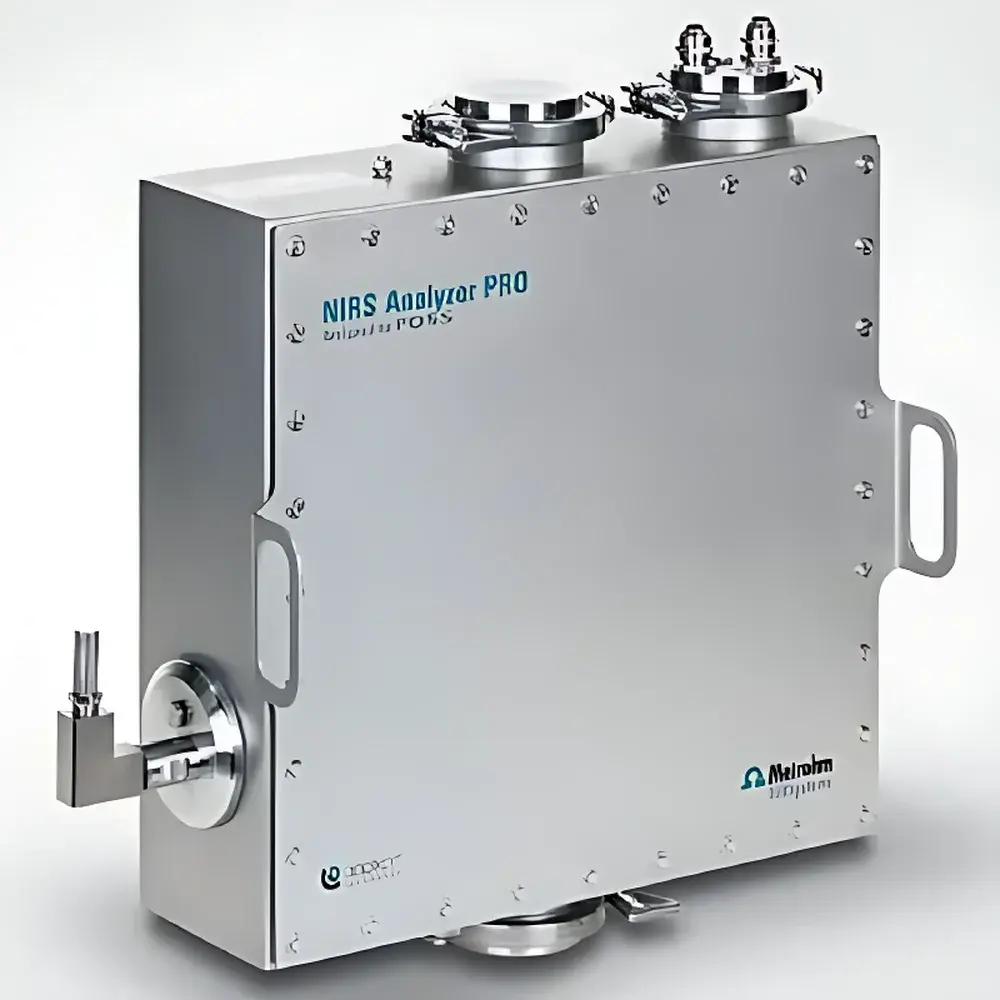
Metrohm PRO Online Near-Infrared Spectrometer
| Brand | Metrohm |
|---|---|
| Origin | Sweden |
| Manufacturer Type | Original Equipment Manufacturer (OEM) |
| Origin Category | Imported |
| Model | PRO Online NIR |
| Instrument Type | Online Process Analyzer |
| Application Field | Petrochemical Industry |
| Operating Principle | Fixed Grating with Diode Array Detector (Non-Scanning) |
| Wavelength Range | 1100–1650 nm (Reflectance), 850–1050 nm (Transmittance) |
| Scan Speed | 0.5 s per spectrum |
| Spectral Sampling Interval | 0.5 nm |
| Sample Interface Modes | Diffuse Reflectance (Solids), Transflectance (Liquids), Transmission (Liquids) |
| Chemometrics Software | Vision with ISIcal™ |
Overview
The Metrohm PRO Online Near-Infrared Spectrometer is a high-performance, non-scanning process analytical technology (PAT) instrument engineered for real-time, in-line chemical composition monitoring in continuous industrial environments. Based on fixed-grating dispersive optics coupled with a high-stability diode array detector, the PRO system captures full-spectrum NIR data without mechanical scanning—enabling robust, drift-resistant spectral acquisition at 0.5-second intervals. Designed for deployment directly at the point of production—whether on conveyor belts, slurry lines, or reactor effluent streams—the PRO eliminates the need for sample extraction, bypass loops, or dilution, thereby delivering true in-situ measurement capability. Its dual tungsten-halogen light source architecture incorporates automatic lamp switching: when the primary source degrades or fails, the secondary source activates seamlessly, ensuring uninterrupted spectral continuity and long-term measurement fidelity. The instrument is housed in an IP65-rated industrial cabinet suitable for Zone 2 hazardous areas, with thermal management optimized for ambient temperatures ranging from 5 °C to 40 °C.
Key Features
- Fixed-grating diode array design ensures high optical throughput and exceptional signal-to-noise ratio across the entire operational wavelength range (850–1050 nm for transmission; 1100–1650 nm for reflectance)
- Real-time spectral acquisition at 0.5 s per scan supports dynamic process control of fast-moving or heterogeneous materials including powders, granules, slurries, and opaque liquids
- Integrated instrument standardization protocol enables rapid, traceable model transfer between multiple PRO units—critical for multi-site manufacturing consistency and regulatory alignment
- Dual-lamp illumination system with automatic failover guarantees >99.9% uptime and eliminates calibration drift caused by source aging
- Modular probe interface options: fiber-coupled diffuse reflectance probes for solids, transflectance flow cells for viscous liquids, and immersion transmission cells for clear or low-turbidity streams
- Self-diagnostic firmware with embedded spectral quality metrics (e.g., SNR, baseline stability, lamp intensity tracking) supports predictive maintenance scheduling
Sample Compatibility & Compliance
The PRO spectrometer accommodates diverse physical states without sample preparation: dry powders and agglomerated granules are measured via contact or standoff diffuse reflectance; suspensions and emulsions utilize transflectance geometry to mitigate scattering artifacts; low-viscosity transparent liquids are analyzed using temperature-controlled transmission cells. All optical interfaces comply with ASTM E1655–22 (Standard Practices for Infrared Multivariate Quantitative Analysis) and support method validation per ICH Q2(R2) guidelines. The system meets electromagnetic compatibility requirements per EN 61326–1 and carries CE marking for industrial use. When configured with OPC UA server functionality and audit-trail-enabled software modules, it satisfies FDA 21 CFR Part 11 requirements for electronic records and signatures in GMP-regulated petrochemical QA/QC environments.
Software & Data Management
Data acquisition, preprocessing, and chemometric modeling are unified within Metrohm Vision software—validated for Windows OS platforms compliant with ISO/IEC 17025:2017 laboratory informatics standards. Vision integrates the proprietary ISIcal™ intelligent standardization algorithm, which corrects inter-instrument spectral variance using reference spectra from NIST-traceable ceramic standards. Calibration models built on one PRO unit can be deployed across an enterprise network with <±0.3% RMSEP deviation—verified through cross-unit validation studies. Raw spectra and processed results are stored in HDF5 format with embedded metadata (timestamp, operator ID, probe ID, environmental conditions). Vision supports automated report generation aligned with ASTM D6300 and ASTM D6299 protocols, and exports structured data via OPC UA, Modbus TCP, or MQTT to DCS/SCADA systems for closed-loop process control.
Applications
The PRO spectrometer is widely deployed in refinery fluid catalytic cracking (FCC) unit monitoring, where it quantifies hydrocarbon composition (e.g., olefin content, aromatic saturation, sulfur species) in real time from hot vapor-phase streams. It enables inline moisture analysis in polymer pellet drying lines (<0.02% w/w LOD), monitors API concentration and polymorphic form in pharmaceutical wet granulation, and tracks ethanol/water ratio in biofuel blending operations. Additional validated use cases include catalyst activity profiling in hydrodesulfurization reactors, additive concentration control in lubricant compounding, and blend uniformity verification in bulk powder mixing vessels—all without interrupting production flow.
FAQ
Can the PRO spectrometer operate in explosive atmospheres?
Yes—when equipped with ATEX/IECEx-certified enclosures and intrinsically safe fiber-optic probe configurations, the PRO meets Zone 2/22 classification requirements.
Is method transfer between instruments supported out-of-the-box?
Yes—ISIcal™ standardization is embedded in firmware and requires no additional hardware; model transfer is executed within Vision using factory-supplied ceramic reference standards.
What spectral resolution is achieved with the 0.5 nm sampling interval?
The optical resolution (FWHM) is ≤3.5 nm across both spectral ranges, consistent with ISO 12099:2017 specifications for NIR process analyzers.
Does the system support multivariate statistical process control (MSPC)?
Yes—Vision includes Hotelling’s T² and Q-residual charts linked directly to real-time spectral residuals, enabling early fault detection in continuous processes.
How is calibration model validation performed?
Validation follows ASTM E1655–22 Annex A3 guidelines, incorporating independent test sets, cross-validation, and bias correction against reference methods (e.g., GC, Karl Fischer titration).
Related Products





