
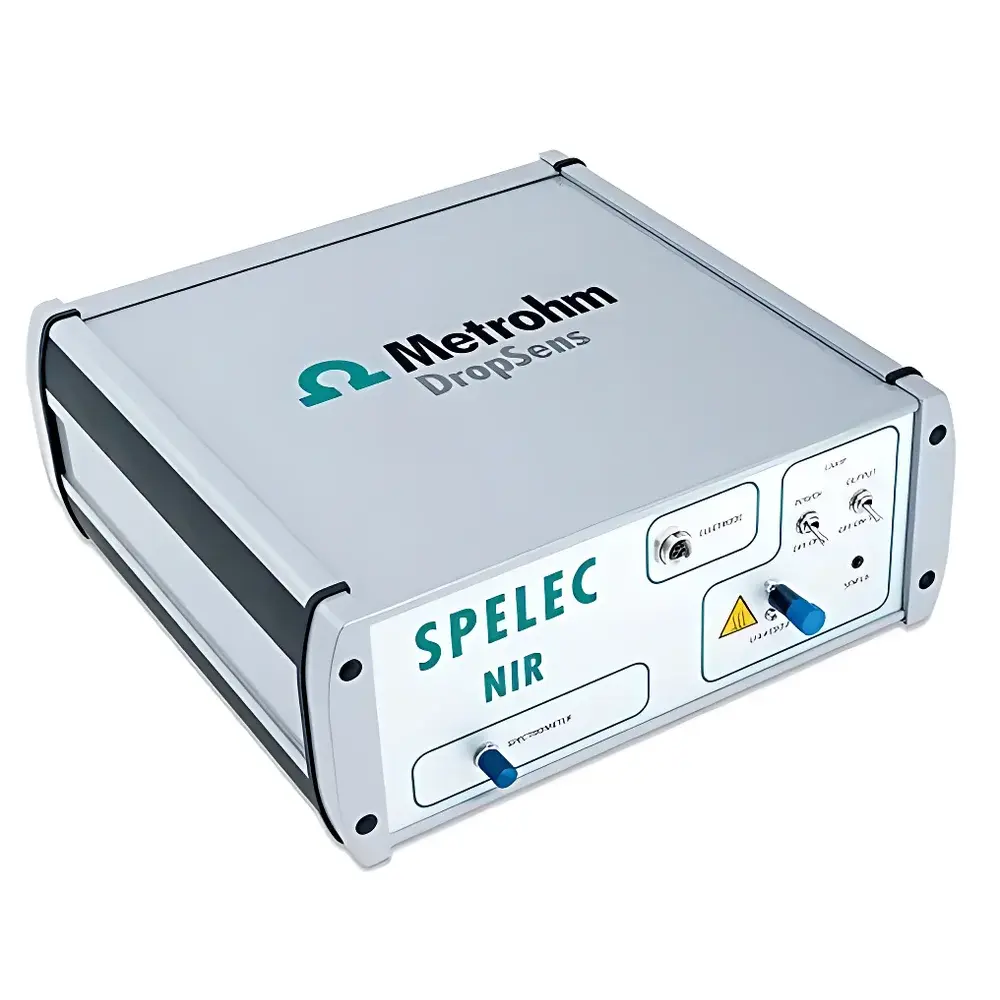
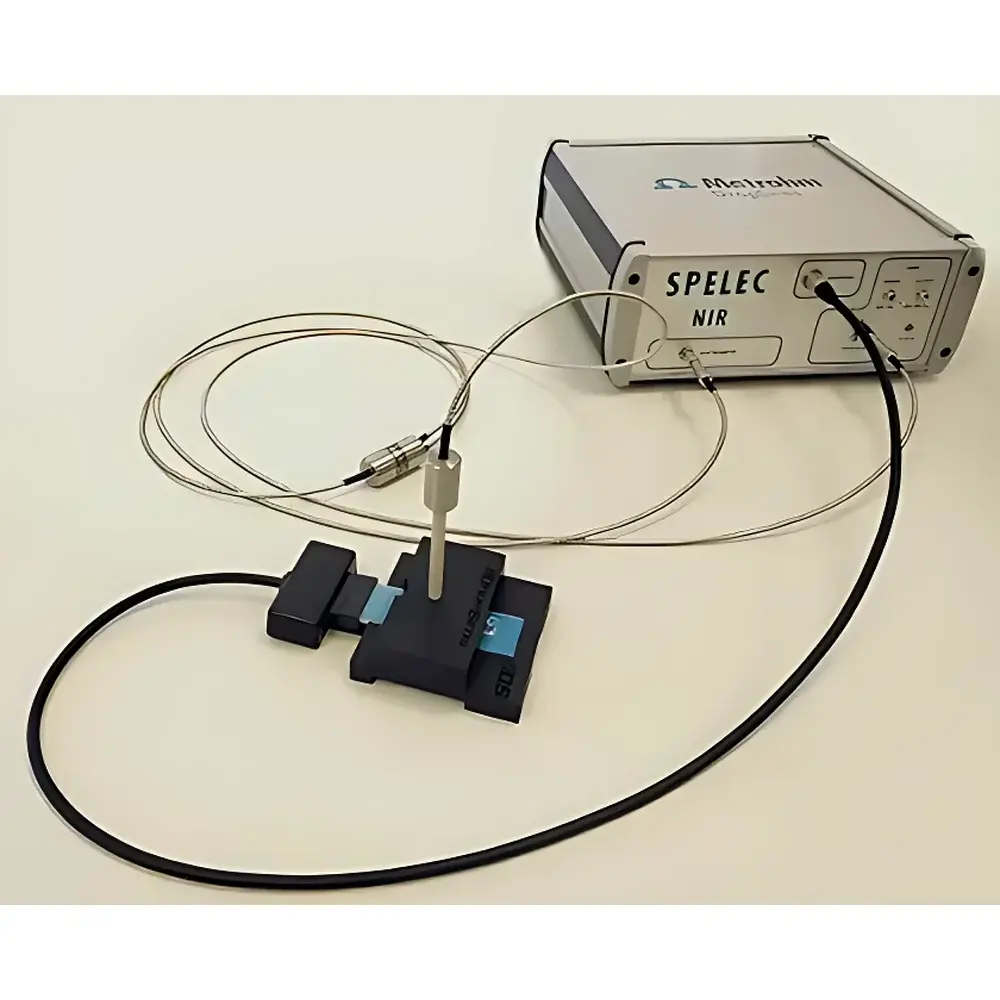
Metrohm SPELECNIR Electrochemical Near-Infrared Spectrometer
| Brand | Metrohm |
|---|---|
| Origin | Switzerland |
| Manufacturer Type | Original Equipment Manufacturer (OEM) |
| Product Category | Imported Instrument |
| Model | SPELECNIR |
| Instrument Type | Multichannel Electrochemical Workstation |
| Current Range | ±1 nA to ±10 mA |
| Current Accuracy | ±0.5 % of reading |
| Potential Accuracy | ±0.2 % of full scale |
| Potentiostatic Range | ±4 V |
| Impedance Frequency Range | Not applicable (dedicated EC–NIR coupling system, not EIS-capable) |
Overview
The Metrohm SPELECNIR Electrochemical Near-Infrared Spectrometer represents the first commercially available instrument that fully integrates near-infrared (NIR) spectroscopy with potentiostatic/galvanostatic electrochemical measurement in a single, co-located, and hardware-synchronized platform. Engineered for operando and in situ studies of electroactive materials, it enables simultaneous acquisition of electrochemical response (current, potential, charge) and molecular-level spectral signatures (600–2500 nm) under identical experimental conditions—eliminating temporal misalignment, spatial mismatch, or signal drift inherent in externally coupled systems. The core architecture comprises a high-stability dual-channel bipotentiostat/galvanostat, a thermoelectrically cooled InGaAs-based NIR spectrometer, and a broadband tungsten-halogen light source—all housed in a rigid, vibration-damped chassis optimized for laboratory-grade reproducibility. Unlike hybrid setups requiring external synchronization via TTL triggers or software bridging, the SPELECNIR implements deterministic hardware-level timing control, ensuring sub-millisecond alignment between electrochemical event triggers and spectral frame capture.
Key Features
- Fully integrated dual-channel potentiostat/galvanostat with independent control of two working electrodes—enabling three-electrode configurations or differential measurements.
- Hardware-synchronized NIR data acquisition: spectral frames are triggered directly by electrochemical events (e.g., potential step, current threshold), not software polling.
- Real-time spectral streaming without buffering delay: raw spectra acquired at user-defined integration times (1 ms to 10 s) are timestamped and aligned to electrochemical data at 1 µs resolution.
- Comprehensive optical calibration suite: automated dark spectrum subtraction, reference spectrum normalization, and real-time correction for lamp intensity drift.
- Multi-modal optical quantification: direct output of absorbance, transmittance, reflectance, and photon count per wavelength bin—calculated on-the-fly using NIST-traceable reference standards.
- Flexible shutter control: both manual override and programmable auto-shuttering synchronized with electrochemical protocol phases (e.g., open during potential hold, closed during scan).
- DropView 3.0 software environment: unified interface for defining electrochemical methods (CV, LSV, CA, CP, DPV), spectral acquisition parameters, and joint analysis workflows.
Sample Compatibility & Compliance
The SPELECNIR supports standard electrochemical cell geometries including 1-cm pathlength quartz cuvettes, custom-built spectroelectrochemical cells with CaF2 or sapphire windows, DropSens disposable screen-printed electrodes (SPEs), and flow-through optically transparent thin-layer electrode (OTTLE) cells. All optical interfaces comply with ISO 17025 traceability requirements for spectral radiometric calibration. The instrument meets CE marking directives (2014/30/EU EMC and 2014/35/EU LVD) and is designed for use in GLP-compliant laboratories; audit trails, electronic signatures, and 21 CFR Part 11–compliant data integrity features are enabled via optional Metrohm Compliance Pack. No modifications to cell design or electrode substrate are required to achieve simultaneous optical-electrochemical fidelity.
Software & Data Management
DropView 3.0 provides native support for time-aligned multi-parameter datasets: each experiment generates a single .dvm file containing synchronized electrochemical waveforms (E vs. t, I vs. t), spectral stacks (intensity vs. λ vs. t), and metadata (cell temperature, gas environment, reference electrode type). Advanced post-processing includes: (i) wavelength-specific kinetic plots (e.g., absorbance at 1380 nm vs. applied potential); (ii) derivative spectroelectrograms (dA/dE); (iii) principal component analysis (PCA) of spectral evolution across potential sweeps; (iv) 3D surface rendering of A(λ,t) matrices; and (v) export of all raw and processed data to CSV, MATLAB (.mat), or Excel (.xlsx) formats with full column labeling and SI-unit annotations. All processing operations are scriptable via Python API (included), enabling automation of batch analysis for QC/QA pipelines.
Applications
The SPELECNIR is deployed in fundamental and applied research domains where redox-state-dependent molecular structure must be correlated with charge-transfer kinetics. Key use cases include: characterization of conducting polymer doping/dedoping mechanisms; in situ monitoring of battery electrode solid-electrolyte interphase (SEI) formation; mechanistic studies of enzymatic bioelectrocatalysis (e.g., glucose oxidase on carbon nanotube electrodes); investigation of corrosion inhibitor adsorption dynamics on steel surfaces; and development of NIR-active electrochromic materials for smart windows. Its ability to resolve subtle OH/NH stretch overtones (1450–1550 nm) and C–H combination bands (1650–1800 nm) makes it particularly valuable for tracking proton-coupled electron transfer (PCET) processes in fuel cell catalysts.
FAQ
Can the SPELECNIR perform electrochemical impedance spectroscopy (EIS)?
No. The SPELECNIR is not configured for frequency-domain impedance measurements; its electrochemical subsystem is optimized for DC and pulsed techniques (CV, CA, DPV). For combined EIS–NIR studies, Metrohm recommends sequential measurement protocols using complementary instruments.
Is fiber-optic coupling supported?
Yes—optional SMA905 fiber-optic adapters enable remote probe configurations for in-line reactor monitoring or hazardous environment operation, with calibrated throughput correction applied in software.
What spectral resolution is achievable?
The standard InGaAs detector array delivers ≤8 nm optical resolution (FWHM) across the 900–2500 nm range, adjustable via slit width selection and grating configuration.
Does the system support temperature-controlled electrochemical cells?
Yes—integrated analog inputs accept signals from external Pt100 sensors, enabling closed-loop temperature regulation and thermal metadata tagging of all spectral-electrochemical datasets.
How is data security handled for regulated environments?
With the Metrohm Compliance Pack activated, all data files include cryptographic hashes, immutable audit logs of user actions, role-based access controls, and electronic signature enforcement per FDA 21 CFR Part 11 requirements.




