METTLER TOLEDO ACM500 Communication Module
| Brand | METTLER TOLEDO |
|---|---|
| Origin | Jiangsu, China |
| Manufacturer Type | Authorized Distributor |
| Region of Manufacture | Domestic (China) |
| Model | ACM500 |
| Pricing | Available Upon Request |
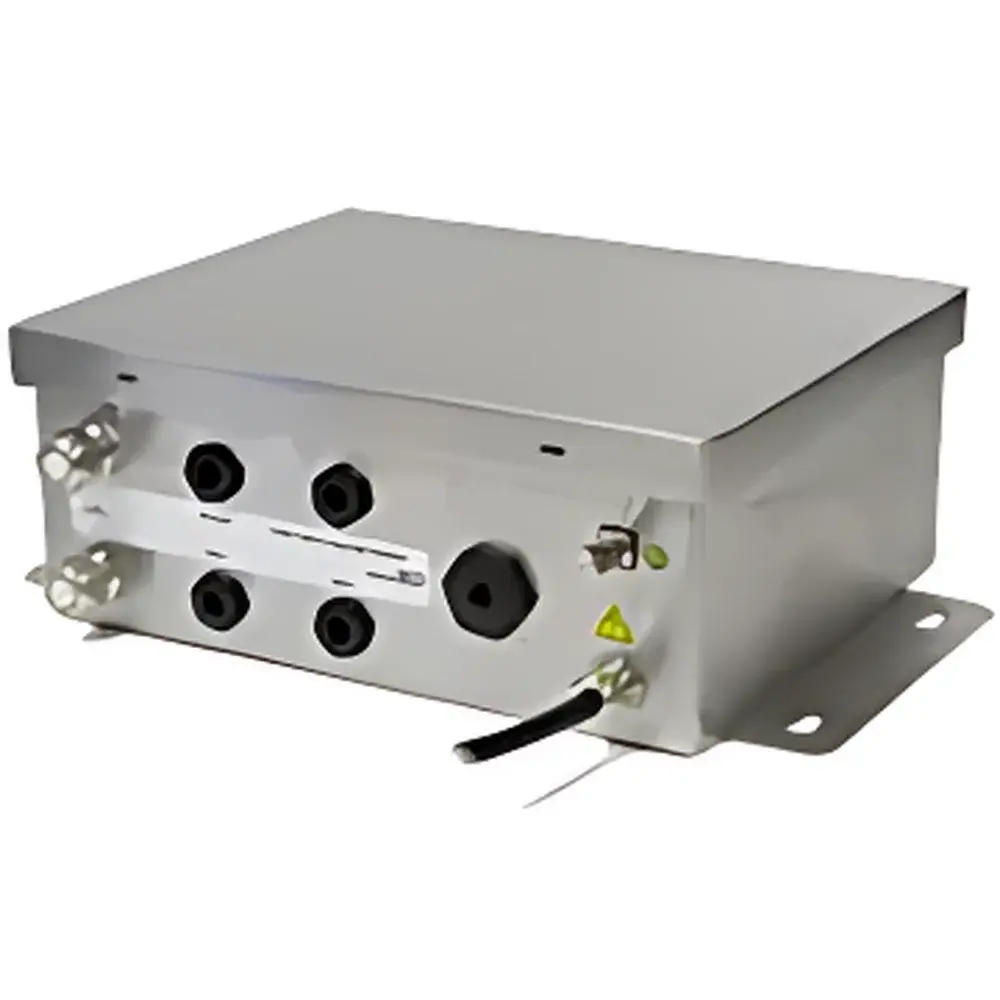
| Enclosure | Stainless Steel, IP66 Rated |
| Hazardous Area Certifications | UL/cUL Class I, II, III Div 1 Groups A–G (Entity) |
| Communication Interfaces | Fiber Optic, Intrinsically Safe Current Loop, Ethernet (10/100BASE-T), RS-232/RS-485 (expandable via COM3 option board) |
| I/O Expansion | Up to 12 digital inputs & 18 digital outputs (with ARM100 + COM3) |
| Dimensions | 210 × 265 × 106 mm (8.3 × 10.4 × 4.2 in.) |
| Power Supply | 100–240 VAC, 50/60 Hz, 250 mA |
Overview
The METTLER TOLEDO ACM500 Communication Module is an intrinsically safe, certified interface device engineered to enable secure, high-integrity bidirectional data exchange between the IND560x weighing terminal—installed in hazardous (classified) areas—and control systems located in safe zones. Designed in accordance with international functional safety and explosion protection standards, the ACM500 eliminates the need for external signal isolators or safety barriers by integrating galvanic isolation directly into its architecture. Its dual-path communication capability—supporting both fiber-optic links and intrinsically safe current-loop interfaces—ensures electromagnetic immunity and signal integrity in electrically noisy industrial environments, including chemical processing plants, pharmaceutical manufacturing suites, and bulk material handling facilities where continuous weight-based process control is subject to stringent regulatory oversight.
Key Features
- Integrated galvanic isolation compliant with intrinsic safety requirements—no external safety barriers required for connection to IND560x in Zone 1/21 (gas/dust) or Div 1 (North America)
- Dual-certified hazardous area approvals: UL/cUL Class I, II, III Div 1 Groups A–G (Entity concept) and ATEX/IECEx II (2) G/D [Ex ib]/[Ex ibD]/[Ex op is] IIC
- Ruggedized stainless-steel enclosure rated IP66—resistant to high-pressure washdown, dust ingress, and corrosive atmospheres
- Flexible connectivity: native 10/100BASE-T Ethernet port, configurable RS-232/RS-485 serial interface, and support for PLC integration via PROFIBUS DP, Modbus TCP/RTU, and EtherNet/IP (via optional firmware configuration)
- Expandable digital I/O: supports up to 12 discrete inputs and 18 discrete outputs when paired with ARM100 remote I/O units and the COM3 expansion board
- Universal AC power input (100–240 VAC, 50/60 Hz) with internal switching-mode supply—designed for global deployment without voltage conversion hardware
Sample Compatibility & Compliance
The ACM500 is not a standalone measurement instrument but a certified system component intended exclusively for use with METTLER TOLEDO IND560x series weighing terminals in hazardous locations. It complies with the essential requirements of the EU ATEX Directive 2014/34/EU and the US NEC Article 500/505. Its certification scope covers installation in gas groups IIC (including hydrogen and acetylene) and dust group IIIC, making it suitable for applications involving flammable vapors, combustible dusts, and hybrid atmospheres. The module supports traceability and audit readiness under FDA 21 CFR Part 11 when deployed within validated weighing processes, provided appropriate electronic record controls are implemented at the host DCS or MES level. All certifications are documented in the official METTLER TOLEDO Declaration of Conformity (DoC) and Ex Certificate (e.g., BVS_08_ATEX_E_100).
Software & Data Management
The ACM500 operates as a transparent protocol bridge and does not include embedded firmware-based data logging or local storage. Configuration is performed via the IND560x terminal’s built-in setup menu or through METTLER TOLEDO’s AutoCal™ and ConfigPro™ engineering tools, which support standardized fieldbus parameterization and diagnostic reporting. When integrated into a DCS or SCADA environment, the module enables real-time transmission of calibrated weight values, status flags (e.g., stable, overload, fault), and event-triggered alarms—including zero drift alerts and load cell diagnostics—using standard industrial protocols. Audit trails, user access control, and electronic signature enforcement must be managed at the supervisory system level per GLP/GMP and ISO/IEC 17025 requirements.
Applications
- Batch weighing and recipe validation in API synthesis and sterile pharmaceutical manufacturing
- Continuous belt scale monitoring in cement, mining, and fertilizer production with SIL 2-capable architecture
- Explosion-proof hopper and silo inventory management in petrochemical refineries and LNG terminals
- Gravimetric feeding control for reactive monomer dosing in polymerization reactors
- Hygienic-scale integration in food & beverage filling lines requiring IP66-rated hardware and washdown compliance
FAQ
Can the ACM500 be used with weighing terminals other than the IND560x?
No—the ACM500 is type-approved only for use with METTLER TOLEDO IND560x terminals. Interfacing with non-certified devices voids hazardous area compliance.
Does the ACM500 support Modbus TCP natively?
Yes—Ethernet connectivity includes native Modbus TCP server functionality; configuration requires firmware version v3.20 or later and proper DIP-switch or web-based setup.
Is fiber-optic communication mandatory for hazardous area operation?
No—both fiber-optic and intrinsically safe current-loop interfaces are certified alternatives; selection depends on distance, EMI exposure, and existing infrastructure.
What is the maximum cable length supported for the current-loop interface?
Up to 1,000 meters using twisted-pair shielded cable (AWG 18–22), assuming loop resistance ≤ 1,000 Ω and supply voltage ≥ 24 VDC at the ACM500 end.
Can the ACM500 be mounted directly on a control panel door?
Yes—the integrated mounting bracket and IP66-rated housing permit direct panel-mount installation, provided ambient temperature remains within –20 °C to +60 °C and ventilation meets manufacturer-specified airflow requirements.