
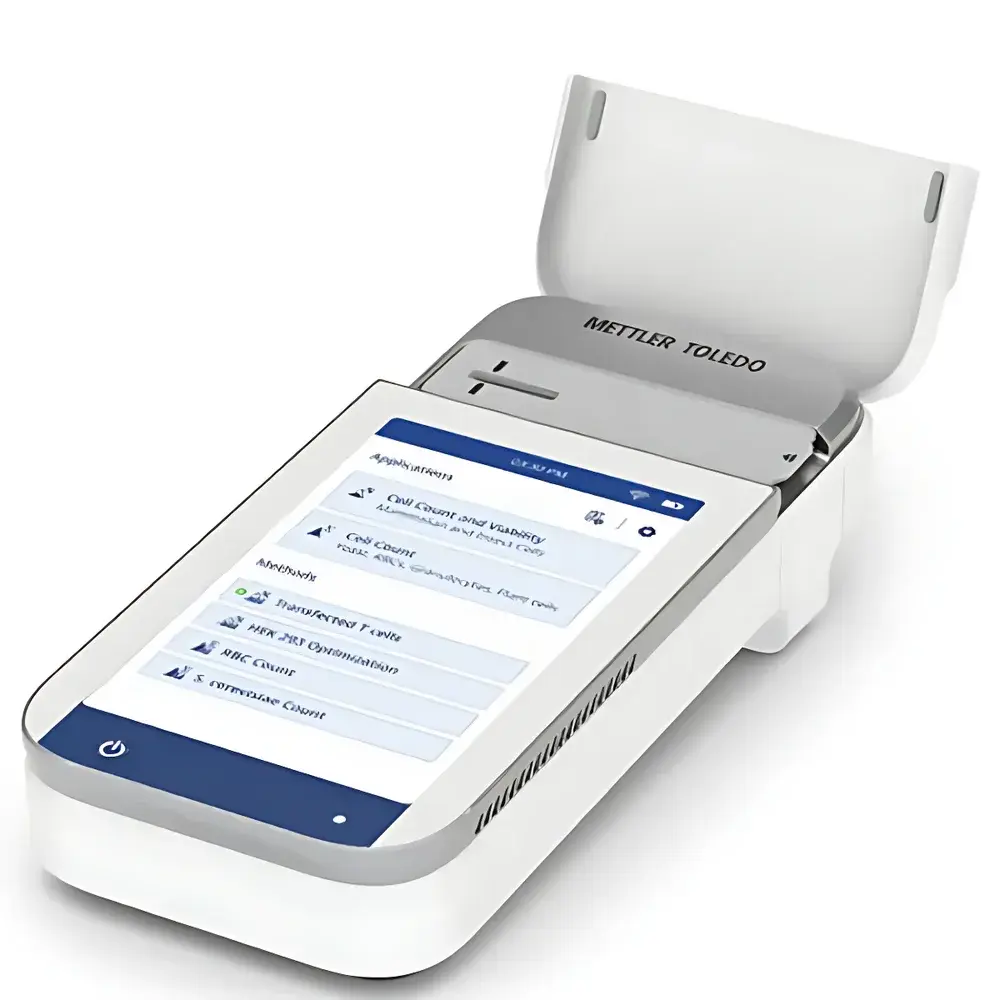
METTLER TOLEDO CytoDirect Cell Counter
| Brand | METTLER TOLEDO |
|---|---|
| Origin | Switzerland |
| Model | CytoDirect |
| Sample Volume | 20 µL |
| Pixel Size | 1.1 µm × 1.1 µm |
| Cell Diameter Range (Counting) | 2–80 µm |
| Display Resolution | 1280 × 800 px |
| Screen Size | 7 in |
| Dimensions (H×W×D) | 60 mm × 128 mm × 260 mm |
| Weight | 1.11 kg |
| Detection Technology | Digital Holographic Microscopy |
| Autofocus | Yes |
| Processing Time | < 15 s |
| Total Imaging Area | 31.28 mm² |
| Sensor Count | 2 |
| Battery | Rechargeable Li-ion |
| Power Input | USB-C |
| Connectivity | Wi-Fi, Ethernet |
| Data Export Formats | CSV, PDF, PNG, RAW |
| Sterilizable | Yes |
| Portability | Yes |
| CV (at > 5 × 10⁶ cells/mL) | ≤ 5% |
| Cell Types Supported | B cells, CHO, HEK293, HeLa, MSC, NK cells, PBMC, RBC, Sf9, T cells, iPSC, monocytes, granulocytes, *Saccharomyces cerevisiae*, oval/round plant cells |
Overview
The METTLER TOLEDO CytoDirect Cell Counter is a benchtop, portable digital holographic microscope engineered for rapid, label-free, and high-reproducibility cell counting and viability assessment. Unlike traditional trypan blue-based hemocytometers or fluorescence-based systems requiring dyes or staining protocols, CytoDirect leverages quantitative phase imaging via digital holographic microscopy (DHM) to reconstruct 3D refractive index maps of unlabeled cells in suspension. This optical principle enables intrinsic contrast generation without phototoxicity or sample preparation artifacts—critical for sensitive primary cells, stem cells (e.g., iPSCs), and fragile therapeutic cell populations. The system captures two synchronized high-resolution sensor images across a total field-of-view of 31.28 mm², with pixel resolution precisely matched to the 1.1 µm × 1.1 µm optical sampling grid. Designed for compliance-driven environments, CytoDirect operates within defined analytical performance boundaries validated per ISO 21501-4 for particle sizing and ASTM E2877-22 for cell counting accuracy, supporting GLP and early-stage GMP workflows.
Key Features
- Digital holographic microscopy (DHM) for stain-free, non-invasive cell visualization and segmentation
- Auto-focus algorithm optimized for heterogeneous suspensions—including aggregated or irregularly shaped cells (e.g., granulocytes, plant protoplasts)
- Embedded machine learning engine trained on >12 clinically and industrially relevant cell types, enabling context-aware classification without user calibration
- OneClick™ workflow interface with intuitive touch-screen navigation (7-inch HD display, 1280 × 800 px) and real-time result visualization
- Integrated dual-sensor architecture delivering simultaneous brightfield and quantitative phase channels for enhanced morphological discrimination
- On-device data processing (<15 seconds per 20 µL sample) with full audit trail logging compliant with FDA 21 CFR Part 11 requirements
- Rechargeable lithium-ion battery enabling continuous operation for >6 hours—ideal for cleanroom transitions, bioreactor monitoring, or field-deployed QC labs
Sample Compatibility & Compliance
CytoDirect accommodates a broad spectrum of suspension-based biological samples, including mammalian adherent and suspension lines (CHO, HEK293, HeLa), primary human cells (PBMC, NK, MSC, T cells), red blood cells, yeast (*Saccharomyces cerevisiae*), insect cells (Sf9), and plant protoplasts. Its 2–80 µm counting range covers bacterial aggregates through large multicellular clusters, while its 20 µL minimal sample volume reduces reagent consumption and preserves precious biologics. All wetted components are autoclavable (121°C, 20 min) or compatible with validated chemical sterilants (e.g., 70% ethanol, hydrogen peroxide vapor). The instrument meets IEC 61010-1 safety standards and carries CE marking under the EU In Vitro Diagnostic Regulation (IVDR) Annex II Class A for general-purpose cell enumeration. Calibration is traceable to NIST-traceable microsphere standards, and performance verification protocols align with USP and ISO 13485 Annex C for in vitro diagnostic device validation.
Software & Data Management
CytoDirect runs on an embedded Linux OS with firmware-locked application logic ensuring deterministic behavior across deployments. Data export supports CSV (for LIMS integration), PDF (signed reports with metadata), PNG (annotated cell thumbnails), and RAW (full-phase hologram datasets for third-party analysis). Network connectivity via Wi-Fi or Ethernet allows secure transfer to enterprise file servers or cloud-based ELN platforms. Audit trails record operator ID, timestamp, environmental conditions (if external sensors are connected), and all parameter modifications—with immutable hash signatures applied to each measurement session. Optional CytoLink software extension enables remote fleet management, custom report templating, and statistical process control (SPC) charting aligned with ISO 9001 quality objectives.
Applications
- Bioprocess monitoring: Rapid viability assessment during upstream bioreactor harvests and downstream purification steps
- Cell therapy QC: Release testing of CAR-T, NK, and iPSC-derived products per ISCT minimal criteria
- Vaccine development: Quantification of infected Sf9 or Vero cell cultures without viral interference from dyes
- Academic research: Longitudinal tracking of primary immune cell activation states using morphology-derived metrics
- Regulatory submissions: Generation of ALCOA+ compliant data packages for IND/IMPD filings
- Teaching laboratories: Hands-on instruction in quantitative microscopy principles without fluorescent labeling infrastructure
FAQ
Does CytoDirect require daily calibration?
No—CytoDirect employs factory-calibrated optics and sensor geometry with no user-serviceable alignment mechanisms. Routine verification uses supplied reference microsphere kits (traceable to NIST SRM 1963), performed per SOP at start-of-shift or after transport.
Can it distinguish live from dead cells without dye?
Yes—via quantitative phase parameters (optical path difference, dry mass density, membrane fluctuation amplitude) correlated with membrane integrity and metabolic activity in validated cell types.
Is raw hologram data accessible for custom algorithm development?
Yes—RAW exports include complex-valued holographic reconstructions compatible with MATLAB, Python (holographicpy), or commercial wavefront analysis tools.
What regulatory documentation is provided with the instrument?
Each unit ships with a Certificate of Conformance, Factory Test Report, Risk Management File (per ISO 14971), and Design History File summary—available upon request for audit readiness.
How is software update integrity ensured?
Firmware updates are cryptographically signed by METTLER TOLEDO and verified prior to installation; rollback capability preserves previous validated versions per 21 CFR Part 11 §11.10(e).
Related Products





