
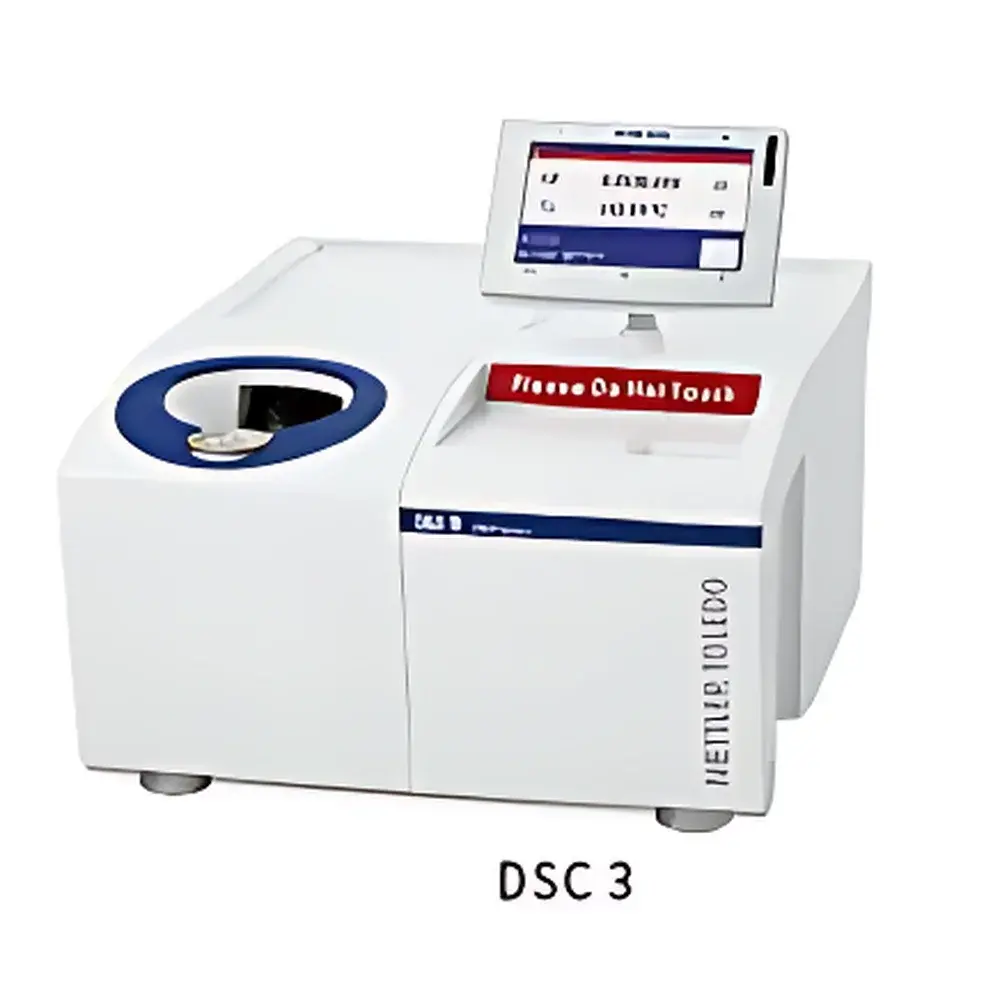
METTLER TOLEDO DSC 3 Excellence Series Differential Scanning Calorimeter
| Brand | METTLER TOLEDO |
|---|---|
| Origin | Switzerland |
| Model | DSC 3 Excellence Series |
| Temperature Range | −150 °C to 700 °C |
| Data Acquisition Rate | Up to 50 data points per second |
| Sensor Type | MultiSTARe™ DSC sensor with 56 or 120 thermocouple pairs (Au/Au-Pd) |
| Cooling Rate | 0.02 K/min to 50 K/min |
| Calibration | FlexCal® (fully automated, multi-point, reference-based) |
| Compliance | Designed for GLP/GMP environments |
Overview
The METTLER TOLEDO DSC 3 Excellence Series Differential Scanning Calorimeter is a high-precision thermal analysis instrument engineered for rigorous quantitative measurement of heat flow associated with physical and chemical transitions in materials. Based on the fundamental principle of power-compensated differential scanning calorimetry, the DSC 3 delivers exceptional baseline stability, reproducibility, and sensitivity across an extended operational temperature range—from cryogenic conditions at −150 °C up to 700 °C. Its core measurement architecture employs the proprietary MultiSTARe™ sensor platform, which integrates either 56 or 120 gold/gold-palladium thermocouple pairs in a symmetrical, dual-furnace configuration. This design enables true dynamic heat-flow detection with minimized thermal lag and optimized signal-to-noise ratio—critical for resolving subtle thermal events such as glass transitions, cold crystallization, melting enthalpies, oxidative induction times (OIT), and reaction kinetics.
Key Features
- MultiSTARe™ sensor technology with selectable 56- or 120-pair thermocouple configurations—optimized for balance between resolution, sensitivity, and thermal response time
- Ultra-stable temperature control with programmable heating/cooling rates from 0.02 K/min to 50 K/min, supporting both slow-scan characterization and rapid thermal profiling
- FlexCal® calibration system: fully automated, reference-material-based, multi-point calibration that eliminates manual intervention and ensures traceable accuracy per ISO 11357 and ASTM E794 standards
- Modular hardware architecture—compatible with optional accessories including controlled-atmosphere modules (gas purging, vacuum, reactive gas), UV-DSC coupling, and synchronized microscopy integration (DSC-Microscope)
- High-speed data acquisition at up to 50 Hz—enabling precise capture of transient thermal events and enabling advanced kinetic modeling
- Robust mechanical design with active vibration damping and electromagnetic shielding—engineered for stable operation in shared laboratory environments
Sample Compatibility & Compliance
The DSC 3 accommodates standard crucibles (aluminum, gold-plated aluminum, stainless steel, ceramic) and supports sample masses from 0.1 mg to 100 mg, depending on required sensitivity and thermal inertia constraints. It is routinely deployed in polymer characterization, pharmaceutical solid-state analysis (polymorph screening, excipient compatibility), battery material thermal safety evaluation, and metallurgical phase transformation studies. The instrument complies with international thermal analysis standards including ISO 11357 (plastics), ASTM E793 (heat of fusion), ASTM E1269 (heat capacity), and USP . When operated with STARe software under validated configurations, it meets regulatory requirements for data integrity in GxP environments—including full electronic signature support, user access controls, and 21 CFR Part 11–compliant audit trail generation.
Software & Data Management
STARe software serves as the unified platform for instrument control, real-time visualization, and advanced thermal data analysis. It provides intuitive workflow templates for routine assays (e.g., Tg determination per ISO 11357-2), customizable peak integration algorithms, and built-in models for Ozawa-Flynn-Wall kinetic analysis, Kissinger activation energy calculation, and modulated DSC (MDSC®) deconvolution. All raw and processed data are stored in a secure, timestamped database with immutable metadata (operator ID, method version, calibration status, environmental logs). Export options include CSV, PDF reports with embedded spectra, and XML formats compatible with LIMS and ELN systems.
Applications
- Quantification of glass transition temperature (Tg), melting point (Tm), crystallization onset (Tc), and enthalpy changes in polymers and biopolymers
- Stability assessment of active pharmaceutical ingredients (APIs) and formulations—detecting degradation onset, hydrate/dehydrate behavior, and amorphous content
- Thermal safety screening of cathode/anode materials and electrolytes in lithium-ion batteries via accelerated rate calorimetry (ARC)-correlated DSC protocols
- Characterization of curing kinetics in thermosetting resins and composites using isothermal and dynamic cure protocols
- Quality control of incoming raw materials and finished products in accordance with internal specifications and pharmacopeial monographs
FAQ
What is the difference between the DSC 3 and earlier METTLER TOLEDO DSC models?
The DSC 3 introduces the MultiSTARe™ sensor architecture, significantly improved temperature uniformity, enhanced cooling performance down to −150 °C without liquid nitrogen dependency (when equipped with optional refrigerated cooling), and native integration with STARe software’s advanced kinetic and compliance modules.
Does the DSC 3 support modulated DSC (MDSC®)?
Yes—the DSC 3 is fully capable of modulated DSC measurements when configured with the appropriate furnace and software license, enabling separation of reversing and non-reversing heat flow components.
Can the DSC 3 be used for oxidative induction time (OIT) testing per ASTM D3895?
Yes—when operated under oxygen or air purge with programmable isothermal holds, the DSC 3 meets all instrumental requirements for OIT determination in polyolefins and related materials.
Is calibration traceable to national standards?
All FlexCal® calibrations use NIST-traceable reference materials (e.g., indium, zinc, tin) and generate calibration certificates compliant with ISO/IEC 17025 documentation practices.
How is data security managed in regulated laboratories?
STARe software supports role-based user permissions, electronic signatures, and tamper-evident audit trails—including operator actions, parameter changes, and report generation—fully aligned with FDA 21 CFR Part 11 and EU Annex 11 expectations.



