
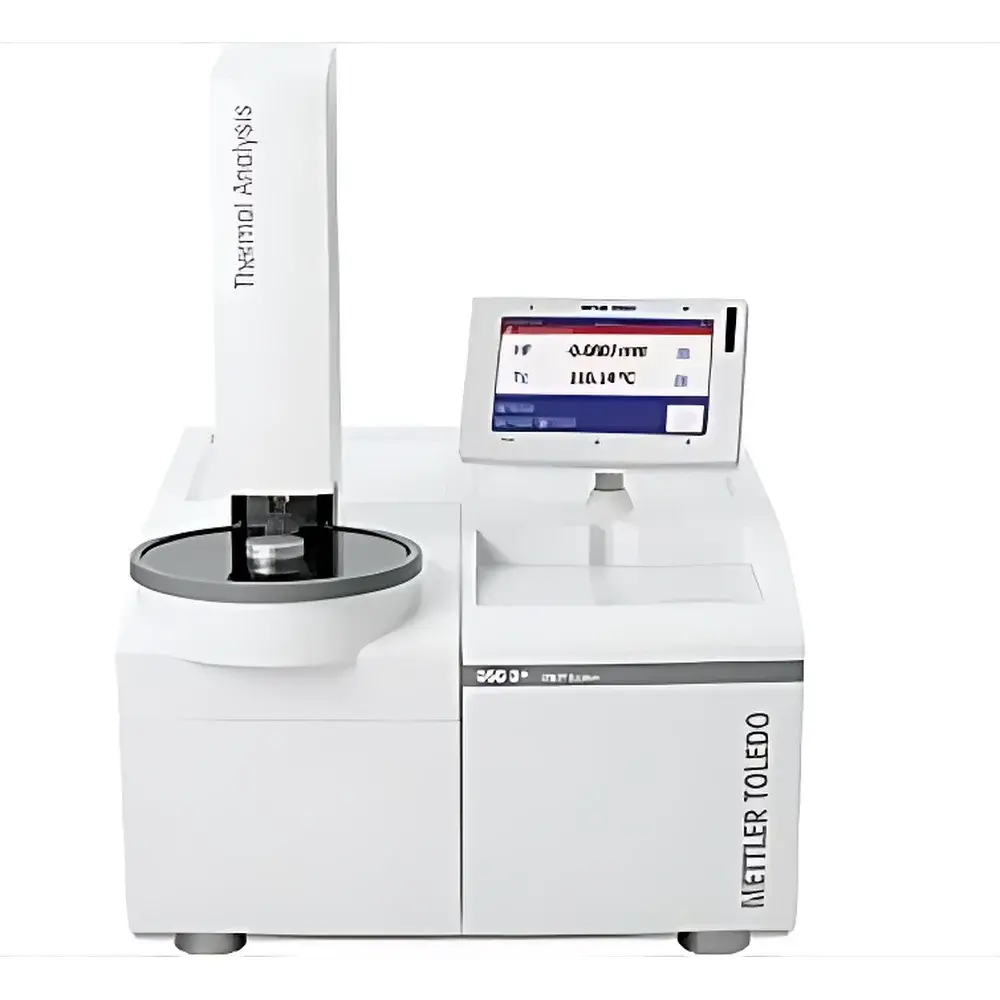
METTLER TOLEDO DSC3+ Differential Scanning Calorimeter
| Brand | METTLER TOLEDO |
|---|---|
| Origin | Switzerland |
| Model | DSC3+ |
| Temperature Range | –150 to 700 °C |
| Temperature Accuracy | ±0.1 °C |
| Heating/Cooling Rate | 0.02–300 K/min (heating), 0.02–50 K/min (cooling) |
| Heat Flow Sensitivity | 0.04 µW (FRS 6+ sensor), 0.02 µW (HSS 9+ sensor) |
| Sensor Configuration | 56-pair (FRS 6+) or 120-pair (HSS 9+) Au/Au-Pd thermocouples in star geometry |
| Compliance | ASTM E794, ISO 11357, USP <1163>, FDA 21 CFR Part 11 (with optional software modules) |
Overview
The METTLER TOLEDO DSC3+ is a high-performance differential scanning calorimeter engineered for precision thermal analysis across research, quality control, and regulatory environments. Based on the heat-flux principle, it measures the difference in heat flow between a sample and inert reference as both are subjected to identical, controlled temperature programs. Its core innovation lies in the MultiSTAR DSC Sensor — available in two configurations: the robust FRS 6+ (56 thermocouple pairs) optimized for routine high-rate measurements and peak separation, and the ultra-sensitive HSS 9+ (120 thermocouple pairs) designed for detecting minute thermal events in microgram-scale or heterogeneous samples. Both sensors feature ceramic substrates, gold/gold-palladium thermocouples, and a thin alumina protective coating — delivering exceptional chemical resistance, long-term baseline stability, and reproducibility under aggressive sample conditions (e.g., corrosive pharmaceutical excipients or halogenated polymers). With a certified temperature range spanning –150 °C to 700 °C and signal time constants below 0.5 s, the DSC3+ supports rapid dynamic scans, modulated DSC (TOPEM®), and hybrid configurations including UV-DSC and DSC-microscopy.
Key Features
- MultiSTAR Sensor Architecture: Star-arranged thermocouple arrays ensure symmetrical heat distribution, minimizing radial thermal gradients and yielding flat, drift-free baselines over extended runs.
- Modular Thermal Control Unit (TCU): Enables seamless integration of liquid nitrogen cooling, mechanical refrigeration, or forced-air systems — configurable per application demands without hardware replacement.
- Automated Sample Handling: Robust 48-position autosampler with programmable vial recognition, lid detection, and temperature-controlled staging — validated for 24/7 unattended operation in GLP/GMP-compliant labs.
- TOPEM® Dynamic Modulation: Patented multi-frequency temperature modulation delivers simultaneous resolution of reversing (heat capacity) and non-reversing (kinetic) transitions — critical for complex polymer curing or amorphous content quantification.
- Calibration Traceability: Fully documented calibration suite compliant with ISO/IEC 17025, including enthalpy (indium, zinc), temperature (mercury, water), and sensitivity verification protocols — all stored with full audit trail.
- Expandable Platform: Native support for UV-DSC (photo-initiated reaction kinetics) and DSC-microscopy (spatially resolved thermal mapping) via standardized optical coupling interfaces.
Sample Compatibility & Compliance
The DSC3+ accommodates sample masses from 0.1 mg to 70 mg in standard aluminum, gold-plated, or hermetic high-pressure crucibles. It routinely analyzes thermally labile APIs, crosslinking epoxy formulations, semi-crystalline polyolefins, and hydrated food matrices without baseline distortion. All sensor and furnace components meet RoHS and REACH directives. Software validation packages support compliance with FDA 21 CFR Part 11 (electronic signatures, audit trails, role-based access), EU Annex 11, and ICH Q5C stability guidelines. Method templates align with ASTM E794 (melting point), ISO 11357-2 (glass transition), and USP (thermal analysis in pharmaceutical development).
Software & Data Management
STARe Software (v18.x) provides integrated instrument control, real-time data visualization, and advanced post-processing. Key capabilities include baseline subtraction algorithms (tangent, sigmoidal, polynomial), peak deconvolution (Gaussian/Lorentzian fitting), kinetic modeling (Ozawa-Flynn-Wall, ASTM E698), and automated report generation with embedded metadata (instrument ID, operator, calibration status, environmental logs). Data files adhere to ASTM E1447 (thermal analysis data exchange format) and export natively to CSV, PDF/A-2, and XML for LIMS integration. Optional Secure Mode enforces electronic signature workflows and encrypted database storage meeting NIST SP 800-53 requirements.
Applications
- Pharmaceuticals: Polymorph screening, excipient compatibility, freeze-drying cycle optimization, and protein denaturation enthalpy quantification.
- Polymers: Crystallinity determination (via fusion enthalpy), oxidative induction time (OIT), cure kinetics (epoxy, silicone), and aging studies (UV/thermal degradation).
- Food Science: Starch gelatinization, fat crystallization profiling, and shelf-life prediction through enthalpic relaxation monitoring.
- Materials R&D: Phase diagram construction for metallic alloys, latent heat measurement in PCMs (phase change materials), and nanocomposite interfacial energy analysis.
- Regulatory Submissions: Validated methods used in ANDA, NDA, and MAA dossiers — with full traceability to primary standards and uncertainty budgets per GUM (JCGM 100).
FAQ
What sensor configuration should I select for routine QC testing?
For general-purpose applications—including melting point verification, Tg determination, and OIT—FRS 6+ provides optimal balance of durability, speed, and reproducibility.
Can the DSC3+ perform low-temperature measurements down to –150 °C without liquid nitrogen?
Yes — when equipped with the optional LN₂-free cryo-cooling module (mechanical refrigeration), it achieves –150 °C with ±0.1 K stability over 4-hour holds.
Is TOPEM® supported out-of-the-box?
Yes — TOPEM® is included in STARe Software at no additional license cost and requires no hardware modification.
How does the system handle corrosive samples like hydrochloric acid additives or sulfur-containing elastomers?
The alumina-coated Au/Au-Pd thermocouples and ceramic sensor housing provide proven resistance to acidic, basic, and halogenated vapors — validated per ISO 11357-8 corrosion exposure protocols.
Does METTLER TOLEDO offer IQ/OQ/PQ documentation for GMP environments?
Yes — comprehensive qualification packages (including test scripts, acceptance criteria, and raw data templates) are provided with each instrument shipment and updated annually per ISO/IEC 17025 requirements.



