
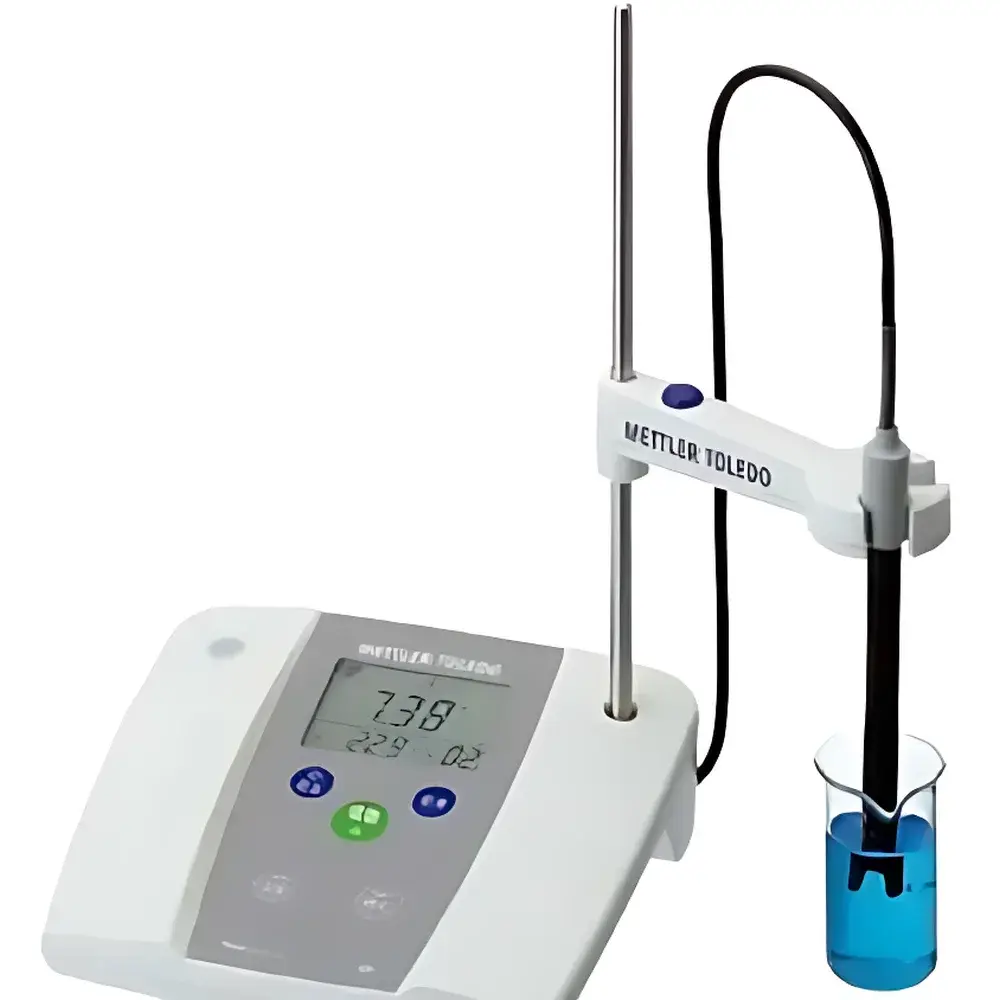
METTLER TOLEDO FiveEasy Plus FE20 pH Meter and FE30 Conductivity Meter
| Brand | METTLER TOLEDO |
|---|---|
| Origin | Switzerland |
| Model | FE20 / FE30 |
| pH Range | 0.00–14.00 |
| Conductivity Range | 0.00 µS/cm–199.9 mS/cm |
| mV Range | −1999–+1999 mV |
| TDS Range | 0.0 mg/L–199.9 g/L |
| Temperature Range | 0.0–100.0 °C |
| Salinity Range | 0.00–19.99 psu |
| pH Resolution | 0.01 pH |
| Conductivity Resolution | 0.01 µS/cm–0.1 mS/cm (auto-ranging) |
| mV Resolution | 1 mV |
| TDS Resolution | 0.1 mg/L–0.1 g/L (auto-ranging) |
| Temperature Resolution | 0.1 °C |
| pH Accuracy | ±0.01 pH |
| Conductivity Accuracy | ±0.5 % of full scale |
| mV Accuracy | ±1 mV |
| TDS Accuracy | ±0.5 % of full scale |
| Temperature Accuracy | ±0.5 °C (±0.3 °C for built-in sensor) |
| Calibration | Up to 3-point pH with 4 predefined buffer sets |
| Power Supply | 220 V/50 Hz AC adapter or 9 V DC battery |
| Data Storage | 99 measurement records |
| Interface | RS232 |
Overview
The METTLER TOLEDO FiveEasy Plus FE20 pH Meter and FE30 Conductivity Meter are benchtop electrochemical instruments engineered for precision, repeatability, and operational simplicity in routine quality control, academic teaching labs, and industrial process support environments. Designed and manufactured in Switzerland, the FE20 and FE30 share a common platform architecture—identical housing, intuitive menu navigation, and identical firmware—enabling seamless dual-role deployment within shared laboratory workflows. The FE20 employs potentiometric measurement via glass electrode technology to determine hydrogen ion activity across the full aqueous pH scale (0.00–14.00), while the FE30 utilizes four-electrode conductivity cell principles to quantify ionic concentration in liquids ranging from ultrapure water (0.00 µS/cm) to highly concentrated brines (199.9 mS/cm). Both instruments integrate temperature compensation using either integrated Pt1000 sensors or external probe inputs, ensuring compliance with ISO 7888 and ASTM D1125 standards for conductivity reporting and with ISO 3696 and USP for pH method validation.
Key Features
- Single-platform design enables consistent user training, documentation, and maintenance across pH and conductivity measurement tasks.
- Auto-ranging conductivity measurement with adaptive resolution (0.01 µS/cm at low ranges, 0.1 mS/cm at high ranges) eliminates manual range selection errors.
- Three-point pH calibration supported by four factory-defined buffer sets (including IUPAC and DIN standards), with automatic recognition of buffer values upon immersion.
- Conductivity zero-point calibration with seven preloaded standard solutions (e.g., KCl 0.01 mol/L, NaCl 0.5% w/w) traceable to NIST-certified reference materials.
- Integrated temperature sensor with ±0.3 °C accuracy ensures linear or non-linear (NTC) compensation per ISO 7888 Annex A.
- RS232 serial interface supports direct connection to LIMS or laboratory PCs for automated data capture, satisfying FDA 21 CFR Part 11 requirements when paired with compliant software.
- Robust ABS housing rated IP54 for resistance to splashes and particulates in non-sterile lab environments.
Sample Compatibility & Compliance
The FE20 and FE30 accommodate aqueous samples across diverse matrices—including pharmaceutical buffers, drinking water, wastewater effluents, food extracts, and chemical process streams—provided sample conductivity remains within specified limits and temperature does not exceed 100 °C. Electrode compatibility includes standard BNC pH electrodes (e.g., LE438, InLab Expert Pro) and interchangeable conductivity cells (e.g., InLab 731-ISM, LF92). All measurements comply with international regulatory frameworks: pH determinations align with USP , EP 2.2.3, and JP 2.05; conductivity results adhere to EP 2.2.39, USP , and ASTM D5391 for purified water testing. Instrument firmware supports GLP-compliant audit trails when connected to METTLER TOLEDO LabX Lite or third-party validated data acquisition systems.
Software & Data Management
Each unit stores up to 99 timestamped measurement records locally, including pH/conductivity value, temperature, date/time, calibration status, and electrode ID (if ISM-enabled). Data export via RS232 follows ASCII-based protocol with configurable delimiters (tab or comma), enabling direct import into Excel, MATLAB, or LIMS without proprietary drivers. While standalone operation requires no software, integration with METTLER TOLEDO LabX Lite (freely available) provides electronic signature support, customizable report templates, and automated backup to network drives—meeting GMP documentation requirements under Annex 11 and ALCOA+ data integrity principles.
Applications
- Pharmaceutical QC: USP conductivity verification of Water for Injection (WFI) and Purified Water (PW); pH monitoring of buffer preparation.
- Environmental Testing: EPA Method 120.1 compliance for surface water conductivity; ISO 5667-3 pH assessment in wastewater sampling.
- Food & Beverage: Salt content estimation via TDS mode (0.0–199.9 g/L) calibrated against NaCl standards; acid-base titration endpoint confirmation.
- Academic Instruction: Hands-on electrochemistry labs covering Nernst equation derivation, Kohlrausch’s law, and temperature-dependent conductivity modeling.
- Industrial Process Support: Routine checks of boiler feedwater purity, cleaning-in-place (CIP) rinse conductivity endpoints, and bioreactor media pH stability.
FAQ
Does the FE20 support automatic temperature compensation (ATC) during pH measurement?
Yes—the FE20 accepts input from integrated or external Pt1000/NTC temperature probes and applies real-time ATC per the Nernst equation slope (−0.198 mV/pH/°C at 25 °C), with selectable linear or non-linear compensation modes.
Can the FE30 measure salinity in seawater-equivalent samples?
Yes—it calculates salinity in psu (practical salinity units) using the PSS-78 algorithm based on conductivity, temperature, and pressure (assumed atmospheric), supporting ranges from 0.00 to 19.99 psu with traceability to IOC standard seawater.
Is electrode calibration data retained after power-off?
Yes—calibration parameters, including slope, offset, and buffer set selection, are preserved in non-volatile memory for up to 10 years without battery backup.
What is the maximum cable length supported for RS232 communication?
Up to 15 meters using shielded twisted-pair cabling meeting EIA/TIA-232-F specifications; longer distances require active repeaters or USB-to-RS232 converters with galvanic isolation.
Are IQ/OQ protocols available for GMP-regulated installations?
METTLER TOLEDO provides validated IQ/OQ documentation packages (order code: FE-IQOQ-KIT) including test scripts, acceptance criteria, and blank execution records aligned with ASTM E2500 and EU GMP Annex 15.
Related Products






