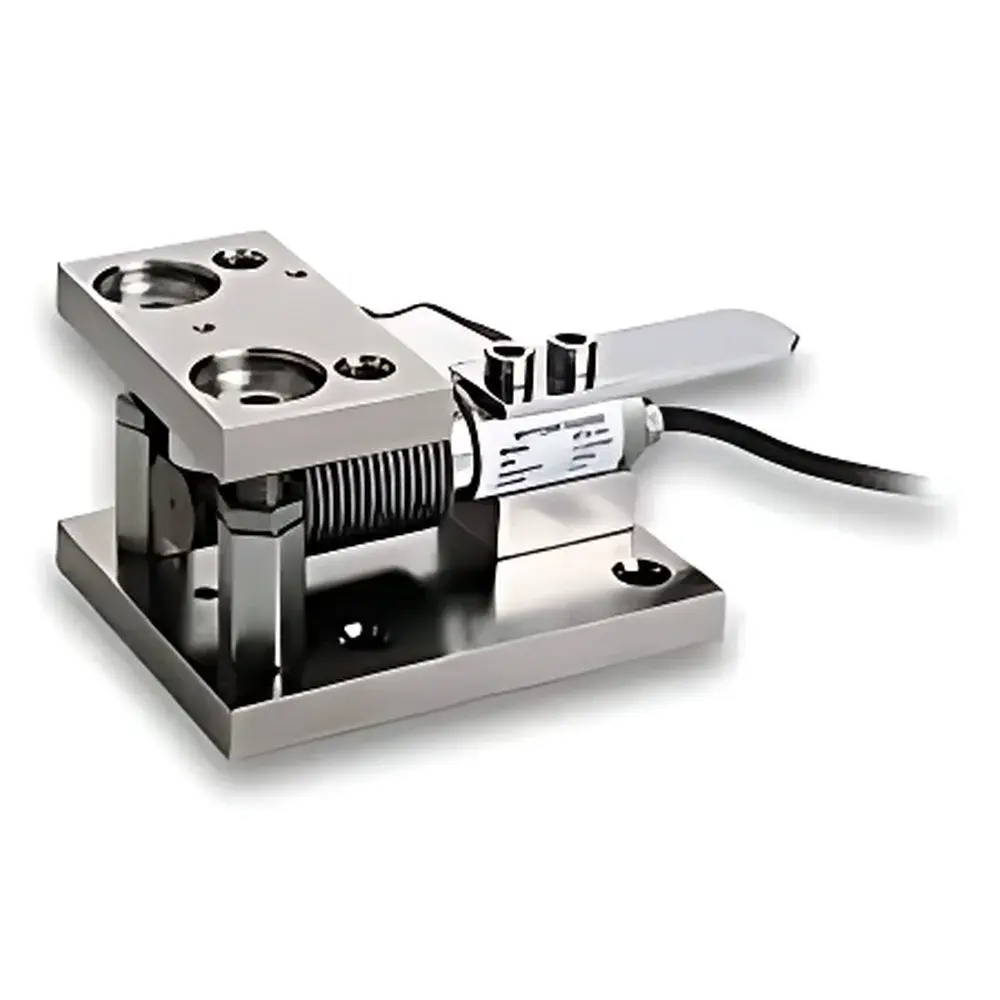
METTLER TOLEDO FWC, FW, CWC, CW, and GW Load Cells for Weighing Modules
| Brand | METTLER TOLEDO |
|---|---|
| Origin | Imported |
| Manufacturer Type | Authorized Distributor |
| Models | FWC, FW, CWC, CW, GW |
| Pricing | Upon Request |
| Construction | Stainless Steel or Alloy Steel |
| IP Rating | IP68 |
| Mounting Configurations | Fixed, Semi-Floating, Fully Floating |
| Typical Installation | 3- or 4-Module Weighing Systems |
| Application Scope | Static Weighing of Tanks, Reactors, Hoppers, and Silos |
Overview
The METTLER TOLEDO FWC, FW, CWC, CW, and GW series are precision-engineered static load cells designed specifically for industrial weighing applications where vertical force dominates and lateral loads remain minimal. These modular load cells operate on the principle of strain gauge transduction within hermetically sealed, welded stainless steel or alloy steel housings—ensuring long-term stability, repeatability, and resistance to mechanical stress, moisture, and chemical exposure. Unlike dynamic or high-frequency measurement systems, these modules are optimized for static or quasi-static mass determination in process environments such as batch mixing, formulation, filling, and inventory monitoring. Their structural design accommodates integration into rigidly mounted vessels—including jacketed reactors, stainless steel tanks, and sanitary hoppers—while maintaining metrological integrity under thermal drift, vibration, and minor foundation settlement. Each module is calibrated traceably to national standards (e.g., NIST, PTB) and conforms to OIML R60 Class C3 or C4 accuracy requirements for industrial weighing instruments.
Key Features
- Hermetically sealed stainless steel or alloy steel sensor housing with IP68 ingress protection—suitable for washdown, humid, corrosive, or explosive atmospheres (ATEX/IECEx optional variants available)
- Spherical articulating top plate and self-aligning ball joint interface—ensures consistent vertical load transmission and eliminates torque-induced measurement error
- Integrated anti-lift and anti-tilt hardware including adjustable support bolts and shear pins—prevents vessel overturning during overfill, seismic events, or maintenance operations
- Modular mounting architecture supporting fixed, semi-floating, and fully floating configurations—enables precise load distribution across 3-, 4-, or multi-point weighing systems
- Low-profile, compact footprint with standardized bolt patterns—facilitates retrofitting into existing tank supports without structural modification
- Maintenance-free operation with no recalibration required under normal service conditions; diagnostic outputs support predictive maintenance via analog 4–20 mA or digital HART/FOUNDATION Fieldbus interfaces
Sample Compatibility & Compliance
These load cells are certified for use with a broad range of process vessels—from 50 L pharmaceutical reactors to 10,000 L chemical storage tanks—provided mechanical constraints (e.g., vessel rigidity, support geometry, anchor point stiffness) comply with METTLER TOLEDO’s installation guidelines (document ref. WT-ENG-INST-002). They meet ISO 9001 and ISO 13849-1 functional safety requirements for Category 3 PLd architectures when integrated with compatible junction boxes and safety-rated controllers. In regulated environments, the modules support 21 CFR Part 11-compliant electronic records when paired with METTLER TOLEDO’s IND570 or ICW-series weighing terminals. They are routinely deployed in facilities operating under GMP (EU Annex 11), FDA cGMP, and ICH Q7 frameworks—particularly for raw material dispensing, in-process blending verification, and final product reconciliation.
Software & Data Management
When connected to METTLER TOLEDO’s ISM (Intelligent Sensor Management) ecosystem, each load cell broadcasts real-time diagnostics—including temperature compensation status, zero stability trend, and overload history—via digital communication protocols. The embedded firmware supports automatic sensor identification, plug-and-play configuration, and seamless integration with MES/SCADA platforms (e.g., Siemens SIMATIC, Rockwell FactoryTalk, Emerson DeltaV) through OPC UA or Modbus TCP. Audit trails, calibration logs, and weight event timestamps are stored locally and synchronized to centralized databases compliant with ALCOA+ principles. Optional validation packages include IQ/OQ documentation templates aligned with ASTM E2500 and GAMP5 standards.
Applications
- Pharmaceutical: Batch-weight verification in API synthesis reactors, excipient dispensing in tablet manufacturing, and sterile buffer preparation
- Food & Beverage: Accurate dosing of flavorings, enzymes, and cultures in fermentation vats; recipe-based ingredient addition in mixing kettles
- Chemical Processing: Closed-loop mass balance control in continuous stirred-tank reactors (CSTRs); hazardous material inventory tracking in solvent recovery units
- Biotechnology: Single-use bioreactor weighing (S.U.B.) with ±0.05% full-scale repeatability; perfusion system media replenishment monitoring
- Water Treatment: Coagulant and polymer dosing control in clarifier feed lines using gravimetric feedback
FAQ
What is the difference between FWC and FW models?
The FWC series features a welded stainless steel housing with integrated cable gland and enhanced corrosion resistance for aggressive chemical environments; the FW series uses high-strength alloy steel with epoxy coating and is optimized for cost-sensitive general-purpose applications.
Can these modules be used in explosion-hazardous areas?
Yes—ATEX-certified versions (II 2G Ex db IIC T4 Gb / II 2D Ex tb IIIC T135°C Db) are available upon request, with intrinsic safety barriers or flameproof enclosures compliant with IEC 60079-0 and -11.
Is field recalibration required after installation?
No—factory calibration is retained if mechanical installation follows METTLER TOLEDO’s published procedures; however, initial zero and span verification is mandatory post-installation per ISO/IEC 17025 guidelines.
How many modules are recommended for a four-leg vessel?
A four-module configuration is standard; three-module setups are acceptable only when vessel geometry ensures symmetrical load distribution and the fourth leg serves purely as mechanical stabilization.
Do these load cells support digital communication protocols?
Yes—HART, FOUNDATION Fieldbus, and IO-Link variants are available; analog 4–20 mA output with digital superimposed signal (DSS) is standard on all models.