
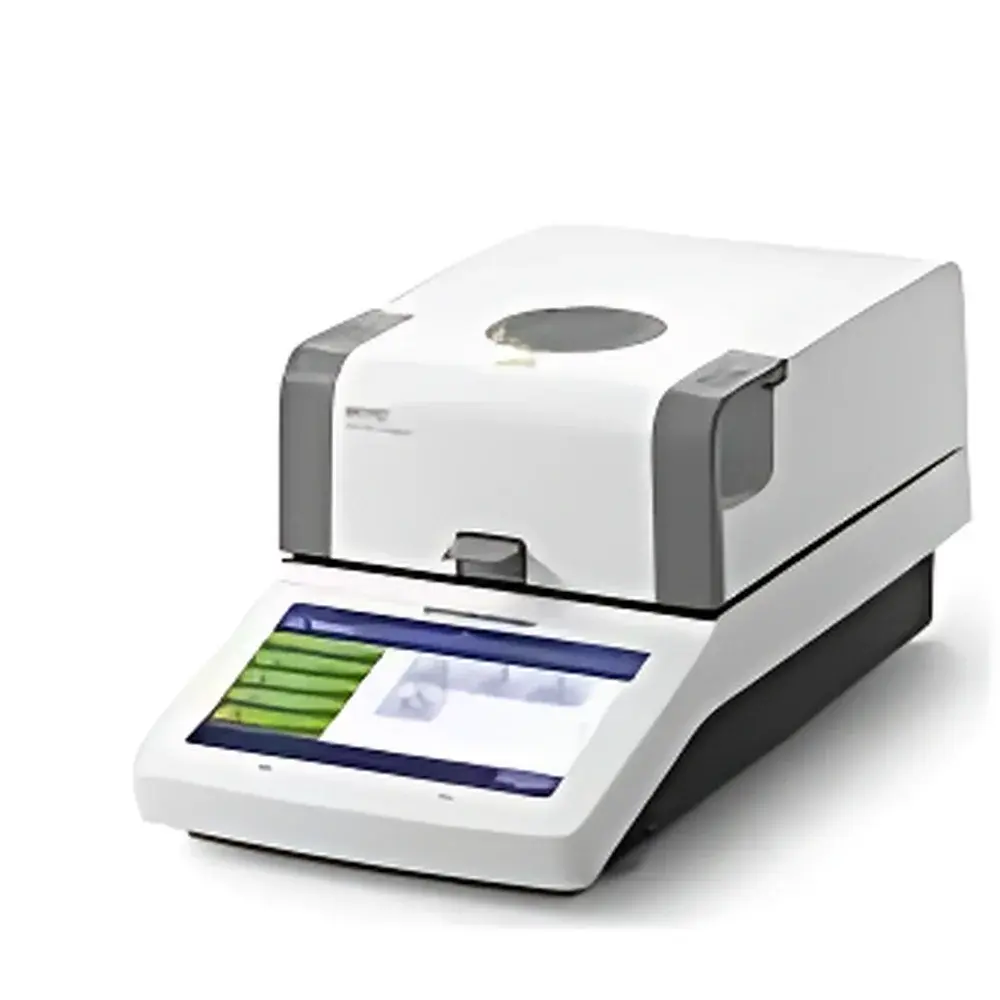
METTLER TOLEDO HC103 Halogen Moisture Analyzer
| Brand | METTLER TOLEDO |
|---|---|
| Origin | Switzerland |
| Model | HC103 |
| Maximum Capacity | 101 g |
| Moisture Content Readability | 0.01 % (equivalent to 1 mg at 10 g sample) |
| Repeatability (2 g sample) | 0.1 % (std. dev.) |
| Repeatability (10 g sample) | 0.015 % (std. dev.) |
| Drying Temperature Range | 40–230 °C (1 °C increment) |
| Preset Drying Programs | Standard, Rapid |
| Method Storage | up to 20 methods |
| Result Storage | 100 results |
| Data Output | Thermal printer (paper tape), USB drive, PC software via USB/RS232 |
| Temperature Calibration | SmartCal®, reference temperature points at 100 °C / 160 °C |
| Display Modes | ATRO moisture %, moisture (g/kg), solids %, solids (g/kg), mass (g), ATRO solids % |
| User Interface | 7" color touchscreen with OneClick™ operation |
| Language Support | English, Spanish, French, German, Italian, Portuguese, Russian, Polish, Czech, Hungarian, Japanese, Korean, Chinese |
| Compliance Features | User management, password-protected settings, audit trail-ready configuration, GLP/GMP-supportive data handling |
Overview
The METTLER TOLEDO HC103 Halogen Moisture Analyzer is a precision-engineered instrument designed for rapid, reliable determination of moisture content in solid and semi-solid materials using the loss-on-drying (LOD) principle. It employs a high-intensity halogen lamp as the heating source, enabling fast, uniform thermal energy transfer across the sample surface. The system integrates a high-resolution analytical balance (1 mg readability at 10 g load) with real-time mass monitoring and adaptive thermal control—ensuring consistent drying kinetics and minimizing measurement drift. Unlike conventional oven-drying methods requiring hours, the HC103 delivers validated moisture results in minutes while maintaining traceability and repeatability required in regulated environments. Its design adheres to fundamental principles outlined in ASTM D4457, ISO 15512, and USP <921>, making it suitable for method development, routine QC testing, and process validation in laboratories and production floors.
Key Features
- 7-inch full-color capacitive touchscreen with intuitive OneClick™ interface—eliminates menu navigation complexity and reduces operator training time.
- Real-time drying curve visualization: graphical display of mass loss vs. time enables immediate assessment of drying endpoint stability and thermal behavior.
- Temperature assistant and method development wizard guide users through optimal parameter selection—including ramp profiles, endpoint criteria (e.g., weight loss threshold or time-based termination), and stabilization logic.
- Dual calibration support: SmartCal® certified temperature verification at 100 °C and 160 °C ensures thermal accuracy traceable to NIST-traceable standards.
- Robust mechanical architecture: IP54-rated enclosure, reinforced weighing pan assembly, and shock-absorbing base mitigate environmental vibration and dust ingress—critical for workshop or pilot-plant deployment.
- Comprehensive user management: Role-based access control (administrator/operator), password-protected method editing, and configurable audit log settings align with FDA 21 CFR Part 11 readiness requirements.
Sample Compatibility & Compliance
The HC103 accommodates diverse sample types including powders, granules, pastes, films, and hygroscopic solids—commonly encountered in food, pharmaceutical, chemical, and polymer manufacturing. Its 101 g maximum capacity supports both small-batch R&D samples and larger QC aliquots. All drying protocols are fully customizable to avoid thermal degradation of heat-sensitive analytes (e.g., APIs, enzymes, or dairy proteins). The instrument complies with essential regulatory expectations for data integrity: electronic records include timestamped metadata (operator ID, method name, start/end time, ambient conditions), automatic result archiving, and exportable raw data files (.csv/.txt). Optional integration with LabX™ software enables centralized method distribution, automated report generation, and electronic signature workflows compliant with GLP and GMP documentation standards.
Software & Data Management
Data output is supported via three independent pathways: built-in thermal paper printer (for immediate hardcopy), USB flash drive (for offline transfer of results and methods), and bidirectional RS232/USB communication with METTLER TOLEDO’s free MT-SOFT software or enterprise-grade LabX™. MT-SOFT provides basic method creation, historical trend analysis, and PDF report generation. LabX extends functionality with server-based method versioning, multi-instrument synchronization, electronic signatures, and full 21 CFR Part 11 compliance—including audit trail review, user activity logging, and data encryption. All stored results retain full contextual metadata: sample ID, batch number, operator, environmental temperature/humidity (if connected to optional sensors), and complete drying profile timestamps.
Applications
The HC103 serves as a primary moisture determination tool across industries where water content directly impacts product stability, shelf life, compaction behavior, or regulatory compliance. In food manufacturing, it verifies moisture specifications for flour, coffee beans, snack foods, and dairy powders per AOAC 950.46 and ISO 665. In pharmaceuticals, it supports excipient qualification (e.g., lactose monohydrate), tablet granulation control, and stability-indicating assays aligned with ICH Q5C. Chemical producers use it for catalyst drying verification and polymer resin moisture specification (ASTM D6980). Its ruggedized construction also supports on-site use in raw material receiving areas, packaging lines, and warehouse quality checkpoints—enabling decentralized testing without sacrificing metrological rigor.
FAQ
What is the recommended minimum sample mass for reliable moisture quantification?
For optimal repeatability, METTLER TOLEDO recommends ≥2 g for most matrices; however, the instrument achieves ≤0.015 % standard deviation at 10 g load—making it suitable for high-precision applications such as API release testing.
Can the HC103 be validated for use in GMP environments?
Yes—when configured with LabX software, user management, and SmartCal® verification, the HC103 supports IQ/OQ/PQ execution and meets core elements of Annex 11 and ALCOA+ data integrity principles.
Does the instrument support automated endpoint detection?
Yes—users may define termination criteria based on absolute weight loss (e.g., ≤0.1 mg/30 s), relative change rate, or fixed duration, with visual confirmation via the live drying curve.
Is external humidity/temperature compensation available?
Ambient sensor inputs are not built-in but can be integrated via LabX using third-party calibrated probes—enabling environmental correction in long-duration or climate-variable testing scenarios.
How are methods protected from unauthorized modification?
Password-protected method editing, role-based access levels, and immutable audit logs ensure method integrity and support internal quality audits and regulatory inspections.
Related Products






