
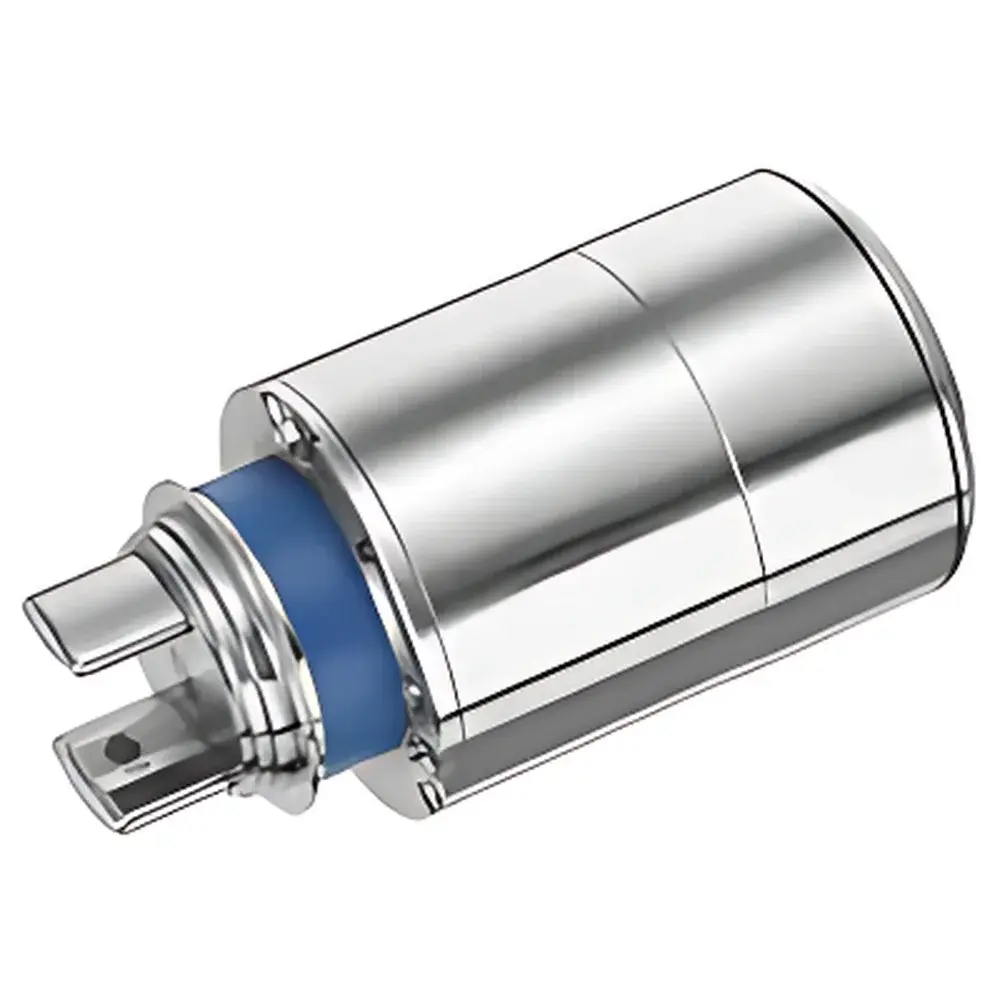
METTLER TOLEDO InPro 8600 Series Dual-Angle (25° and 90°) Scattering Turbidimeter
| Brand | METTLER TOLEDO |
|---|---|
| Origin | Switzerland |
| Model | InPro 8600 |
| Measurement Range | 0–100 EBC / 0–400 FTU |
| Process Connection | Inline sanitary sleeve (Varivent®-compatible) |
| Wetted Materials | 316L stainless steel, sapphire optics |
| Operating Temperature | 0–80 °C (standard), up to 120 °C (short-term) |
| Operating Pressure | 1–16 bar |
| Optical Detection Angles | 25° and 90° scattering |
Overview
The METTLER TOLEDO InPro 8600 Series is an inline turbidimeter engineered for high-precision, real-time measurement of suspended particulates in liquid process streams using dual-angle scattered light detection. Based on the ISO 7027-compliant nephelometric principle, it simultaneously captures scattered light at 25° (forward scatter) and 90° (side scatter) relative to the incident beam—enabling not only robust turbidity quantification but also insight into particle size distribution dynamics. Unlike single-angle instruments, this dual-scatter architecture enhances sensitivity to sub-micron contaminants in optically clear fluids, making it especially suitable for critical post-filtration verification in hygienic manufacturing environments. The sensor integrates optical path alignment, temperature-compensated photodetectors, and digital signal processing directly within the probe head—eliminating signal degradation from long analog cabling and ensuring metrological stability under varying thermal and mechanical loads.
Key Features
- Compact, all-in-one probe design with integrated electronics reduces footprint and eliminates external transmitter housing requirements.
- Sapphire optical windows provide exceptional chemical resistance, scratch resistance, and long-term transmission stability—even in aggressive cleaning-in-place (CIP) and sterilization-in-place (SIP) cycles.
- Sanitary construction compliant with EHEDG Doc. 8 and 3-A SSI standards; compatible with Varivent® and other DIN 11851/ISO 2852 sanitary fittings.
- ISM (Intelligent Sensor Management) technology enables plug-and-play operation: automatic sensor identification, factory calibration traceability (NIST-traceable), and embedded diagnostic logs accessible via standard HART or Profibus PA interfaces.
- Wireless configuration via Bluetooth-enabled ISM handheld tool streamlines commissioning, eliminates field wiring for setup, and supports remote parameter adjustment without process interruption.
- Robust pressure and temperature rating (up to 16 bar / 120 °C short-term) allows deployment across primary and secondary process stages—from cold-fill beverage lines to hot aseptic processing loops.
Sample Compatibility & Compliance
The InPro 8600 is validated for use with aqueous, low-viscosity, non-opaque process liquids typical of food & beverage, biopharmaceutical, and fine chemical applications—including clarified juices, beer, wine, purified water (PW), water-for-injection (WFI), and buffer solutions. Its sapphire-wetted surface meets USP and FDA 21 CFR Part 211 requirements for material compatibility in GMP environments. Measurement performance conforms to ISO 7027:2016 (nephelometric method), EN 27027, and ASTM D6506-19 for turbidity reporting in EBC (European Brewery Convention) and FTU (Formazin Turbidity Unit) scales. Data integrity is supported by audit-trail-capable firmware compliant with ALCOA+ principles and aligned with Annex 11 and FDA 21 CFR Part 11 expectations for electronic records.
Software & Data Management
Configuration, diagnostics, and historical trend analysis are managed through METTLER TOLEDO’s iSense software platform or integrated into distributed control systems (DCS) via standard industrial protocols (HART 7, Profibus PA, FOUNDATION Fieldbus). All calibration events, sensor health metrics (e.g., window fouling index, LED aging compensation), and measurement timestamps are stored onboard with tamper-resistant logging. Exportable CSV reports include raw scatter intensities at both angles, compensated turbidity values, and environmental metadata—facilitating root-cause analysis during quality investigations or regulatory audits.
Applications
- Real-time monitoring of crossflow and depth filtration efficiency in beer, dairy, and plant-based beverage production.
- In-line verification of sterile filtration integrity prior to aseptic filling in biopharmaceutical upstream and downstream operations.
- Detection of micro-aggregates or leachables during buffer preparation and chromatography column elution.
- Early warning of membrane fouling or gasket failure in sanitary process skids.
- Dynamic assessment of particle growth kinetics during crystallization or precipitation steps.
FAQ
What turbidity units does the InPro 8600 report in, and how are they calibrated?
The sensor outputs values in both EBC (European Brewery Convention) and FTU (Formazin Turbidity Units), traceably calibrated against NIST-certified formazin standards per ISO 7027. Calibration coefficients are stored in the ISM memory and automatically applied during measurement.
Can the InPro 8600 distinguish between different particle sizes?
While not a full particle sizing instrument, the ratio of 25° to 90° scatter signals provides a semi-quantitative indicator of relative particle size distribution shifts—enabling trending of aggregation, fragmentation, or colloidal instability in real time.
Is the sensor suitable for steam sterilization?
Yes—its design supports SIP cycles up to 121 °C for 30 minutes when installed with appropriate thermal isolation and pressure relief; validation documentation is available upon request for GMP-compliant installations.
How is sensor fouling compensated for during extended operation?
The ISM algorithm continuously monitors baseline scatter drift and applies adaptive compensation using reference photodiode readings; users receive automated alerts when window cleaning is recommended based on fouling index thresholds.
Does the InPro 8600 support predictive maintenance integration?
Yes—via HART or Fieldbus, it delivers diagnostic parameters (LED drive current, temperature gradient, signal-to-noise ratio) that can be fed into MES or CMMS platforms for condition-based maintenance scheduling.





