METTLER TOLEDO InPro5000i / InPro5500i Online Dissolved CO₂ Sensor
| Brand | METTLER TOLEDO |
|---|---|
| Origin | Switzerland |
| Product Line | InPro5000i (for bioprocessing & cell culture), InPro5500i (for beverage carbonation) |
| Measurement Principle | Severinghaus-type electrochemical membrane sensor with temperature-compensated pH-based detection |
| Output Signal | 4–20 mA, HART, or digital ISM interface |
| Pressure Rating | Up to 10 bar (g) |
| Process Temperature Range | 0–50 °C |
| Materials of Construction | PPSU body, PTFE/PFA membranes, FDA-compliant wetted parts |
| Certifications | ATEX/IECEx Zone 1, SIL2 compliant, cGMP-ready design |
| Smart Features | ISM (Intelligent Sensor Management) with diagnostic logging, lifetime calibration tracking, and predictive maintenance alerts |
Overview
The METTLER TOLEDO InPro5000i and InPro5500i online dissolved carbon dioxide (CO₂) sensors are engineered for continuous, real-time measurement of aqueous CO₂ concentration in demanding bioprocess and beverage production environments. These sensors operate on the established Severinghaus principle: CO₂ diffuses through a gas-permeable hydrophobic membrane into a thin electrolyte layer, inducing a pH shift in a buffered bicarbonate solution; this change is detected by a precision pH electrode pair and converted to a quantitative CO₂ value via the Henderson–Hasselbalch equation. Built-in platinum RTD temperature sensing enables dynamic compensation across the full 0–50 °C operating range, ensuring traceable accuracy under variable process conditions. Unlike optical or infrared methods, this electrochemical architecture delivers high selectivity for dissolved CO₂ without interference from O₂, N₂, or volatile organics—critical for sterile fermentation and low-CO₂ soft drink formulations.
Key Features
- Two application-optimized variants: InPro5000i for mammalian cell culture, microbial fermentation, and upstream bioreactor monitoring; InPro5500i calibrated for high-dynamic-range CO₂ control in beer lagering tanks, carbonation lines, and soft drink fillers.
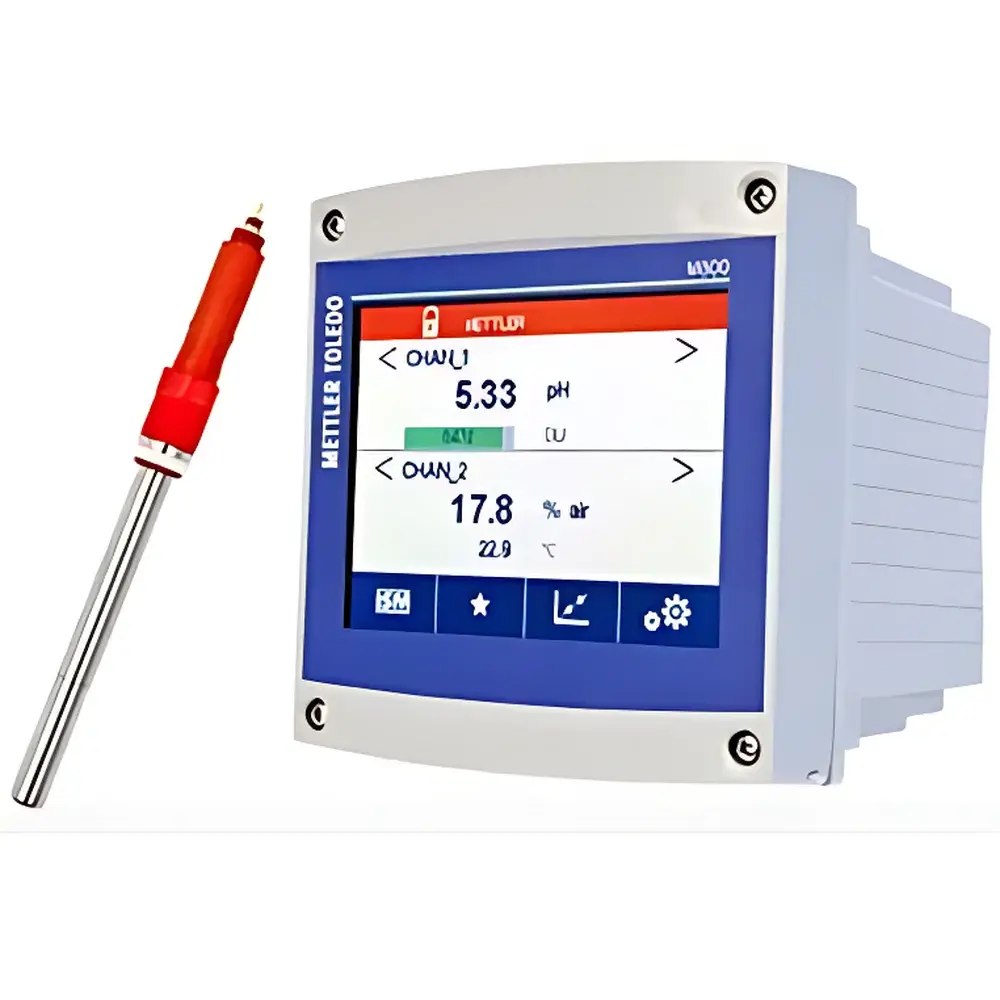
- ISM (Intelligent Sensor Management) integration provides embedded diagnostics—including membrane hydration status, electrolyte depletion rate, electrode drift trend, and remaining service life—accessible via compatible METTLER TOLEDO transmitters (e.g., M300, M800) or DCS/SCADA systems.
- Robust mechanical design with PPSU housing and chemically resistant PTFE/PFA membranes ensures long-term stability in aggressive cleaning-in-place (CIP) and sterilization-in-place (SIP) cycles (up to 135 °C steam).
- Multiple mounting options: direct-thread (½” NPT, G1/2), sanitary clamp (DIN 11851, SMS 1145), and retractable insertion assemblies for pressurized vessels or pipelines.
- Optional integrated pneumatic or ultrasonic self-cleaning modules reduce manual intervention and maintain signal integrity during particulate-laden operations (e.g., yeast-rich fermentations).
Sample Compatibility & Compliance
The InPro series is validated for use in conductive aqueous matrices with conductivity ≥ 50 µS/cm. It meets ISO 20483:2020 requirements for dissolved gas analysis in biopharmaceutical processes and complies with ASTM D5117–19 for beverage CO₂ quantification. All wetted materials conform to USP Class VI and FDA 21 CFR 177.2600 specifications. The sensor’s intrinsic safety certification (ATEX II 1G Ex ia IIC T4 Ga, IECEx Ex ia IIC T4 Ga) permits installation in classified zones adjacent to bioreactors or bottling lines. Data integrity features—including audit-trail-enabled calibration logs, user-access controls, and electronic signature support—align with FDA 21 CFR Part 11 and EU Annex 11 expectations for regulated manufacturing.
Software & Data Management
ISM data is natively supported by METTLER TOLEDO’s iSense software platform, enabling configuration, firmware updates, historical trend review, and automated report generation (PDF/CSV). When deployed with M800 multi-parameter transmitters, the system supports Modbus TCP, OPC UA, and MQTT protocols for seamless integration into MES (Manufacturing Execution Systems) and historian platforms such as PI System or Ignition SCADA. Calibration events, diagnostic flags, and sensor aging metrics are timestamped and exportable for quality review during internal audits or regulatory inspections (e.g., FDA pre-approval inspections, EMA GMP audits).
Applications
- Monitoring dissolved CO₂ in CHO and HEK293 cell culture bioreactors to optimize pH control loops and prevent acidosis-induced viability loss.
- Real-time CO₂ profiling during fed-batch and perfusion modes to correlate metabolic activity with lactate/glucose consumption rates.
- Carbonation level verification in inline mixers prior to canning/filling—ensuring consistent mouthfeel and shelf-life stability in sparkling water and craft beer.
- Leak detection and purge validation in modified-atmosphere packaging (MAP) lines using CO₂ concentration decay kinetics.
- Environmental monitoring in closed-loop cleanroom HVAC systems where CO₂ serves as a proxy for occupancy and ventilation efficiency.
FAQ
How does the InPro5000i differ from traditional offline CO₂ titration methods?
Offline titration requires sample extraction, degassing artifacts, and 15–30 minute turnaround—introducing delay and variability. The InPro5000i provides sub-30-second response time (t₉₀) with continuous in-situ measurement, eliminating sampling bias and enabling closed-loop pH/CO₂ cascade control.
Can the same sensor be used for both fermentation and beverage applications?
No. The InPro5000i uses a low-range membrane optimized for 0–100 mM CO₂ (typical in cell culture), while the InPro5500i employs a high-permeability membrane and extended electronics for 0–5000 ppm (v/v) CO₂—required for carbonated beverage saturation control.
What maintenance intervals are recommended under GMP conditions?
ISM diagnostics recommend membrane replacement every 6–12 months depending on CIP frequency and process fouling potential; electrolyte refill is not required—the sealed, factory-filled module is designed for single-use lifecycle compliance.
Is calibration traceable to NIST standards?
Yes. Factory calibration uses gravimetrically prepared CO₂-sparged standard solutions traceable to NIST SRM 1690 (certified CO₂ gas mixture), with certificate of calibration supplied per unit.
Does the sensor support wireless configuration?
Not natively—but when paired with METTLER TOLEDO’s M300 Wireless Gateway and iSense Mobile, field technicians can perform zero/span checks, view diagnostics, and download logs via Bluetooth LE without physical transmitter access.