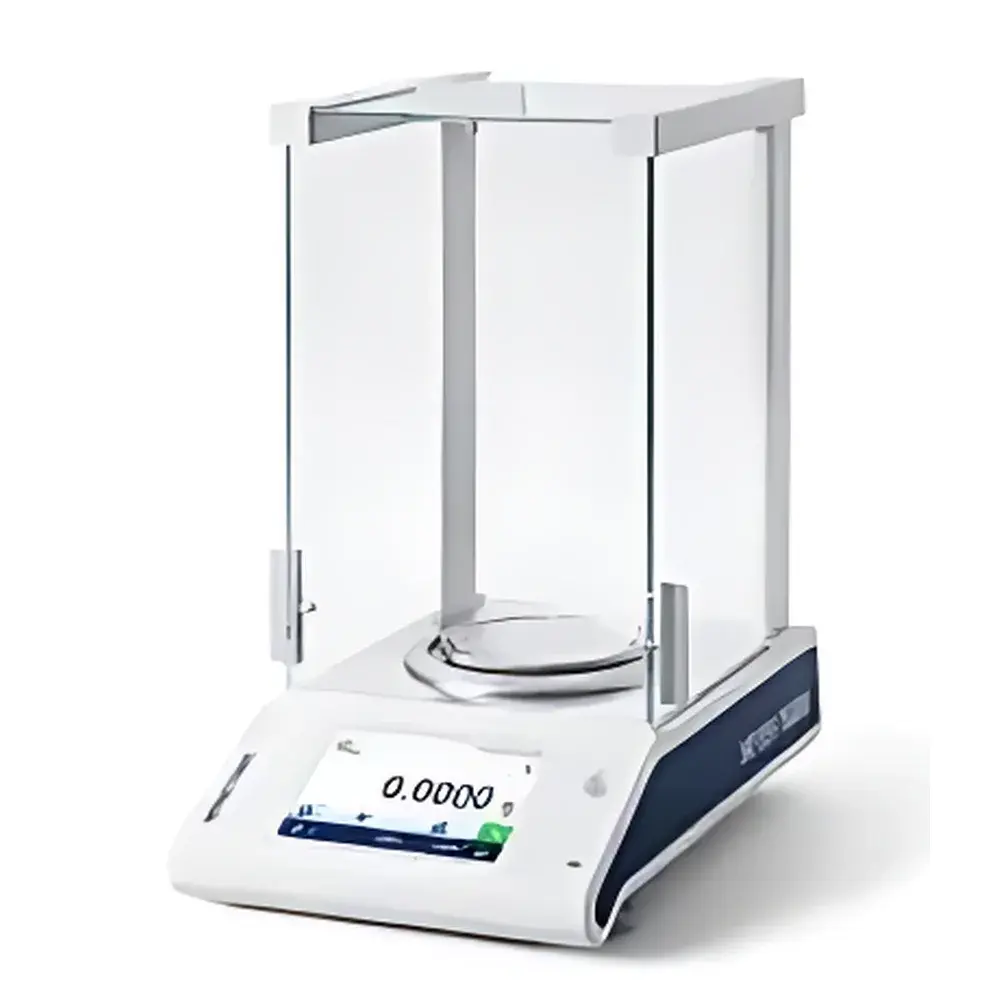
METTLER TOLEDO ML104T/02 Analytical Balance
| Brand | METTLER TOLEDO |
|---|---|
| Origin | Switzerland |
| Model | ML104T/02 |
| Type | Analytical Balance |
| Maximum Capacity | 120 g |
| Readability | 0.1 mg |
| Repeatability | 0.1 mg (at 100 g) |
| Minimum Weight (USP, typical) | 0.16 g |
| Stabilization Time | 2 s |
| Pan Diameter | 90 mm |
| Calibration | Internal / FACT |
| Connectivity | RS232, USB Device, USB Host, Optional Bluetooth |
| Housing | Die-cast aluminum with ABS plastic |
| Dimensions (D×H×W) | 290 mm × 193 mm × ? mm |
| Legal for Trade | No |
| Hygienic Design | Yes |
Overview
The METTLER TOLEDO ML104T/02 Analytical Balance is a high-precision, ISO-compliant laboratory balance engineered for routine analytical weighing in regulated and non-regulated environments. Based on METTLER TOLEDO’s proven MonoBloc weighing cell architecture, it delivers metrological stability and long-term reliability under variable environmental conditions. Its operating principle relies on electromagnetic force compensation (EMFC), where the mass-induced displacement of a precision load receptor is counteracted by a controlled electromagnetic current; the resulting current is linearly proportional to the applied mass and digitally converted into a weight value with 0.1 mg resolution. Designed for applications demanding traceable, repeatable, and auditable measurements — including pharmaceutical formulation, quality control testing, reference standard preparation, and academic research — the ML104T/02 integrates built-in regulatory safeguards such as FACT (Fully Automatic Calibration Technology), LevelControl, MinWeigh, and ISO-compliant event logging.
Key Features
- Monobloc high-stability weighing sensor with integrated temperature compensation and drift correction
- FACT internal calibration system with automatic adjustment triggered by temperature change or time interval (user-configurable)
- LevelControl: real-time leveling guidance via intuitive on-screen prompts and visual indicators
- MinWeigh function: enforces USP Chapter <41> minimum weight requirements by highlighting values below user-defined thresholds in red until net sample mass exceeds the limit
- ISO-compliant audit trail: automatically logs all critical events including calibrations, level adjustments, FACT activations, and parameter changes — compliant with ALCOA+ data integrity principles
- QuickLock draft shield: tool-free removal of all transparent acrylic components for rapid cleaning and contamination control
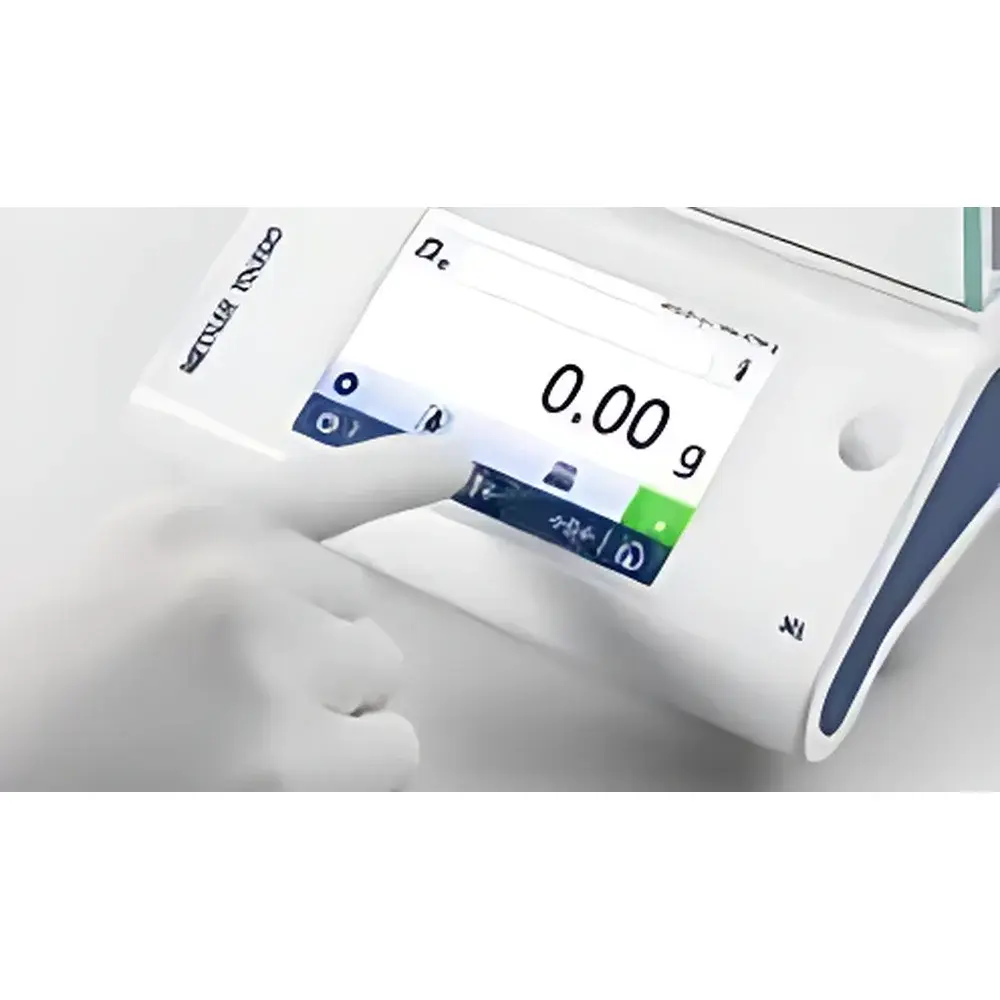
- 4.5-inch full-color capacitive touchscreen with glove-compatible operation (tested with cotton, silicone, and nitrile gloves)
- Dual USB ports (host and device) plus RS232 interface; optional Bluetooth module supports wireless data export to LIMS or ELN systems
- PC Direct mode enables direct ASCII data transmission to spreadsheet or database applications without proprietary software
- Robust die-cast aluminum chassis with chemical-resistant ABS housing and hygienic, crevice-free surfaces for GMP-aligned cleanroom use
Sample Compatibility & Compliance
The ML104T/02 accommodates standard laboratory samples in crucibles, vials, weighing boats, and filter papers, with a 90 mm diameter stainless steel pan optimized for volumetric compatibility and minimal air turbulence interference. Its design conforms to ISO 9001, ISO/IEC 17025, and USP <41> and <1251> requirements for analytical balance qualification. While not certified for legal-for-trade applications, its performance meets or exceeds ASTM E898–21 and OIML R76 Class I specifications for laboratory-grade analytical instruments. The integrated audit trail satisfies FDA 21 CFR Part 11 requirements when used with appropriate system configuration and access controls. All firmware updates and calibration records are timestamped and attributable to authorized users, supporting GLP/GMP audit readiness.
Software & Data Management
No external software is required for basic operation or data export. The embedded operating system includes preloaded applications for percentage weighing, density determination, dynamic weighing, statistics, and formulation. Raw weight data can be exported in CSV or TXT format via USB flash drive or serial connection. When connected to a validated PC environment, the balance supports automated integration with LabWare LIMS, Thermo Fisher SampleManager, or custom Python-based acquisition scripts via standard ASCII protocols. Audit trail entries include operator ID (if password-protected user accounts are enabled), timestamp (with UTC synchronization support), event type, pre- and post-change parameter values, and contextual metadata — enabling full forensic reconstruction during regulatory inspections.
Applications
- Pharmaceutical QC: active pharmaceutical ingredient (API) assay, excipient blending verification, and reference standard weighing per ICH Q5C and Q7 guidelines
- Chemical synthesis: stoichiometric reagent dispensing, yield calculation, and reaction monitoring
- Environmental testing: gravimetric analysis of particulate matter (PM2.5/PM10) filters per EPA Method 201A
- Food & beverage: moisture content determination (AOAC 950.46), ash analysis (AOAC 942.05), and nutritional labeling compliance
- Academic research: nanomaterial dosage preparation, catalyst loading, and microscale reaction setup
- Materials science: coating thickness validation via mass gain measurement on substrates
FAQ
What is the difference between FACT and external calibration?
FACT uses internal reference masses and temperature sensors to trigger recalibration automatically when environmental drift exceeds predefined thresholds; external calibration requires manual intervention with traceable weights and is typically performed during periodic verification or after relocation.
Does the ML104T/02 support 21 CFR Part 11 compliance?
Yes — when configured with password-protected user roles, electronic signatures, and audit-trail-enabled firmware, it fulfills technical controls for electronic records and signatures under Part 11, provided the host IT environment and procedural SOPs are also validated.
Can the minimum weight threshold be adjusted for specific SOPs?
Yes — users may define custom MinWeigh values based on method-specific uncertainty budgets, process tolerances, or pharmacopeial requirements (e.g., USP <41>, Ph. Eur. 2.2.17).
Is the draft shield resistant to common lab solvents?
The acrylic draft shield is compatible with isopropanol, ethanol, and mild detergent solutions; avoid prolonged exposure to acetone, chloroform, or strong alkaline cleaners.
How often should FACT calibration be scheduled?
Default factory setting triggers FACT every 2°C temperature change or every 4 hours; intervals may be extended or shortened depending on lab environmental stability and risk assessment outcomes.