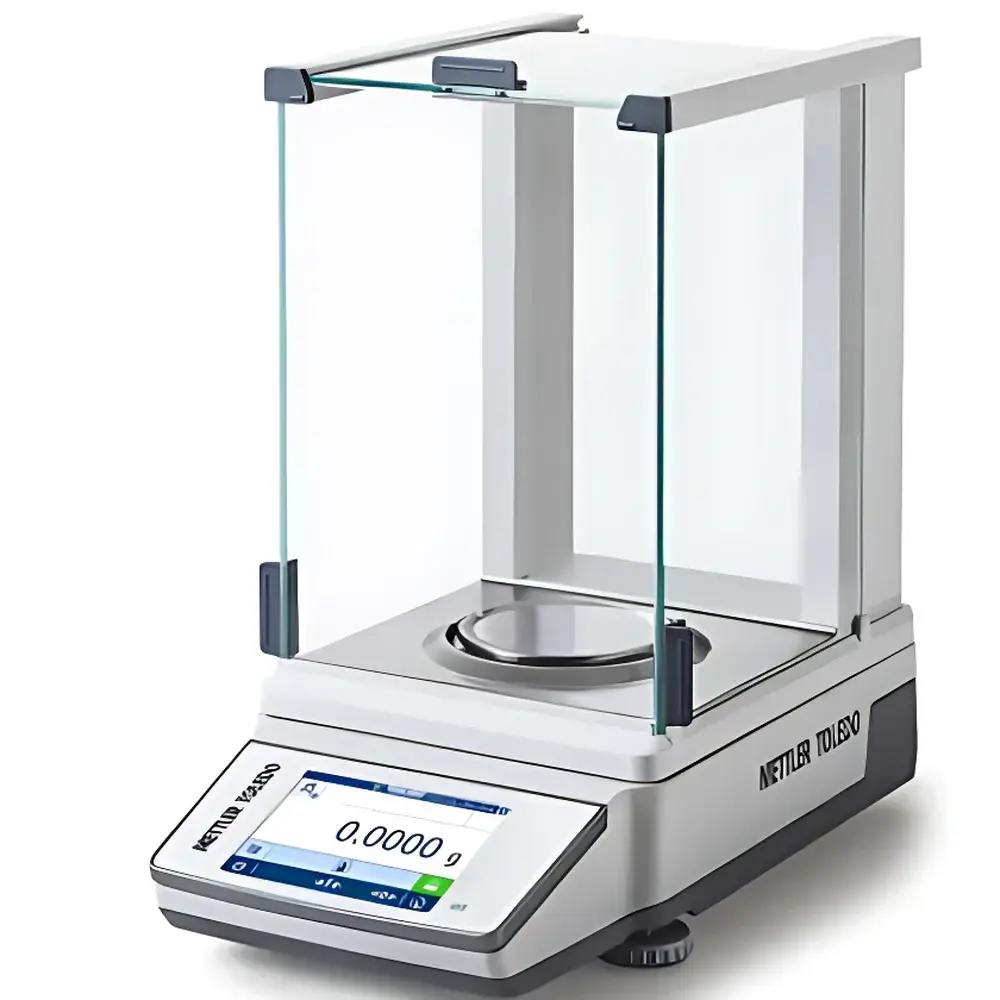
METTLER TOLEDO MR304 Analytical Balance
| Brand | METTLER TOLEDO |
|---|---|
| Origin | Shanghai, China |
| Manufacturer Type | Authorized Distributor |
| Product Origin | Domestic (China) |
| Model | MR304 Analytical Balance |
| Pricing | Available Upon Request |
Overview
The METTLER TOLEDO MR304 Analytical Balance is a precision laboratory instrument engineered for high-reproducibility mass measurement in demanding industrial and research environments. Operating on electromagnetic force compensation (EMFC) principle, the MR304 delivers stable, drift-resistant readings with resolution down to 0.1 mg and maximum capacity of 300 g — consistent with ISO/IEC 17025-compliant analytical weighing requirements. Its robust mechanical architecture integrates a monolithic stainless-steel weighing cell, hermetically sealed electronics, and an optimized thermal mass design to minimize environmental sensitivity — particularly critical in non-climate-controlled production floors or multi-user QC laboratories where temperature fluctuations, air currents, and vibration are common. Unlike entry-level balances, the MR304 is purpose-built for continuity of operation: its full-metal housing meets IP54-rated ingress protection against dust and incidental liquid splashes, while internal overload safeguards prevent damage from accidental overloading up to 200% of nominal capacity.
Key Features
- Electromagnetic force compensation (EMFC) sensor with automatic internal adjustment and real-time drift compensation
- Integrated guided leveling system with visual LED feedback — eliminates manual bubble-level dependency and reduces setup time by >60%
- QuickLock draft shield mechanism: tool-free removal in <3 seconds; all transparent components dishwasher-safe (top-rack cycle, max 65°C)
- Modular spill tray design: slide-out polymer tray with chemical-resistant surface; compatible with standard lab cleaning protocols
- Dual-interface connectivity: RS232, USB Device/Host, and optional Ethernet (via EASY Connect module) for direct integration into LIMS, MES, or PLC networks
- User-defined access control: up to 10 configurable user profiles with role-based permissions (e.g., operator, supervisor, administrator), enforcing GLP/GMP-aligned workflow segregation
- Preloaded GxP-compliant applications: formulation, statistics, pipette verification, density determination, and percent weighing — all validated per ASTM E899 and USP <41>
Sample Compatibility & Compliance
The MR304 accommodates standard analytical sample containers (including 100-mm diameter crucibles, volumetric flasks, and weigh boats) within its 120 mm × 120 mm pan area. Its draft shield aperture supports routine handling of volatile solvents, hygroscopic powders, and temperature-sensitive samples without condensation-induced error. Regulatory compliance includes full traceability under FDA 21 CFR Part 11 (with electronic signature support via LabX Lite software), adherence to ISO 9001:2015 quality management clauses for calibration documentation, and alignment with European Union Measuring Instruments Directive (MID) Annex MI-001 for non-automatic weighing instruments. Calibration certificates issued by METTLER TOLEDO service centers include uncertainty budgets per EURAMET cg-18 and are recognized by CNAS-accredited labs in APAC.
Software & Data Management
Data integrity is enforced through native MT-SICS (METTLER TOLEDO Standard Interface Command Set) protocol — enabling bidirectional communication with third-party systems using ASCII-based command strings. The balance supports audit trail logging (user ID, timestamp, action, value before/after) with tamper-evident file encryption. When paired with optional LabX Lite software, users gain automated report generation (PDF/CSV), customizable SOP-driven workflows, and secure cloud backup to on-premise NAS or validated SaaS platforms. All data exports comply with ALCOA+ principles (Attributable, Legible, Contemporaneous, Original, Accurate, Complete, Consistent, Enduring, Available) for regulatory inspections.
Applications
- Quality control testing in pharmaceutical manufacturing (raw material assay, tablet weight variation per USP <905>)
- Chemical synthesis — reagent dispensing, stoichiometric ratio validation, and reaction yield calculation
- Food safety labs — moisture content analysis (AOAC 950.46), ash determination (AOAC 942.05), and nutritional labeling compliance
- Materials science — powder density profiling, catalyst loading quantification, and nanomaterial dispersion mass verification
- Environmental testing — filter weighing for PM2.5/PM10 gravimetric analysis (EPA Method 201A)
- Educational laboratories — teaching fundamental metrology concepts including repeatability, linearity, and eccentricity error assessment
FAQ
What is the recommended calibration frequency for the MR304 in a regulated environment?
Calibration should follow a risk-based schedule aligned with usage intensity and process criticality — typically daily zero-check, weekly span verification, and full recalibration every 3–6 months using certified Class M1 weights. Full calibration records must be retained for ≥2 years per FDA 21 CFR Part 11.
Can the MR304 be used in a fume hood?
Yes — provided the draft shield is fully engaged and airflow velocity at the balance opening remains below 0.2 m/s (per ISO 17025:2017 Annex C.3). Avoid placement directly in front of hood sash openings.
Does the MR304 support external printer integration?
Yes — via RS232 or USB with ESC/P or PCL-compatible thermal or dot-matrix printers. Print templates can be customized using MT-SICS commands for batch ID, operator ID, and statistical summaries.
Is the QuickLock draft shield compatible with static-dissipative materials?
Standard acrylic shields are not ESD-rated; however, optional antistatic polycarbonate shields (Order Code: MR304-ESD-KIT) are available for electrostatic-sensitive environments such as semiconductor packaging labs.