
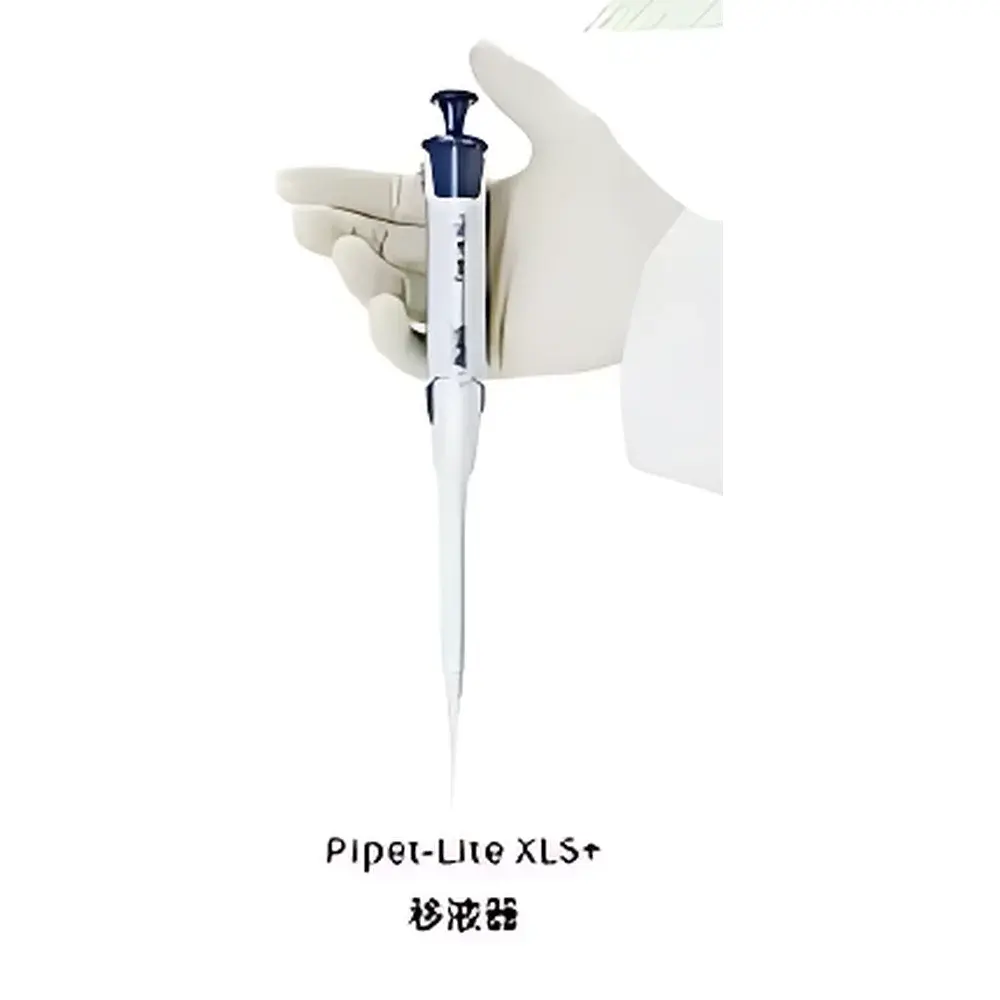
METTLER TOLEDO Pipet-Lite XLS+ Single-Channel Manual Pipette
| Brand | METTLER TOLEDO |
|---|---|
| Origin | Switzerland |
| Model | Pipet-Lite XLS+ |
| Type | Single-Channel Manual Pipette |
| Sterilization | Autoclavable (full liquid end, including seals and piston) |
| RFID Integration | Yes, for GLP/GMP-compliant service and calibration traceability |
| Ergonomic Design | Low-force plunger activation, optimized grip geometry, glove-compatible volume lock |
| Tip Ejection | Reinforced high-density polymer ejector arm with one-step removal for cleaning |
| Compliance | Designed to support ISO 8655, ASTM E1154, and FDA 21 CFR Part 11–aligned laboratory documentation workflows |
Overview
The METTLER TOLEDO Pipet-Lite XLS+ is a precision-engineered single-channel manual pipette designed for laboratories requiring consistent volumetric accuracy, long-term mechanical stability, and full compliance with international quality management frameworks. Built upon the foundational principles of positive displacement and air-cushion aspiration/dispensing, the XLS+ operates via a calibrated spring-loaded piston mechanism housed within a thermally stable stainless-steel and polymer composite body. Its design adheres to ISO 8655-2 (volumetric performance) and ISO 8655-5 (testing methods), ensuring traceable accuracy across its operational range—though specific volume ranges are user-selectable per model variant (e.g., 0.5–10 µL, 10–100 µL, up to 1–10 mL). Unlike electronic or motorized alternatives, the XLS+ delivers deterministic mechanical repeatability without dependency on battery life or firmware updates, making it suitable for environments where instrument uptime, audit readiness, and tactile control are critical—such as QC microbiology labs, clinical diagnostics, and regulated pharmaceutical manufacturing.
Key Features
- Ergonomic actuation system: Reduced plunger force (≤25% lower than prior-generation models) combined with contoured finger hooks and balanced center-of-gravity distribution minimizes operator fatigue during high-throughput workflows.
- Glove-compatible volume lock: A tactile, spring-biased locking collar prevents accidental volume drift during handling or transport—even when wearing standard nitrile or latex gloves.
- Autoclavable liquid end: The entire fluid path—including piston, O-rings, nozzle, and tip cone—is rated for repeated steam sterilization at 121°C for 20 minutes (EN 285 compliant), with no degradation in sealing integrity or plunger hysteresis.
- RFID-enabled traceability: Integrated ISO 15693–compliant transponder stores unique serial number, last calibration date, maintenance history, and user-defined asset tags—readable via handheld scanners or integrated LIMS interfaces to satisfy GLP/GMP audit requirements.
- Modular tip ejector assembly: High-density polyoxymethylene (POM) ejector arm features chemical resistance to ethanol, isopropanol, 10% sodium hypochlorite, and autoclave-cycle thermal stress; removable in one motion for ultrasonic cleaning or visual inspection.
Sample Compatibility & Compliance
The Pipet-Lite XLS+ accommodates standard conical polypropylene tips meeting ANSI/SLAS dimensional specifications (e.g., Tecan, Eppendorf, Gilson, and Rainin compatibility). It maintains accuracy with aqueous solutions, buffers, serum-containing media, and low-viscosity organic solvents (e.g., ≤30% methanol/water). For viscous or volatile samples, optional low-retention tips and reverse-pipetting protocols are recommended. Regulatory alignment includes support for ISO/IEC 17025 accreditation, USP Analytical Instrument Qualification, and FDA 21 CFR Part 11 data integrity provisions—particularly through its RFID-augmented calibration log retention and tamper-evident service records.
Software & Data Management
While the XLS+ is a manual device with no onboard display or connectivity, its RFID tag interfaces seamlessly with METTLER TOLEDO’s LabX® Pipette Management Module and third-party LIMS platforms via standard USB or Bluetooth readers. Calibration certificates, preventive maintenance schedules, and usage logs can be automatically synchronized, generating audit-ready reports that document instrument lifecycle events—including time-stamped calibrations, technician IDs, environmental conditions (if logged externally), and pass/fail criteria per ISO 8655-6. This enables laboratories to demonstrate continuous compliance without manual record transcription.
Applications
The XLS+ serves core workflows in analytical chemistry (standard solution preparation), molecular biology (PCR setup, restriction digests), cell culture (media and reagent dispensing), clinical pathology (serum dilution series), and environmental testing (extraction solvent transfer). Its robustness and sterilizability make it especially valuable in BSL-2 containment labs, cleanrooms (ISO 5–7), and sterile manufacturing suites where routine decontamination is mandated. The low-force operation also benefits users with repetitive strain concerns or those performing fine-scale dispensing into 384-well plates or capillary tubes.
FAQ
Is the Pipet-Lite XLS+ compatible with non-METTLER TOLEDO tips?
Yes—provided tips conform to ANSI/SLAS tip geometry standards (e.g., outer diameter, taper angle, and seal depth); however, optimal accuracy and leak resistance are validated only with METTLER TOLEDO-certified tips.
Can the entire pipette be autoclaved?
No—only the liquid end (piston, seals, nozzle, and tip cone) is autoclavable; the upper housing contains non-heat-resistant elastomers and must be sterilized via surface disinfection or UV exposure.
How frequently should the XLS+ be calibrated?
Per ISO 8655-6 and internal QA policies, calibration is recommended every 3–6 months for daily use, or after any impact event, disassembly, or change in ambient humidity exceeding ±15% RH.
Does RFID data require proprietary software to access?
No—RFID tags store read-only data in plain-text ISO 15693 format; any compliant reader (including open-source Python libraries) can extract serial number and calibration timestamp.
What materials are used in the piston seal assembly?
Fluoroelastomer (FKM) O-rings combined with hardened stainless-steel piston shafts ensure chemical inertness against common lab solvents and long-term compression set resistance under repeated cycling.



