
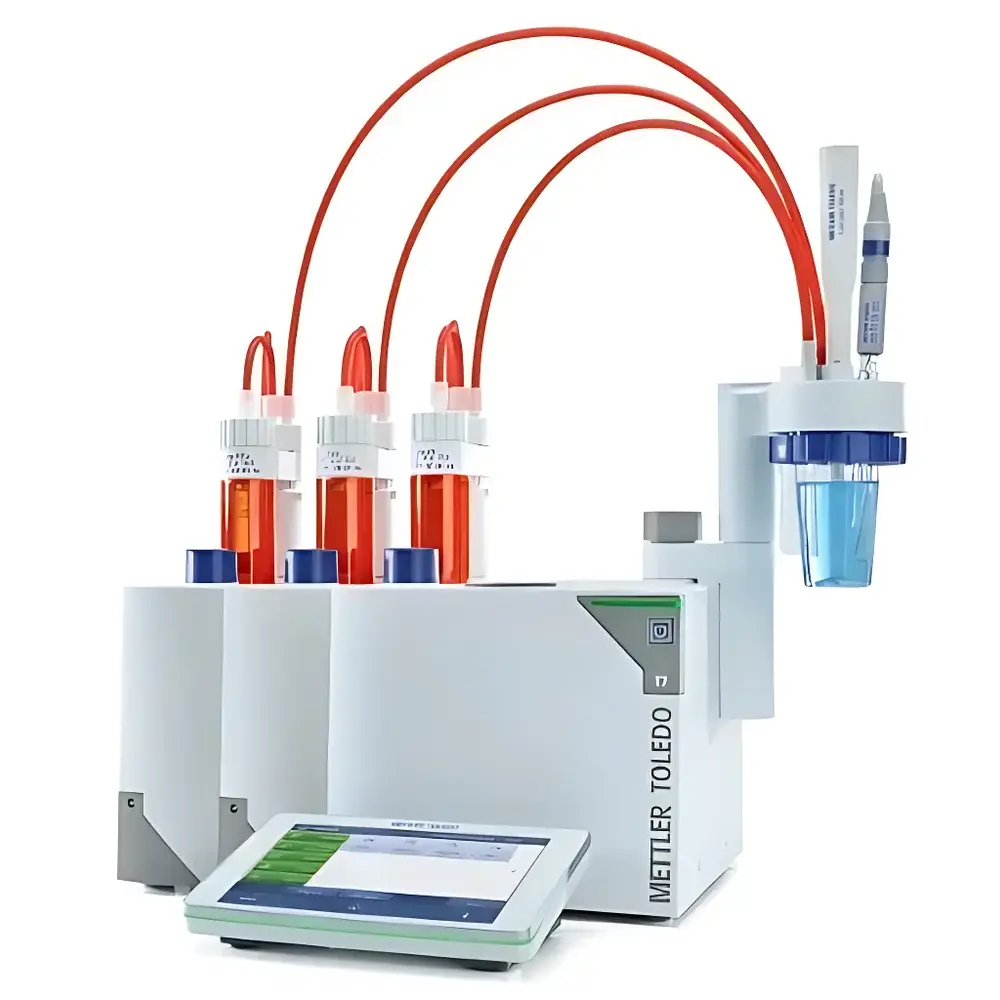
METTLER TOLEDO Potentiometric Titrator Preventive Maintenance & Calibration Service
| Brand | METTLER TOLEDO |
|---|---|
| Origin | Switzerland |
| Manufacturer Type | Authorized Distributor |
| Product Category | Imported Instrument |
| Model | Universal |
| Instrument Type | Universal Automatic Potentiometric Titrator |
| Application Scope | General-purpose Titration |
Overview
The METTLER TOLEDO Potentiometric Titrator Preventive Maintenance & Calibration Service is a comprehensive, traceable, and standards-aligned technical support program designed for laboratories operating automatic potentiometric titrators in regulated and non-regulated environments. Built upon the fundamental principle of potentiometric endpoint detection—where the potential difference between a reference electrode and an indicator electrode is monitored continuously during titration—the service ensures that instrument performance remains within validated operational boundaries. This is critical for applications governed by pharmacopeial methods (e.g., USP , EP 2.2.20), ISO/IEC 17025-accredited testing, or internal quality control protocols requiring documented metrological integrity. Unlike reactive repair, this service adopts a proactive lifecycle management approach: it systematically verifies mechanical actuation accuracy (burette piston displacement, dosing repeatability), electrochemical signal fidelity (electrode response time, asymmetry potential, high-impedance input stability), and fluidic path integrity (leak-tightness, valve switching consistency, tubing elasticity). All procedures follow METTLER TOLEDO’s original equipment manufacturer (OEM) technical specifications and are executed exclusively by certified Field Service Engineers trained on the full DV/AT/GX series platforms.
Key Features
- Traceable calibration of three core subsystems: burette drive mechanism (volumetric accuracy per ISO 8655-3), analog signal board (input impedance ≥1012 Ω, noise floor ≤1 µV RMS), and reference/indicator electrode interface (asymmetry potential ≤±30 mV, response time <15 s for 95% step change)
- Preventive cleaning protocol compliant with ICH Q7 Annex 11 and FDA 21 CFR Part 11 requirements—including solvent residue verification and electrode hydration state assessment
- Wear-part inspection and replacement guidance for critical consumables: silicone tubing (per ASTM D2000 classification), glass burettes (Class A volumetric tolerance), and Ag/AgCl reference junctions
- Full audit trail generation: each service event produces a PDF-certified report containing pre-service baseline data, post-service verification results, calibration certificates (traceable to NIST or PTB standards), and technician signature with service ID
- Integration-ready documentation: reports include machine-readable metadata (XML export option) for LIMS or ELN ingestion, supporting GLP/GMP electronic record retention policies
Sample Compatibility & Compliance
This service applies to all METTLER TOLEDO universal automatic potentiometric titrators (including AT-series, DL-series, and newer GX-platform instruments) used across aqueous, non-aqueous, and mixed-solvent titration matrices—including acid-base, redox, precipitation, and complexometric determinations. It fully supports compliance with international regulatory frameworks: ISO/IEC 17025:2017 Clause 6.4 (equipment verification), USP Analytical Instrument Qualification, and EU GMP Annex 15. Electrode conditioning protocols align with IUPAC Technical Report on pH and Ion-Selective Electrodes (Pure Appl. Chem., 2011, 83, 2023–2037). Burette calibration adheres to ISO 8655-3 for piston burettes, with volumetric error limits verified at 10%, 50%, and 100% nominal capacity.
Software & Data Management
All maintenance and calibration activities are logged within METTLER TOLEDO LabX™ software (v3.10+), enabling automated service scheduling, predictive alerting for upcoming calibration due dates, and secure electronic signature capture. The service report integrates directly into LabX’s instrument history module, preserving full chain-of-custody for audit readiness. For labs operating under 21 CFR Part 11, the service includes validation of electronic records—ensuring audit trail integrity, user authentication, and tamper-evident digital signatures. Optional add-ons include remote diagnostics via Secure Remote Access (SRA) and integration with enterprise CMMS systems using RESTful API endpoints.
Applications
This service underpins analytical reliability in diverse use cases: pharmaceutical assay validation (e.g., active pharmaceutical ingredient quantification per USP monographs), food acidity determination (AOAC 941.15), water hardness analysis (ISO 6059), biodiesel titration (ASTM D664), and polymer carboxyl content measurement (ISO 10363). It is especially critical when titrating low-conductivity solvents (e.g., glacial acetic acid), high-viscosity samples (e.g., edible oils), or unstable reagents (e.g., silver nitrate solutions prone to photolytic decomposition), where subtle mechanical drift or electrode polarization can introduce systematic bias exceeding ±0.2% relative error.
FAQ
How often should preventive maintenance be scheduled for a METTLER TOLEDO potentiometric titrator?
For routine QC/QA labs operating 8 hours/day, 5 days/week, annual maintenance is recommended; high-throughput or GMP environments require biannual servicing. Frequency may increase based on usage intensity, reagent aggressiveness (e.g., concentrated NaOH), or environmental conditions (humidity >60% RH).
Does the service include replacement of consumables such as electrodes or tubing?
Standard service covers inspection and functional verification. Electrodes, burette tips, and tubing are classified as wear parts and are available separately under METTLER TOLEDO’s Genuine Parts Program—with batch-specific certificates of conformance and shelf-life tracking.
Can calibration be performed without interrupting laboratory operations?
Yes. Our engineers deploy rapid-validation protocols (<90 min downtime) using in-situ reference standards and parallel sample spiking, minimizing workflow disruption while maintaining data continuity.






