
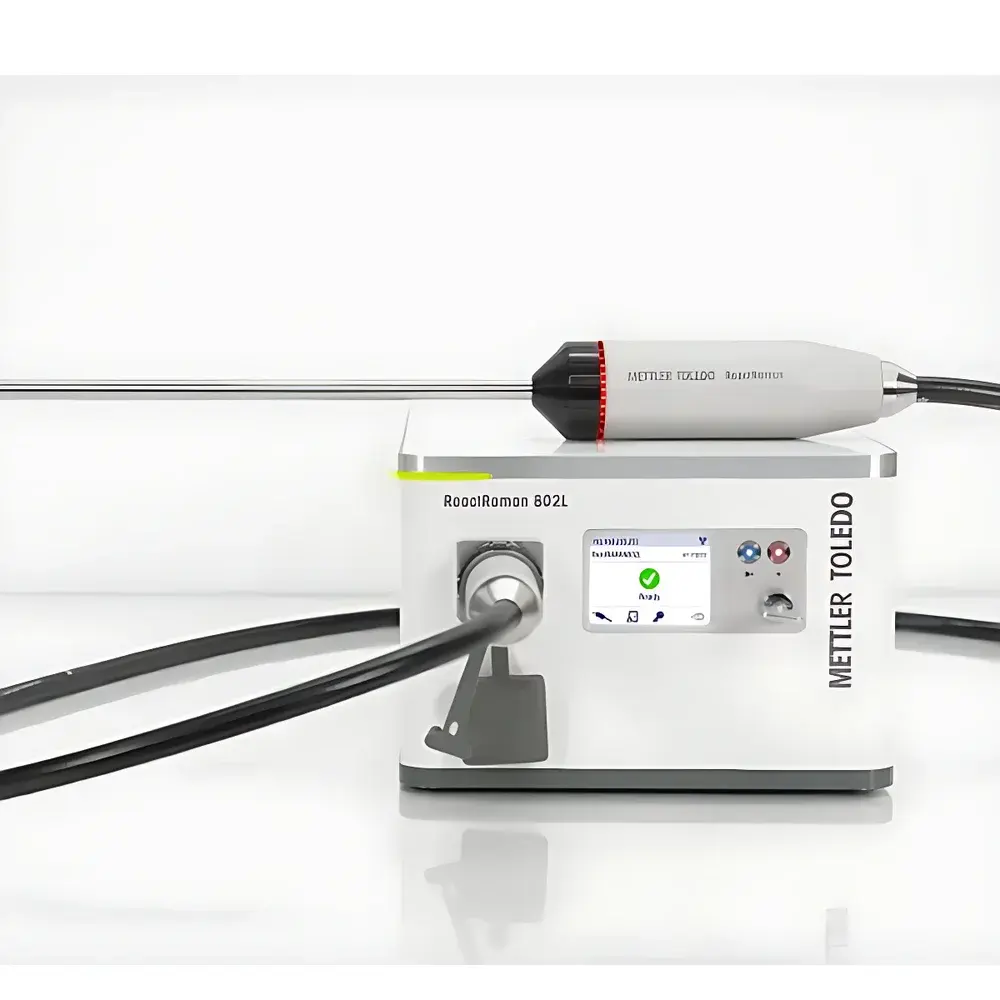
METTLER TOLEDO ReactRaman 802L In-line Raman Spectrometer
| Brand | METTLER TOLEDO |
|---|---|
| Origin | USA |
| Manufacturer Type | Authorized Distributor |
| Origin Category | Imported |
| Model | ReactRaman 802L |
| Instrument Type | Fourier Transform Raman Spectrometer |
| Spectral Range | 150–3400 cm⁻¹ |
| Spectral Resolution | 6 cm⁻¹ |
| Spatial Resolution | 2 µm |
| Minimum Wavenumber | 50 cm⁻¹ |
| Spectral Repeatability | ±0.2 cm⁻¹ |
Overview
The METTLER TOLEDO ReactRaman 802L is a high-performance, probe-based in-line Raman spectrometer engineered for real-time, non-invasive molecular monitoring of chemical reactions and crystallization processes in research, development, and pilot-scale environments. Unlike dispersive Raman systems, the ReactRaman 802L employs a robust Fourier transform (FT) architecture optimized for stability, signal-to-noise ratio, and long-term spectral fidelity under dynamic process conditions. Its core measurement principle relies on inelastic scattering of monochromatic laser light (typically 785 nm), enabling label-free identification and quantification of chemical species based on vibrational fingerprint spectra. Designed specifically for process analytical technology (PAT) implementation, the instrument delivers reproducible, calibration-ready spectra directly from reactors, flow cells, or crystallizers—without sample extraction or dilution—supporting ICH Q8/Q9/Q10 and FDA PAT guidance frameworks.
Key Features
- Compact, thermally stabilized FT-Raman platform with integrated fiber-optic probe interface for flexible deployment in fume hoods, gloveboxes, or reactor manifolds.
- High-fidelity spectral acquisition across 150–3400 cm⁻¹ with ≤6 cm⁻¹ resolution and ±0.2 cm⁻¹ wavenumber repeatability—validated per ASTM E1840 and ISO/IEC 17025 traceable protocols.
- Sub-micron spatial resolution (2 µm) enabled by precision optical coupling and confocal probe design, supporting localized analysis in heterogeneous slurries and multiphase reaction mixtures.
- Low-frequency capability down to 50 cm⁻¹—critical for detecting lattice modes, polymorphic transitions, and metal–ligand vibrations in catalytic and pharmaceutical systems.
- Hardware-level synchronization with METTLER TOLEDO’s iC software ecosystem, ensuring time-aligned data capture across ReactIR™, Easy Max®, and automated reactor platforms.
Sample Compatibility & Compliance
The ReactRaman 802L supports direct in situ interrogation of liquid, slurry, suspension, and semi-solid samples in glass, quartz, or sapphire vessels (compatible with standard 1/4″ or 3/8″ probe ports). It operates effectively in corrosive, high-pressure (up to 10 bar), and temperature-controlled environments (−10 to 150 °C) when paired with appropriate probe housings. All optical components comply with IEC 61000-6-3 (EMC) and IEC 60825-1 (laser safety Class 1). Data integrity meets FDA 21 CFR Part 11 requirements via iC Raman 8.0’s audit-trail-enabled user management, electronic signatures, and secure data archiving—fully aligned with GLP and GMP documentation standards.
Software & Data Management
Powered by iC Raman 8.0, the ReactRaman 802L provides a validated, workflow-driven environment for method development, multivariate calibration (PLS, PCA), and real-time trend visualization. The One Click Analytics™ engine enables rapid conversion of raw spectra into concentration profiles, phase transition markers, or kinetic rate constants using pre-built or user-defined chemometric models. Integrated correlation tables link spectral features directly to stoichiometric events, facilitating mechanistic interpretation without manual peak assignment. Raw and processed data are stored in vendor-neutral HDF5 format, supporting interoperability with third-party analytics tools (e.g., MATLAB, Python scikit-learn) and enterprise LIMS/MES systems via OPC UA and RESTful API interfaces.
Applications
- Real-time tracking of reaction progress in API synthesis—including nucleophilic substitution, hydrogenation, and condensation reactions.
- In situ monitoring of polymorphic form selection, solvate desolvation, and amorphous-to-crystalline transitions during antisolvent crystallization.
- Quantitative analysis of impurity formation, residual solvent content, and catalyst speciation in batch and continuous flow reactors.
- Support for Quality by Design (QbD) initiatives through Design of Experiments (DoE)-driven spectral model generation and critical process parameter (CPP) mapping.
- Method transfer between lab-scale ReactRaman 802L and production-grade in-line Raman systems (e.g., METTLER TOLEDO’s RM5) with minimal revalidation effort.
FAQ
Is the ReactRaman 802L compatible with non-METTLER TOLEDO reactor systems?
Yes—it supports standard fiber-optic coupling (SMA 905) and can be integrated with third-party reactors via custom probe mounts and analog/digital I/O modules.
Does the system require routine wavelength calibration with external standards?
No—its internal reference laser and thermal stabilization eliminate the need for daily recalibration; a single annual verification against NIST-traceable polystyrene standard is recommended.
Can iC Raman 8.0 models be exported for use on standalone analysis workstations?
Yes—calibration models and processing workflows are fully portable and retain full audit trail functionality when deployed on validated client machines.
What laser safety class applies during in situ operation?
The system operates as a Class 1 device under all normal operating conditions, including probe insertion and continuous measurement, per IEC 60825-1:2014.
How is data integrity maintained during extended unattended runs (e.g., overnight crystallizations)?
Continuous checksum validation, automatic file rotation, and redundant storage (local SSD + network backup) ensure zero data loss over multi-day acquisitions.
Related Products





