
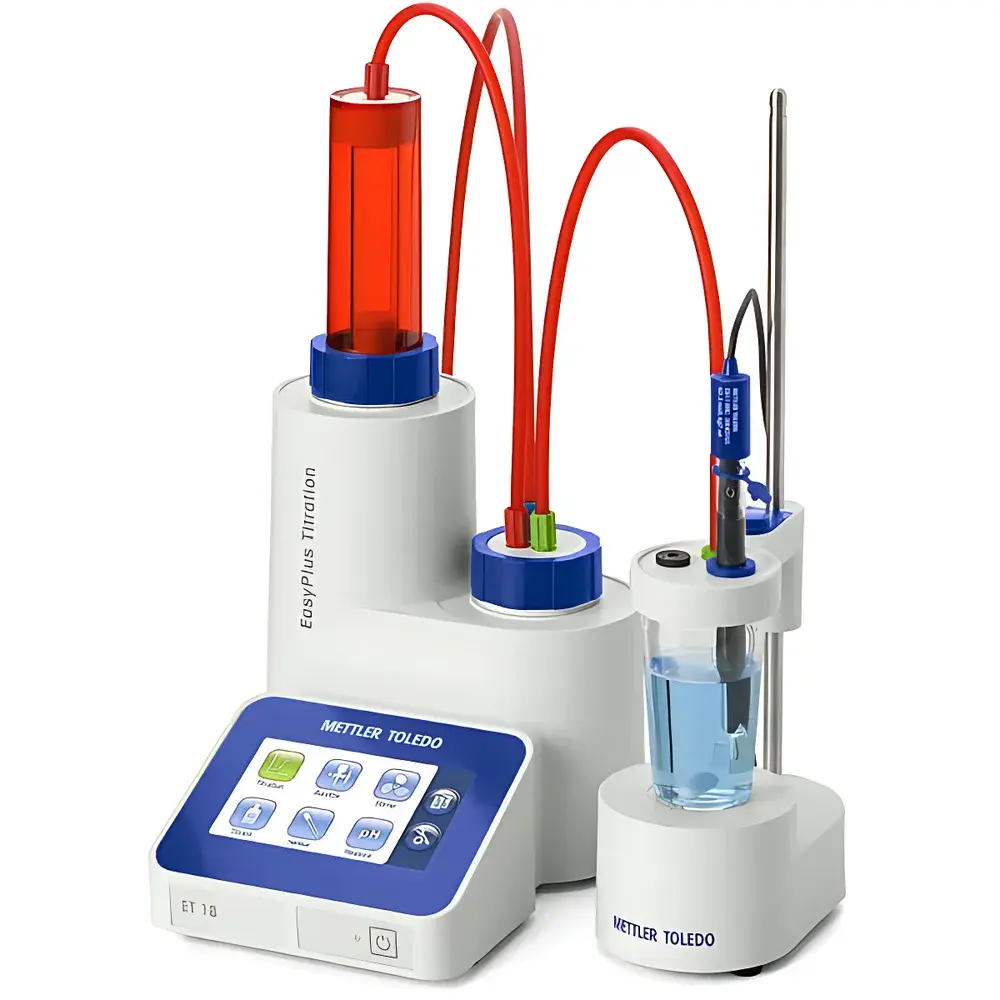
METTLER TOLEDO ET Series EasyDrop Automatic Potentiometric Titrator
| Brand | METTLER TOLEDO |
|---|---|
| Origin | Switzerland |
| Model | ET Series (ET08/ET12/ET15/ET18/ET28/ET38/ET58) |
| Type | Benchtop Automatic Potentiometric Titrator |
| Compliance | Designed for GLP/GMP-aligned workflows |
| Software Interface | EasyDirect™ (PC-based), iTitrat™ intelligent calculation engine |
| Titration Drive Resolution | 12,000 steps per full stroke |
| Display | Capacitive touchscreen interface |
| Liquid Handling | Motorized burette with programmable dosing modes (fixed-volume dispensing, manual titration assist, auto-titration) |
Overview
The METTLER TOLEDO ET Series EasyDrop Automatic Potentiometric Titrator is a modular, benchtop electrochemical analysis platform engineered for precision, reproducibility, and operational simplicity in routine potentiometric titration workflows. Based on the fundamental principle of potentiometric endpoint detection—measuring the potential difference between a reference electrode and an indicator electrode as titrant is incrementally added—the ET Series supports acid-base, redox, precipitation, complexometric, and Karl Fischer volumetric titrations. Its architecture integrates a high-resolution motorized burette (12,000-step actuation), low-drift pH/mV sensing circuitry, and real-time potential monitoring to ensure robust endpoint recognition under varying sample matrices. Designed and manufactured in Switzerland, the system complies with core metrological requirements for traceable volumetric analysis and aligns with ISO 8655-3 (burette accuracy), ASTM E2081 (standard practice for potentiometric titration), and USP (volumetric apparatus calibration). The ET Series serves laboratories requiring audit-ready documentation, operator-independent result consistency, and seamless integration into regulated quality control environments.
Key Features
- Modular configuration across seven models (ET08 to ET58), enabling scalable deployment—from basic fixed-volume dispensing (ET12) to fully automated multi-method titration (ET38/ET58)
- Capacitive touchscreen interface with intuitive icon-driven navigation; no keyboard or mouse required; supports multilingual UI (English, German, French, Chinese, Japanese)
- iTitrat™ intelligent calculation engine: automatically applies pre-validated formulas upon unit selection (e.g., % w/w, mmol/g, mg KOH/g), eliminating manual post-processing errors
- Motorized burette with 12,000-step resolution ensures sub-microliter dosing precision and repeatability ≤ ±0.2% RSD for 1 mL dispense
- Dual-mode operation: supports both guided manual titration (ET15 with real-time pH feedback and over-titration warning) and unattended automatic titration with customizable equivalence point algorithms (1st/2nd derivative, fixed potential, Gran plot)
- Integrated electrode holder with automatic rinsing port and optional temperature probe input (Pt1000) for temperature-compensated titration
Sample Compatibility & Compliance
The ET Series accommodates aqueous and non-aqueous samples across pH 0–14 and mV ranges from –2000 to +2000 mV. It accepts standard double-junction pH electrodes, redox electrodes (Pt, Ag/AgCl), ion-selective electrodes (e.g., Cl⁻, F⁻, CN⁻), and Karl Fischer reagent-compatible cells. All models meet IEC 61010-1 safety standards for laboratory electrical equipment. Data integrity is supported through configurable user access levels (administrator/operator/visitor), electronic signature capability, and audit trail logging compliant with FDA 21 CFR Part 11 requirements when used with EasyDirect™ software. System validation templates (IQ/OQ/PQ) are available for GxP-regulated environments including pharmaceutical QC, food safety testing, and environmental compliance labs.
Software & Data Management
EasyDirect™ software (Windows-based, license-free) provides centralized method management, instrument control, real-time data visualization, and PDF report generation with embedded metadata (operator ID, timestamp, method version, raw curve data). Reports include titration curves, equivalence point tables, statistical summaries (mean, SD, RSD), and pass/fail criteria against predefined specification limits. All measurement data—including raw mV/pH values, dosing volume logs, and electrode diagnostics—are stored in encrypted SQLite databases with immutable timestamps. Backup and export support CSV, XML, and LIMS-compatible ASTM E1384 formats. Audit trails record every parameter change, method execution, and user login event with tamper-proof hashing.
Applications
- Pharmaceutical: assay of active ingredients (e.g., amine content in APIs via acid-base titration), residual chloride quantification in excipients, water content by Karl Fischer
- Food & Beverage: acidity (titratable acidity in wines, dairy), salt content (argentometric titration), vitamin C (ascorbic acid via redox)
- Chemical Manufacturing: acid number/base number in lubricants and fuels (ASTM D974/D664), free fatty acid in biodiesel (EN 14104)
- Environmental: alkalinity and hardness in wastewater, cyanide in industrial effluents (ISO 6703-1), fluoride in drinking water (ISO 10359-1)
- Academic Research: teaching labs benefit from guided manual titration mode (ET15) with immediate visual feedback; research groups utilize custom method scripting for kinetic or multi-step titrations
FAQ
What titration methods are pre-programmed in the ET Series?
The system includes factory-loaded methods for common applications: strong acid–strong base, weak acid–strong base, precipitation (AgNO₃ vs Cl⁻), redox (KMnO₄ vs Fe²⁺), and Karl Fischer volumetric water determination. Users may modify parameters or create new methods using the built-in editor.
Can the ET Series connect to a LIMS?
Yes—via EasyDirect™ software exporting structured data in ASTM E1384-compliant format or through OPC UA interface (optional hardware module) for direct LIMS integration.
Is temperature compensation supported during titration?
Temperature input is accepted via Pt1000 probe (optional accessory); all calculations—including pKa correction and volume expansion correction—can be enabled in method settings.
How is data security ensured for regulated environments?
Role-based access control, electronic signatures, time-stamped audit trails, and encrypted local database storage satisfy core requirements of FDA 21 CFR Part 11 and EU Annex 11 for electronic records and signatures.
What maintenance is required for long-term reliability?
Routine verification includes burette calibration (using certified weights and water density tables), electrode performance checks (asymmetric potential, response time), and periodic firmware updates distributed through METTLER TOLEDO’s validated release channel.
Related Products






