
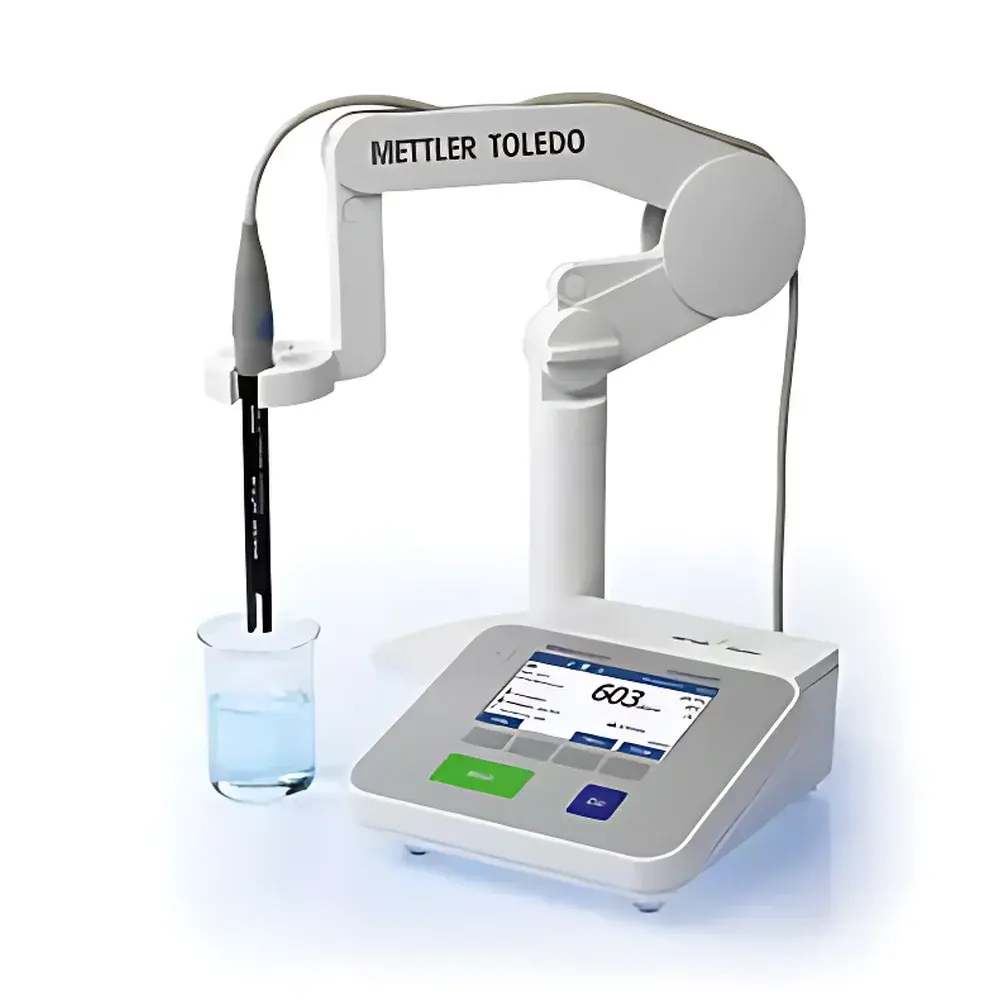
METTLER TOLEDO SevenCompact™ S230 Conductivity Meter, Salinity and TDS Analyzer
| Brand | METTLER TOLEDO |
|---|---|
| Model | SevenCompact™ S230 |
| Measurement Range | 0.001 µS/cm to 1000 mS/cm |
| Conductivity Accuracy | ±0.5% |
| TDS Range | 0.00 mg/L to 1000 g/L |
| Salinity Range | 0.00–80.0 psu |
| Resistivity Range | 0.00–100.0 MΩ·cm |
| Ash Conductivity (Conductivity Ash) | 0.000–2022% |
| Temperature Compensation | Automatic (ATC) or Manual (MTC), -5.0 to 130.0 °C (ATC), -30.0 to 130.0 °C (MTC) |
| Resolution | Auto-variable from 0.001 µS/cm to 1 mS/cm |
| Data Storage | 1000 GLP-compliant entries |
| IP Rating | IP54 |
| Connectivity | RS232, USB-A (for printer, flash drive, keyboard, barcode scanner, stirrer), USB-B (for PC) |
| Compliance | Supports FDA 21 CFR Part 11 audit trail via LabX Direct software (optional) |
Overview
The METTLER TOLEDO SevenCompact™ S230 is a high-precision benchtop conductivity meter engineered for rigorous electrochemical analysis in regulated and research-intensive laboratory environments. It operates on the principle of two-electrode or four-electrode AC conductivity measurement—applying a known alternating current across a defined cell geometry and calculating conductance based on Ohm’s law (G = I/V), then converting to conductivity (κ) using the cell constant (κ = G × K). This methodology ensures stable, temperature-compensated readings across an exceptionally wide dynamic range—from ultrapure water (0.001 µS/cm) to saturated brines (1000 mS/cm). Designed as part of the SevenCompact™ platform, the S230 integrates seamlessly with the S220 pH/ion meter, sharing identical hardware architecture, user interface logic, and data governance infrastructure. Its core application scope includes conductivity profiling in pharmaceutical water systems (PW, WFI per USP ), salinity validation in marine biology and aquaculture, TDS quantification in beverage formulation, and resistivity monitoring in semiconductor rinse processes.
Key Features
- 7-inch full-color capacitive touchscreen with 10-language support (including English, German, French, Chinese, Japanese), featuring intuitive icon-driven navigation and context-sensitive soft keys.
- Dual display modes: Standard View (full parameter dashboard) and uFocus™ Mode (minimalist layout showing only active measurement, unit, stability indicator, and temperature)—enabling rapid visual verification during high-throughput workflows.
- uPlace™ ergonomic electrode holder with vertical linear motion mechanism—designed to eliminate lateral torque on sensor shafts, prevent sample container displacement, and reduce operator-induced measurement variability.
- Intelligent Sensor Management (ISM®) technology: auto-detects electrode type and serial number; logs calibration history, sensor age, and usage cycles; enforces calibration due dates and alerts upon drift exceeding user-defined thresholds.
- Three endpoint detection modes: manual hold, automatic stabilization (±0.1 µS/cm for 3 s), and timed acquisition (1–120 s); combined with automatic standard recognition (ASTM D1125, ISO 7888 compliant solutions).
- Configurable security framework: role-based password protection (operator, supervisor, administrator), GLP-compliant electronic signature prompts, and editable measurement limits with audible/visual alarms.
Sample Compatibility & Compliance
The S230 accommodates standard DIN/ISO conductivity cells (e.g., 2-pole stainless steel, graphite, platinum, or titanium electrodes) with cell constants from 0.01 to 10 cm⁻¹. It supports direct immersion in aqueous liquids, slurries (with optional flow-through cells), and non-aqueous solvents when paired with appropriate chemically resistant sensors. All measurements adhere to internationally recognized standards: conductivity per ISO 7888 and ASTM D1125; salinity per UNESCO Practical Salinity Scale (PSS-78); TDS calculation per EPA 120.1 algorithm (NaCl equivalence); and resistivity per ASTM D1125 Annex A1. The instrument’s firmware and data handling architecture are validated for compliance with EU Annex 11, USP , and FDA 21 CFR Part 11 when used with LabX Direct software and enabled audit-trail configuration.
Software & Data Management
Internal storage retains up to 1000 fully timestamped, user-annotated measurement records—including raw conductance values, compensated conductivity, temperature, electrode ID, calibration parameters, and operator ID. Data export is supported via USB flash drive in CSV or PDF format (with embedded metadata). For centralized control, the S230 connects to LabX Direct software (Windows-based) over USB-B or RS232, enabling automated data capture, statistical process control (SPC) charting, multi-instrument synchronization, and electronic batch record generation. LabX Direct provides full 21 CFR Part 11 compliance: electronic signatures with biometric or token-based authentication, immutable audit trails, and configurable retention policies aligned with ALCOA+ principles (Attributable, Legible, Contemporaneous, Original, Accurate, Complete, Consistent, Enduring, Available).
Applications
- Pharmaceutical & Biotechnology: Conductivity verification of Purified Water (PW) and Water for Injection (WFI) per USP ; cleaning validation rinse water monitoring; buffer conductivity profiling in downstream purification.
- Food & Beverage: Salt content verification in sauces, dairy products, and processed meats; TDS consistency checks in carbonated beverages and bottled water; brine concentration control in fermentation tanks.
- Chemical & Petrochemical: Electrolyte concentration tracking in catalyst regeneration loops; corrosion inhibitor efficacy assessment via solution resistivity; wastewater salinity screening prior to biological treatment.
- Academic & Research Laboratories: Teaching electrochemistry fundamentals (Kohlrausch’s law, molar conductivity); environmental water quality studies (estuarine mixing zone characterization); battery electrolyte development (Li-ion, Na-ion conductivity mapping).
FAQ
Does the S230 support four-electrode conductivity measurement?
Yes—the instrument automatically detects and configures for both two-electrode and four-electrode sensor inputs, eliminating polarization errors in high-conductivity or fouling-prone samples.
Can calibration data be transferred between S220 and S230 units?
No—calibration profiles are device-specific and stored locally; however, ISM-enabled electrodes retain their own calibration history and can be migrated across compatible SevenSeries instruments.
Is IQ/OQ documentation available for the S230?
Yes—METTLER TOLEDO provides factory-verified Installation Qualification (IQ) and Operational Qualification (OQ) protocols, including test scripts, acceptance criteria, and execution templates compliant with GAMP5 guidelines.
What temperature compensation algorithms are implemented?
Linear, non-linear (CaCl₂, NaCl, KCl), and custom polynomial models—user-selectable per measurement method to match matrix-specific thermal response behavior.
How is data integrity ensured during power interruption?
All measurements are written to non-volatile memory before display update; unsaved data is retained through brownout events, and the system performs automatic self-diagnostic on reboot.






