
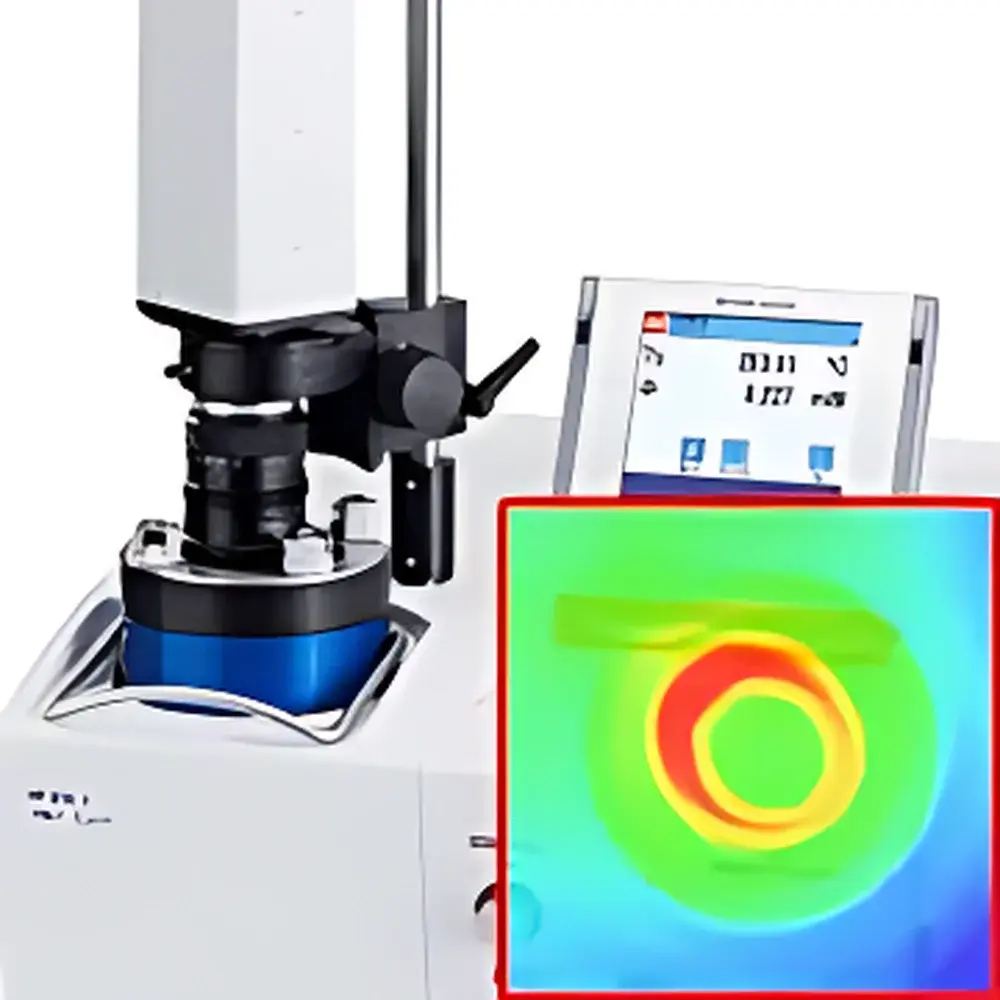
METTLER TOLEDO UV-DSC1 Photo-Calorimetric Differential Scanning Calorimeter
| Brand | METTLER TOLEDO |
|---|---|
| Origin | Switzerland |
| Model | UV-DSC1 |
| Temperature Range | −150 to 700 °C |
| Temperature Accuracy | ±0.1 °C |
| Heating Rate | 0.02–300 °C/min |
| Heat Flow Sensitivity | 0.04 µW (FRS5 sensor) / 0.01 µW (HSS8 sensor) |
| UV Wavelength Range | 240–400 nm (optional extension to 400–700 nm, visible) |
| UV Irradiance | 4500 mW/cm² (at 365 nm) |
Overview
The METTLER TOLEDO UV-DSC1 is a fully integrated photo-calorimetric differential scanning calorimeter engineered for quantitative thermodynamic characterization of light-induced processes under controlled thermal and photonic stimuli. It combines the high-precision DSC1 or DSC82x platform with a modular, fiber-coupled UV–vis irradiation system, enabling simultaneous real-time measurement of heat flow and photochemical energy input. Unlike conventional DSC systems, the UV-DSC1 operates on a dual-stimulus principle: thermal ramping or isothermal holds are executed while delivering calibrated, collimated UV or visible radiation directly onto the sample pan via quartz optical path. This architecture allows direct quantification of enthalpy changes associated with photopolymerization, photodegradation, photo-crosslinking, and photostabilizer activation—providing fundamental kinetic and thermodynamic parameters including reaction onset temperature under irradiation, photoreaction enthalpy (ΔHphoto), and photon efficiency (J/mol photons). The instrument is designed for compliance with ISO 11357-1/2/7, ASTM E1269, and ICH Q5C stability testing guidelines, supporting GLP/GMP-aligned workflows in regulated environments.
Key Features
- Modular photo-DSC architecture: seamless integration of UV–vis irradiation module with DSC1 or DSC82x base units—no hardware modification required for field upgrade.
- High-intensity, spectrally defined UV source: narrow-band LED or mercury-xenon lamp options with selectable wavelengths (240–400 nm standard; 400–700 nm optional), calibrated irradiance up to 4500 mW/cm² at 365 nm.
- Real-time synchronized data acquisition: independent, time-aligned logging of heat flow (µW), temperature (°C), UV dose (J/cm²), and irradiance (mW/cm²) at 10 Hz sampling rate.
- Advanced thermal control: active furnace with 0.02–300 °C/min programmable heating/cooling rates and ±0.1 °C absolute temperature accuracy across −150 to 700 °C range.
- Dual-sensor calorimetry: interchangeable FRS5 (0.04 µW sensitivity) and HSS8 (0.01 µW sensitivity) sensors for broad dynamic range—from low-energy photostabilizer screening to high-enthalpy cationic polymerizations.
- Optimized sample environment: hermetically sealed, purge-gas-compatible (N₂, air, O₂) DSC pans with UV-transparent quartz lids and integrated temperature calibration reference wires.
Sample Compatibility & Compliance
The UV-DSC1 accommodates standard 40 µL aluminum, gold-plated, or high-transmission quartz crucibles (diameter: 6 mm), compatible with solid films, powders, viscous resins, and thin-film coatings up to 20 mg mass. Liquid samples require sealed, optically clear pans with minimal path-length distortion. All UV exposure protocols adhere to ISO 4892-3 (UV exposure of plastics) and ASTM G154 (fluorescent UV exposure apparatus). Data integrity meets FDA 21 CFR Part 11 requirements through audit-trail-enabled software with electronic signatures, role-based access control, and immutable raw-data archiving. System validation documentation supports IQ/OQ/PQ execution per GAMP 5 guidelines.
Software & Data Management
Thermal Analysis Software STARe (v18.x or later) provides dedicated UV-DSC experiment templates—including isothermal irradiation, temperature-ramped photopolymerization, and multi-step light/dark cycling. Built-in photo-kinetic modeling tools enable fitting of autocatalytic, nth-order, or diffusion-controlled photoreaction models to extracted ΔH(t) curves. Raw heat flow and irradiance traces are exportable in ASCII (.txt) or HDF5 format for third-party analysis (e.g., MATLAB, Python SciPy). All measurement metadata—including lamp age, filter transmission history, and calibration certificate IDs—are embedded in each data file. Cloud-synced project repositories support cross-site collaboration with version-controlled experiment logs.
Applications
- Photocurable resin development: quantifying gel point temperature under UV, measuring conversion-dependent enthalpy release, and optimizing post-cure thermal profiles.
- UV stabilizer efficacy testing: evaluating HALS and benzotriazole performance via accelerated photodegradation enthalpy shifts under controlled irradiance gradients.
- Electronics encapsulant qualification: assessing photo-induced exotherms in diepoxies during LED packaging cure cycles and correlating with post-cure glass transition shifts.
- Pharmaceutical photosafety assessment: detecting unintended photoreactivity in APIs and excipients per ICH Q5C, including identification of photo-oxidation enthalpies below 10 µW detection threshold.
- Food packaging polymer aging: monitoring UV-triggered chain scission enthalpies in PET and polyolefin laminates under simulated shelf-life irradiation conditions.
FAQ
Can the UV-DSC1 operate without UV irradiation?
Yes—the system functions as a full-featured standalone DSC1 or DSC82x instrument when the optical module is disconnected or deactivated.
Is spectral irradiance uniformity validated across the sample area?
Yes—each UV module undergoes NIST-traceable spatial mapping using a calibrated CCD radiometer; uniformity exceeds ±3% over the central 3 mm diameter.
How is UV dose accuracy maintained over lamp lifetime?
Integrated real-time photodiode monitoring corrects for lamp intensity drift; users perform quarterly recalibration using a certified reference radiometer.
Does the system support inert atmosphere during UV exposure?
Yes—standard gas purging (N₂, Ar, synthetic air) is fully compatible with UV irradiation; quartz window transmission remains >92% down to 240 nm under dry nitrogen.
Are application-specific method templates available?
METTLER TOLEDO provides validated SOP packages for photopolymer cure optimization (ASTM D7028), UV stabilizer screening (ISO 4892-3), and pharmaceutical photosafety (ICH Q5C Annex II).



