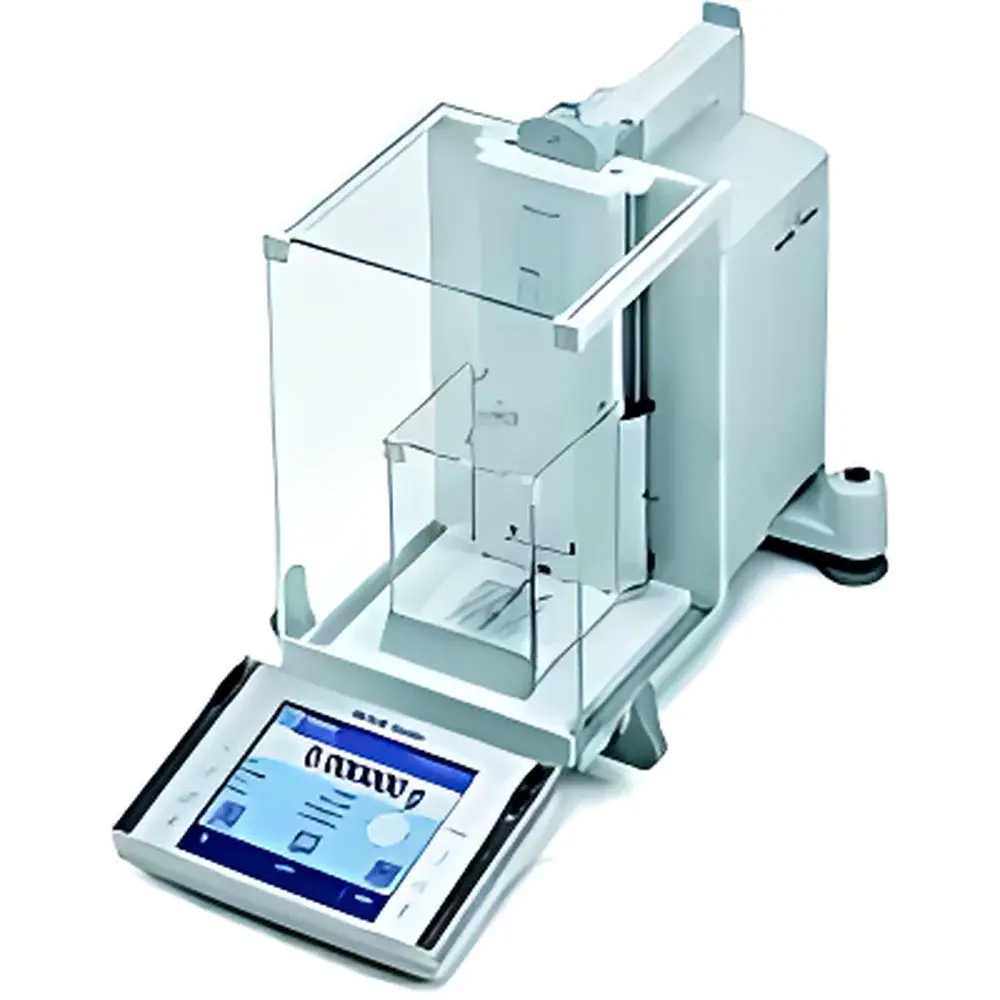
METTLER TOLEDO XP Micro Balance
| Brand | METTLER TOLEDO |
|---|---|
| Origin | Switzerland |
| Model | XP Micro Balance |
| Readability | down to 0.001 mg |
| Repeatability (sd) | as low as 0.002 mg |
| Linearity error | ≤ 0.006 mg |
| Typical stabilization time | 3.5 s |
| Pan dimensions | 40 × 40 mm |
| Compliance | GWP® Excellence, USP <41>/<1251>, ISO/IEC 17025, GLP/GMP-ready |
Overview
The METTLER TOLEDO XP Micro Balance is an ultra-high-precision analytical instrument engineered for trace-level mass determination in regulated laboratory environments. Operating on electromagnetic force compensation (EMFC) principle, it delivers sub-milligram resolution and exceptional long-term stability under variable ambient conditions. Designed and manufactured in Switzerland, the XP series integrates a physically separated weighing cell and control unit — a structural innovation that isolates thermal drift from electronics, thereby preserving metrological integrity during extended measurement cycles. Its core architecture conforms to fundamental metrological requirements defined in OIML R 76 and EU Directive 2014/31/EU for non-automatic weighing instruments. The balance is intended for use in quality control laboratories, pharmaceutical development, reference material certification, and advanced materials research where uncertainty budgets must meet stringent ISO/IEC 17025 criteria.
Key Features
- Physically decoupled weighing cell and display/control unit to eliminate thermal interference from electronic components
- BalanceCheck™ function: automated prompts for external calibration using certified weights, supporting traceable verification per ISO 9001 and ISO/IEC 17025 workflows
- GWP® Excellence™ integrated risk-based monitoring system — continuously evaluates performance against predefined tolerances and alerts users when recalibration or maintenance is required
- Configurable weighing parameters (e.g., filter settings, draft shield sensitivity, auto-zero interval) to optimize performance across diverse environmental conditions (temperature gradients, air currents, vibration)
- Fully removable glass draft shield — both inner and outer panels are tool-free detachable for rapid cleaning and decontamination, essential for high-integrity applications such as cytotoxic compound handling or reference standard preparation
- Built-in application software suite including statistics, formulation, piece counting, percentage weighing, density determination, differential weighing, and quantitative dispensing support
- MinWeigh™ functionality with up to three independently configurable minimum weight thresholds aligned with USP , USP , and internal GMP/GLP policies — automatically flags weighings below validated lower limits
Sample Compatibility & Compliance
The XP Micro Balance accommodates a wide range of sample formats via standardized 40 × 40 mm weighing pans and optional accessories. Its modular design supports integration with ErgoClip Flask micro for secure positioning of vials and volumetric flasks during tare-and-add procedures, and MinWeigh Door micro for controlled sample introduction without opening the draft shield — minimizing airflow disturbance and accelerating stabilization. An optional integrated antistatic module mitigates electrostatic effects common in low-humidity environments or when handling insulating powders. Regulatory compliance extends across multiple frameworks: full alignment with FDA 21 CFR Part 11 requirements for electronic records and signatures (when used with LabX software), audit-trail enabled operation, and documented validation support packages compliant with Annex 11 and EU GMP guidelines.
Software & Data Management
When connected to METTLER TOLEDO’s LabX™ laboratory software, the XP Micro Balance enables centralized method management, role-based user access control, automatic data archiving, and seamless integration into LIMS or ERP systems. All weighing events — including calibration logs, MinWeigh status, BalanceCheck notifications, and user actions — are timestamped, digitally signed, and stored with full audit trail capability. Data export adheres to ASTM E2500-07 and ISO/IEC 17025 reporting standards, ensuring traceability from raw measurement to final certificate. Local operation retains full functionality without network dependency, maintaining continuity during IT infrastructure outages.
Applications
- Pharmaceutical dosage form development requiring accurate quantification of active pharmaceutical ingredients (APIs) at µg levels
- Certification of certified reference materials (CRMs) in national metrology institutes
- Gravimetric preparation of calibration standards for ICP-MS, LC-MS/MS, and elemental analysis
- Quality assurance testing of catalysts, nanomaterials, and specialty polymers
- Research involving isotopic labeling, radiopharmaceutical synthesis, and forensic trace evidence analysis
- Environmental testing labs performing ultra-trace heavy metal analysis by GF-AAS or HR-ICP-MS
FAQ
What does “DualRange (DR)” mean in XP26DR and XP56DR models?
DualRange technology provides two distinct readability modes within a single instrument — e.g., 0.002 mg for fast preliminary weighing and 0.001 mg for final high-accuracy determination — optimizing throughput without sacrificing metrological rigor.
Is the XP Micro Balance compliant with USP for minimum weight determination?
Yes — the MinWeigh™ function supports configuration of multiple minimum weight thresholds based on user-defined repeatability criteria and process risk assessments, fully satisfying USP statistical requirements.
Can the balance be validated according to GAMP 5 guidelines?
Absolutely — METTLER TOLEDO supplies IQ/OQ/PQ protocols, traceable calibration certificates, and risk assessment templates aligned with GAMP 5 and Annex 15 expectations.
Does the XP series support connection to third-party LIMS platforms?
Yes — via ASCII or XML output over RS232, USB, or Ethernet interfaces; LabX software also provides OPC UA and REST API connectivity for enterprise-level integration.
How often should BalanceCheck be performed?
Frequency depends on usage intensity and criticality of application — typically daily for GMP environments, but may be extended to weekly in research settings with stable environmental conditions and documented justification.