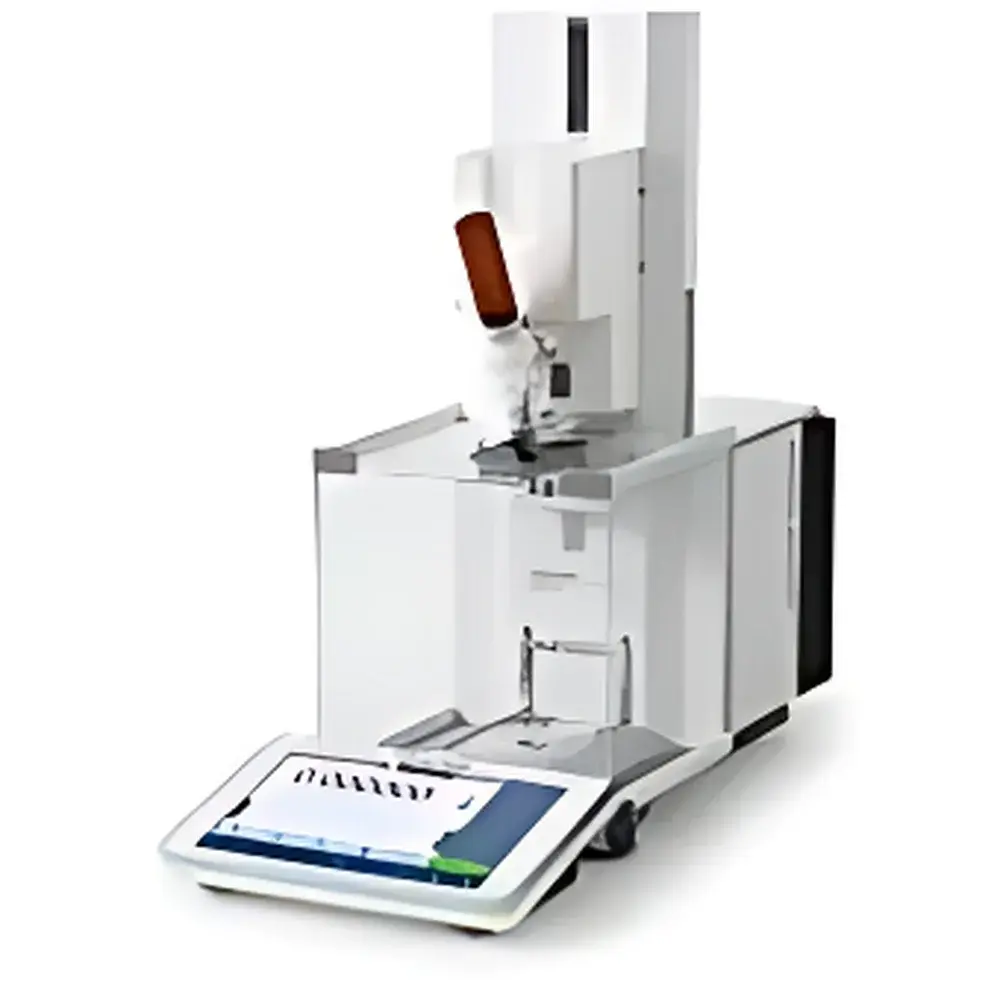
METTLER TOLEDO XPR Automatic Dispensing Balance
| Brand | METTLER TOLEDO |
|---|---|
| Origin | Switzerland |
| Model | XPR Automatic Dispensing Balance |
| Maximum Capacity | >5000 g |
| Readability | 2 µg |
| Accuracy Class | Class I (ISO 9001, ISO/IEC 17025 compliant) |
| Compliance | FDA 21 CFR Part 11 ready (with LabX), GLP/GMP traceable workflows |
| Software Integration | LabX® PC software (centralized instrument & user management, audit trail, electronic signatures) |
| Sample Handling | Integrated force compensation sensor, auto-tare on ultra-low-mass containers (down to 0.1 g tare), closed-loop dispensing control |
Overview
The METTLER TOLEDO XPR Automatic Dispensing Balance is a Class I precision weighing instrument engineered for high-accuracy mass-based dispensing in regulated and research-intensive laboratory environments. Unlike conventional analytical balances, the XPR integrates real-time force-compensation sensing, dynamic gravitational correction, and closed-loop feedback control to deliver true gravimetric dispensing — not volumetric approximation. Its core architecture employs electromagnetic force restoration (EMFR) technology with dual-range transducer design, enabling stable 2 µg readability across its full operational range (>5000 g capacity). This balance is purpose-built for applications where sample conservation, operator safety, regulatory compliance, and process reproducibility are non-negotiable — including reference standard preparation, pharmaceutical formulation development, catalyst dosing, and toxicology sample handling.
Key Features
- 2 µg readability with automatic calibration and drift compensation — maintained under variable environmental conditions via internal temperature and vibration monitoring
- Integrated dispensing module with motorized micro-dosing head, programmable dispensing speed, and adaptive flow control for powders, granules, and low-cohesion solids
- Zero-contact tare detection: built-in capacitive and load-cell hybrid sensing enables reliable auto-tare on containers as light as 0.1 g, eliminating manual tare errors and transfer losses
- Modular automation interface supporting up to 30-position auto-samplers (XSR/XPR series compatible), with mechanical alignment verification and container presence detection
- Full EMFR-based weighing engine certified to OIML R 76-1 and ASTM E898–22 for Class I performance; validated per USP and EP 2.1.6 for repeatability and eccentricity
- Ergonomic dispensing zone with anti-static enclosure (optional ionizer integration), HEPA-filtered exhaust path, and removable splash guard for containment of hazardous materials
Sample Compatibility & Compliance
The XPR Automatic Dispensing Balance accommodates a broad spectrum of sample types — from hygroscopic APIs and nanomaterials to pyrophoric catalysts and cytotoxic compounds — without compromising measurement integrity. Its sealed weighing chamber and optional glove-port integration support ISO Class 5 (Class 100) cleanroom operation. All dispensing sequences generate ALCOA+ compliant metadata: timestamp, operator ID, container ID, ambient T/RH logs, calibration status, and raw force-transducer output. When paired with LabX software, the system satisfies FDA 21 CFR Part 11 requirements through role-based access control, electronic signatures, immutable audit trails, and automated backup to networked SQL databases or validated LIMS/ELN platforms. Documentation meets ISO/IEC 17025 clause 7.7 (result reporting) and EU Annex 11 (computerized systems).
Software & Data Management
LabX software serves as the centralized command layer for method deployment, instrument orchestration, and data governance. SOPs are authored once and deployed synchronously across all connected XPR units — ensuring inter-laboratory consistency. Each dispensing event captures ≥32 metadata fields, including environmental drift correction values, tare stability metrics, and dispensing acceleration profiles. Data export supports CSV, PDF, XML, and direct API push to enterprise systems (e.g., SAP QM, Veeva Vault, Thermo Fisher SampleManager). Custom report templates comply with internal QA templates or external regulatory submissions (e.g., CMC sections of IND/NDA dossiers). Audit-ready reports include full chain-of-custody logs, calibration history, and user activity summaries — all timestamped and digitally signed.
Applications
- Preparation of certified reference materials (CRMs) requiring ≤0.1% RSD at sub-milligram levels
- Formulation of oncology drug candidates where 50 µg batch variance triggers full reprocessing (reducing rework by up to 50%)
- In-process control of lyophilized product fill weights during clinical trial manufacturing
- Dispensing of radioisotope tracers under hot-cell constraints, minimizing personnel exposure time
- Multi-step dilution protocols achieving 10⁴-fold concentration reduction in single workflow (e.g., 1 mg/mL → 0.1 mg/g)
- Capsule content uniformity testing per USP , with automated weight correction and statistical outlier detection
FAQ
What is the minimum net weight achievable with guaranteed repeatability?
For routine operations, the XPR achieves ≤0.3% RSD at 1 mg net weight (n=10), verified per USP . At 100 µg, RSD remains ≤1.2% under controlled humidity (<40% RH) and anti-vibration mounting.
Does the system support liquid dispensing?
Yes — when integrated with the XPR Liquid Dispensing Module (LDM), it delivers gravimetric liquid dosing with 2 µg resolution, enabling direct solvent addition into target vessels without intermediate transfer.
How is calibration traceability maintained?
Internal calibration uses NIST-traceable weights (certified to ISO/IEC 17025) with automatic recalibration triggered by temperature shift >1°C or time interval (user-definable). External verification follows ASTM E898–22 procedures.
Can the XPR operate in a GMP environment without LabX?
Standalone mode supports basic dispensing with local audit trail (on-device SD card), but full 21 CFR Part 11 compliance — including electronic signatures and centralized review — requires LabX Enterprise edition.
What container formats are supported out-of-the-box?
Standard adapters exist for 2–20 mL vials (Wheaton, Kimble, Thermo), 96-well plates, gelatin capsules (size 00–5), and custom OEM trays. Mechanical alignment tolerance is ±0.15 mm for repeatable positioning.