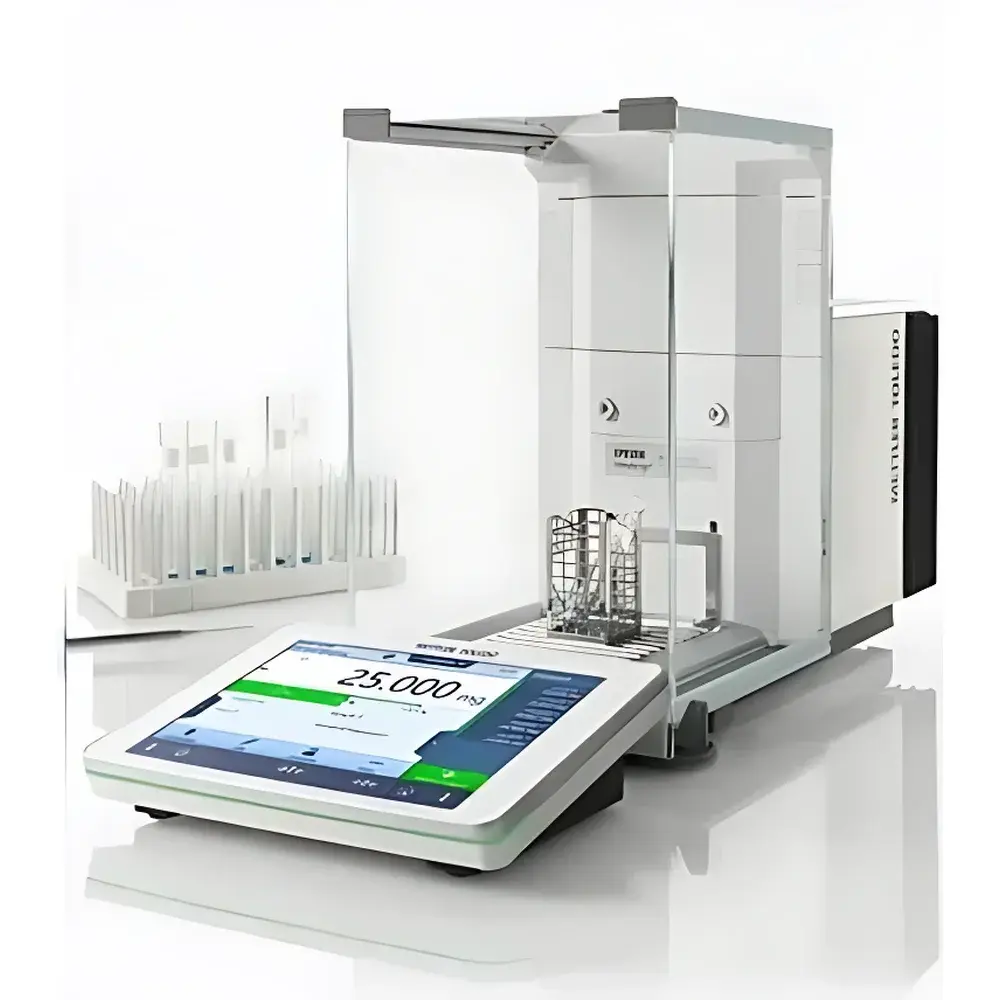
METTLER TOLEDO XPR Series Analytical Balance
| Brand | METTLER TOLEDO |
|---|---|
| Origin | Switzerland |
| Product Type | Analytical Balance |
| Model | XPR Series |
| Maximum Capacity | 52 g |
| Readability | 1 µg |
| Repeatability | 0.004 mg |
| Calibration | Automatic |
| Compliance Features | StatusLight, LevelControl, Minimum Weight Warning, GWP Approved, FDA 21 CFR Part 11–ready software integration |
Overview
The METTLER TOLEDO XPR Series Analytical Balance is an ISO/IEC 17025–aligned precision weighing instrument engineered for trace-level mass determination in regulated laboratory environments. Operating on electromagnetic force compensation (EMFC) principle, it delivers high reproducibility and long-term stability under variable environmental conditions—including minor air currents, temperature fluctuations, and electrostatic interference. With a readability of 1 µg and verified repeatability of ≤0.004 mg, the XPR series meets USP requirements for minimum weight assessment (down to 10 mg at 0.1% tolerance), making it suitable for critical applications in pharmaceutical development, reference standard preparation, catalyst dosing, and nanomaterial formulation. Its monolithic weighing cell architecture minimizes mechanical hysteresis and thermal drift, while active temperature compensation ensures consistent performance across ambient ranges of 10–30 °C.
Key Features
- Intelligent StatusLight system provides real-time visual feedback on balance readiness—green (ready), amber (leveling required), red (error or calibration due)—reducing operator decision latency.
- LevelControl integrated inclinometer automatically detects and alerts users to out-of-level conditions; guided leveling procedure ensures optimal mechanical alignment before measurement.
- Electrostatic charge detection and neutralization via built-in ionizer module mitigates one of the most common unreported sources of weighing error in low-mass applications.
- GWP Approved functionality performs automated risk-based assessment of calibration and performance verification intervals aligned with user-defined accuracy requirements and process tolerances.
- AutoCal™ technology enables fully automatic internal calibration triggered by time, temperature shift (>1.5 °C), or user command—no external weights required.
- Ergonomic design includes adjustable draft shield height, tool-free removable components, and EasyTouch™ capacitive touchscreen interface optimized for gloved operation.
Sample Compatibility & Compliance
The XPR series supports diverse sample forms—including powders, crystalline solids, viscous suspensions, and volatile compounds—through configurable draft shields, anti-static accessories, and modular weighing pans. All models comply with international metrological standards including OIML R 76-1, NIST Handbook 44, and EU Directive 2014/32/EU (Measuring Instruments Directive). For regulated industries, the balance is validated-ready for GxP environments: full audit trail support (user actions, calibration logs, test records), electronic signature capability, and ALCOA+–compliant data handling when interfaced with LabX software. It satisfies key clauses of FDA 21 CFR Part 11 (electronic records and signatures), MHRA GMP Annex 11, and ISO/IEC 17025:2017 Clause 7.8.2 (data integrity and traceability).
Software & Data Management
When connected to METTLER TOLEDO LabX laboratory software, the XPR balance becomes part of a centralized, secure digital workflow platform. LabX enforces SOP-driven weighing procedures with step-by-step on-screen guidance, automatic calculation of net weight, dilution factors, and assay concentrations—and captures full metadata (operator ID, timestamp, environment log, balance serial number, method version). All raw data and processed results are stored in an encrypted, SQL-based central database with role-based access control, immutable audit trails, and configurable retention policies. Integration extends beyond weighing: LabX serves as a unified control hub for titrators, pH meters, density meters, and melting point instruments—enabling cross-instrument statistical analysis and batch release reporting.
Applications
- Pharmaceutical QC/QA: USP-compliant assay of active pharmaceutical ingredients (APIs), reference standard weighing, and content uniformity testing.
- Academic & industrial research: Precise dosing of catalysts, quantum dot precursors, and radiolabeled compounds where sub-milligram accuracy is non-negotiable.
- Materials science: Determination of specific surface area via BET analysis, gravimetric sorption measurements, and polymer degradation kinetics.
- Clinical diagnostics: Weighing of lyophilized reagents, calibration standards for IVD assays, and trace-element reference materials.
- Environmental testing: Preparation of certified reference materials (CRMs) and microgram-level spiking of soil/water extracts for GC-MS validation.
FAQ
What does “GWP Approved” mean on the XPR balance?
GWP (Good Weighing Practice™) Approved is a built-in function that evaluates whether current calibration status, environmental conditions, and usage history meet predefined accuracy targets—then recommends recalibration or performance verification if thresholds are exceeded.
Is the XPR balance compatible with LIMS or ERP systems?
Yes—via Ethernet or USB-to-PC connection, it supports ASCII, Excel, and custom XML output formats. LabX provides native APIs and ODBC connectivity for seamless integration into enterprise data ecosystems.
How does the balance handle electrostatic interference?
It incorporates an integrated ionizer with automatic activation upon detecting static-induced instability, combined with conductive weighing pans and optional anti-static kits for full mitigation.
Can the XPR series perform dynamic or off-center weighing?
No—it is designed exclusively for static, center-loaded measurements under controlled draft shield conditions to maintain metrological integrity per OIML R 76.
What documentation is provided for regulatory audits?
Factory calibration certificate (traceable to national standards), IQ/OQ protocol templates, GWP Verification Report, and LabX-generated electronic audit trails—all compliant with FDA, EMA, and PMDA expectations.