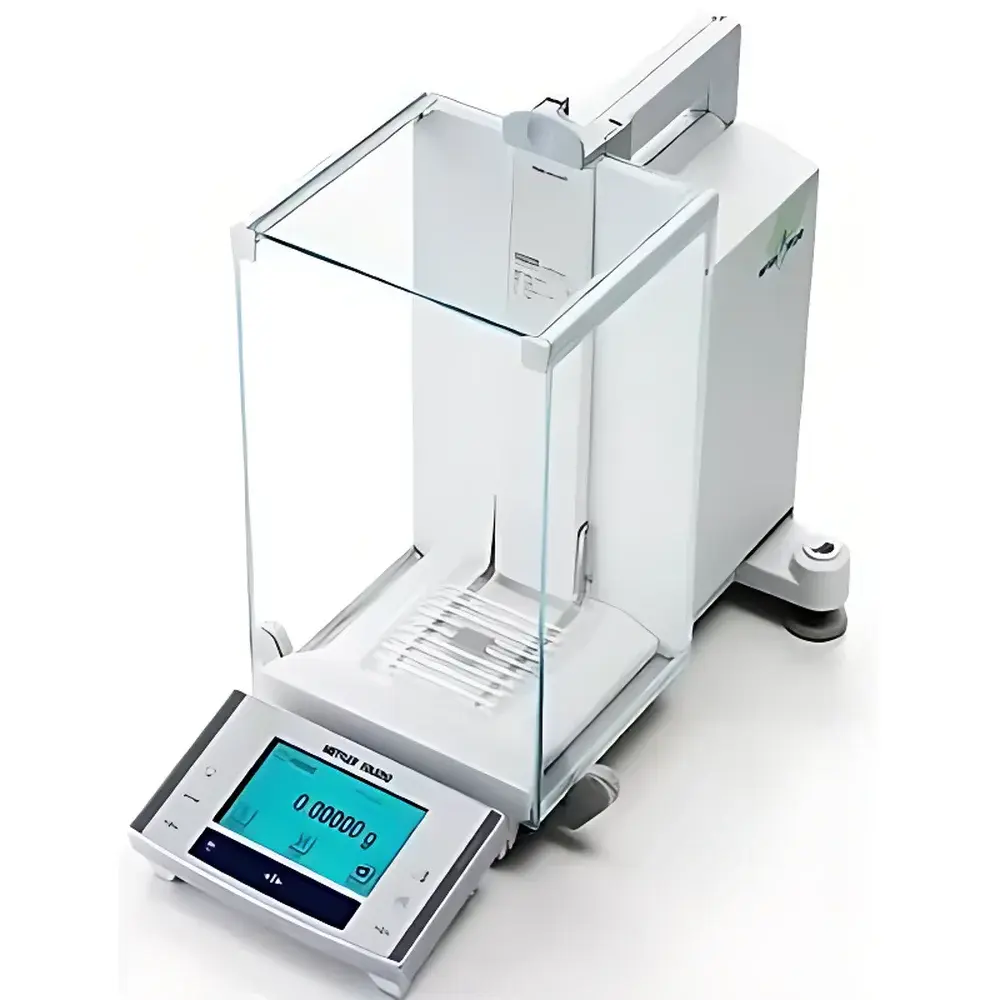
METTLER TOLEDO XS Series Analytical Balance
| Brand | METTLER TOLEDO |
|---|---|
| Origin | Switzerland |
| Model | XS Series |
| Instrument Type | Analytical Balance |
| Capacity Range | 41–220 g (dual-range and single-range variants) |
| Readability | 0.01 mg to 0.1 mg |
| Repeatability (sd) | 0.02 mg to 0.1 mg |
| Linearity Error | ≤ 0.2 mg |
| Typical Stabilization Time | 1.5–4 s |
| Pan Dimensions | 78 × 73 mm (standard) |
Overview
The METTLER TOLEDO XS Series Analytical Balance is a high-precision laboratory weighing instrument engineered for reproducible, traceable mass measurement in regulated and research-intensive environments. Built upon METTLER TOLEDO’s monolithic sensor architecture and electromagnetic force compensation (EMFC) principle, the XS series delivers exceptional stability and resolution across its dual-range (DU) and variable-range (DR) configurations. Each balance employs a temperature-compensated, hermetically sealed weighing cell housed in a thermally isolated chamber—minimizing drift caused by ambient thermal gradients or electronic self-heating. The separation of the weighing unit from the display and control module further eliminates thermal interference from power electronics, ensuring metrological integrity under continuous operation. Designed and manufactured in Switzerland, the XS platform complies with international metrological standards including OIML R76, NIST Handbook 44, and ISO/IEC 17025 requirements for calibration laboratories.
Key Features
- Modular architecture with physically decoupled weighing sensor and touchscreen control unit to suppress thermal cross-talk and enhance long-term accuracy.
- SmartGrid™ perforated weighing pan—reduces air turbulence effects inside the draft shield, shortening stabilization time by up to 40% compared to solid pans; retains spilled samples on the underlying metal base without compromising measurement integrity.
- Fully removable, autoclavable glass draft shield with tool-free disassembly—enables rapid cleaning and decontamination, supporting GLP/GMP hygiene protocols and multi-user lab workflows.
- Backlit capacitive touchscreen interface with intuitive icon-driven navigation, multilingual support (including English), and context-sensitive on-screen guidance—reducing operator training time and minimizing input errors.
- GWP® Excellence integrated risk-based assessment system—automatically verifies balance performance against user-defined tolerances, logs verification events, and triggers alerts when calibration or adjustment is required per ISO 9001 and FDA 21 CFR Part 11 data integrity guidelines.
Sample Compatibility & Compliance
The XS Series accommodates diverse sample forms—including powders, granules, liquids in tared vessels, and small solid components—within its 78 × 73 mm pan footprint and configurable draft shield height. All models meet ISO 14405-1:2016 for dimensional metrology support and are certified for use in environments compliant with USP , USP , and ASTM E898-22. The dual-range (DU) and variable-range (DR) configurations provide flexibility for applications requiring both ultra-low-load sensitivity (e.g., micro-reagent dispensing) and higher-capacity routine weighing—without sacrificing readability or repeatability. Full traceability is ensured via built-in internal calibration (IntCal™) with documented weight traceability to NIST and BIPM reference standards.
Software & Data Management
Embedded firmware supports seamless integration with METTLER TOLEDO LabX® software for centralized instrument management, audit-trail generation, and electronic record retention. All weighing events—including tare, net/gross, statistics, density determination, and formulation steps—are timestamped, user-ID authenticated, and stored with immutable metadata. The system conforms to ALCOA+ principles (Attributable, Legible, Contemporaneous, Original, Accurate, Complete, Consistent, Enduring, Available) and supports 21 CFR Part 11-compliant electronic signatures when deployed with LabX. Data export formats include CSV, PDF, and XML for LIMS and ELN interoperability.
Applications
- Quantitative analytical chemistry: preparation of standard solutions, gravimetric analysis, and titrant standardization.
- Pharmaceutical QC/QA: active pharmaceutical ingredient (API) assay, excipient blending verification, and content uniformity testing per USP .
- Materials science: powder density characterization (via pycnometry mode), catalyst loading precision, and thin-film mass deposition monitoring.
- Academic research: stoichiometric reagent dosing in synthetic organic chemistry, isotopic tracer quantification, and nanomaterial mass fractioning.
- Regulatory compliance labs: method validation studies requiring documented repeatability (≤ 0.1 mg SD), linearity verification, and intermediate precision assessment.
FAQ
What does “DU” or “DR” signify in XS model designations?
“DU” denotes Dual-Range capability—offering two distinct readability modes (e.g., 0.01 mg/0.1 mg) within one instrument. “DR” indicates Variable-Range operation, where the balance automatically switches between high-sensitivity and high-capacity ranges based on load.
Is internal calibration available on all XS models?
Yes—every XS balance includes motorized internal calibration weights with temperature-triggered recalibration and full audit trail logging.
Can the XS Series be connected to a networked LIMS environment?
Yes—via Ethernet or RS232, with native support for ASTM E1384, ASTM E1578, and HL7 messaging protocols when used with LabX or third-party middleware.
Does the SmartGrid™ pan affect weighing accuracy for volatile or static-prone samples?
No—the grid geometry has been validated for minimal buoyancy deviation (< 0.005% at 20 °C, 50% RH) and includes optional anti-static coating for low-conductivity materials.
How frequently should performance verification be performed?
Per GWP® Excellence recommendations: daily checks with calibrated test weights, weekly repeatability verification, and full calibration every 3–6 months—or after relocation, maintenance, or environmental change exceeding ±2 °C.