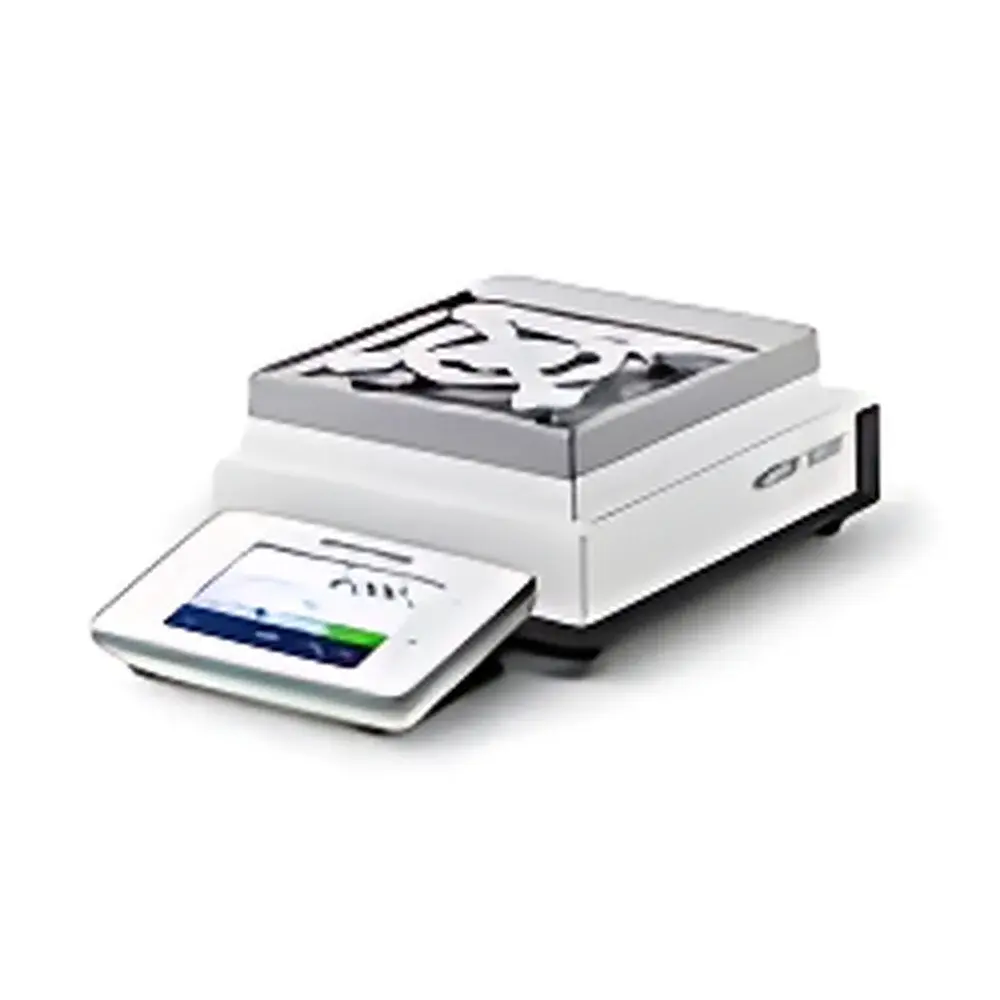
METTLER TOLEDO XSR Precision Balance
| Brand | METTLER TOLEDO |
|---|---|
| Origin | Switzerland |
| Model | XSR Precision Balance |
| Instrument Type | Precision Balance |
| Compliance | ISO/IEC 17025, USP <41>, ASTM E898, GLP/GMP-ready |
| Weighing Principle | Electromagnetic Force Compensation (EMFC) |
| Readability | Down to 0.1 mg–1 mg (model-dependent) |
| Repeatability | ≤ 0.0002 g (at full capacity) |
| Internal Calibration | FACT (Fully Automatic Calibration Technology) with motorized weights |
| Environmental Compensation | Built-in temperature and drift monitoring |
| Connectivity | 4× USB-A, 1× Ethernet (LAN), optional RS-232 |
| Data Security | User-level password protection, audit trail enabled, 21 CFR Part 11 compliant configuration available |
| SmartPan™ | Patented draft shield-free weighing pan design reducing air current interference |
Overview
The METTLER TOLEDO XSR Precision Balance is an electromagnetically force-compensated (EMFC) analytical-grade instrument engineered for high reproducibility, regulatory compliance, and operational efficiency in quality control laboratories, R&D environments, and regulated manufacturing facilities. Designed and manufactured in Switzerland, the XSR series integrates metrological excellence with intuitive human-machine interaction. Its core measurement principle relies on real-time electromagnetic feedback to maintain equilibrium at the load cell, delivering stable, drift-resistant results even under minor environmental fluctuations. Unlike conventional precision balances requiring bulky draft shields, the patented SmartPan™ technology minimizes aerodynamic disturbances—enabling accurate 1 mg readability without a windscreen in ISO Class 5 or better ambient conditions. This architecture reduces mechanical complexity, accelerates setup, and supports lean laboratory workflows where speed and traceability are critical.
Key Features
- SmartPan™ Draft-Free Weighing Platform: A mechanically optimized pan geometry combined with active airflow compensation algorithms allows reliable sub-milligram measurements without physical draft shields—reducing cleaning time and eliminating static charge buildup.
- Full-Color Touchscreen Interface: High-resolution capacitive display with multi-language support (including English, German, French, Chinese, and Japanese); customizable home screen layout and task-centric navigation.
- LevelControl™ Visual Leveling System: Real-time graphical guidance via on-screen bubble indicator ensures rapid, error-free leveling—critical for maintaining calibration integrity and minimizing measurement uncertainty.
- User-Defined Method Storage: Up to 99 programmable methods can be saved directly on the balance, each containing tare settings, unit selection, stability criteria, print/export preferences, and post-weighing actions (e.g., auto-zero, auto-print).
- Built-in Results Notebook: All weighing events—including date/time stamp, user ID, method name, gross/net/tare values, standard deviation (if multiple readings), and environmental metadata—are automatically logged with tamper-evident timestamps.
- Robust Data Connectivity: Four USB-A ports support direct connection to printers, flash drives, and barcode scanners; one Gigabit Ethernet port enables seamless integration into LIMS, ELN, or SAP systems via TCP/IP or HTTP protocols.
- Integrated Overload Protection & Quick-Clean Design: Mechanical stop limits prevent sensor damage up to 200% of maximum capacity; smooth, non-porous surfaces and removable pan supports simplify decontamination between samples.
Sample Compatibility & Compliance
The XSR Precision Balance accommodates a broad range of sample types—from powders and granules to viscous liquids and small metallic components—within its specified capacity range (ranging from 120 g to 3200 g depending on model). Its EMFC transducer exhibits minimal hysteresis and excellent linearity across the full scale, supporting applications governed by pharmacopeial standards including USP (Balances), USP (Weighing on an Analytical Balance), and EP 2.1.6. The instrument meets ISO/IEC 17025 requirements for calibration traceability and supports GLP and GMP environments through configurable audit trails, electronic signatures, and 21 CFR Part 11-compliant software modules (available upon request with validated firmware). All factory calibrations are traceable to national metrology institutes (e.g., METAS, NIST).
Software & Data Management
Data integrity is enforced through embedded security protocols: user accounts with role-based access (administrator, operator, reviewer), password-protected configuration changes, and encrypted local storage. The built-in notebook exports structured CSV or PDF reports with digital signatures. Optional LabX® software extends functionality with centralized instrument management, automated report generation, statistical process control (SPC) dashboards, and full audit trail review—including who changed what, when, and why. All data transfers comply with IEC 62304 (medical device software lifecycle) and ISO 13485 (if deployed in medical device manufacturing).
Applications
The XSR Precision Balance serves critical roles in pharmaceutical formulation (API dispensing, excipient blending), chemical synthesis (reaction stoichiometry verification), food safety testing (moisture content pre-weighing), materials science (density determination via pycnometry), and academic research labs requiring ISO-certified mass measurement. Its method-driven interface accelerates routine tasks such as percentage weighing, differential weighing, density determination, and formulation checking—reducing operator training time and inter-user variability.
FAQ
Is the XSR Precision Balance suitable for use in ISO Class 5 cleanrooms?
Yes—when operated within specified temperature (10–30 °C) and humidity (20–80% RH, non-condensing) ranges, and with SmartPan™ enabled, models with 1 mg readability require no draft shield in ISO Class 5 environments.
Does it support automatic internal calibration?
Yes—FACT (Fully Automatic Calibration Technology) triggers motorized internal calibration at user-defined intervals or upon detected temperature drift exceeding ±1.5 °C.
Can audit trails be exported for regulatory review?
Yes—audit trail logs (including user logins, method edits, calibration events, and weighing records) are exportable in encrypted CSV format with cryptographic hash verification.
What is the warranty coverage?
Standard global warranty is 24 months parts and labor, extendable to 36 months with METTLER TOLEDO ServicePlus agreement.
Are service manuals and firmware updates available online?
Yes—authorized users may access technical documentation, firmware patches, and validation templates via the METTLER TOLEDO Support Portal using their instrument serial number.