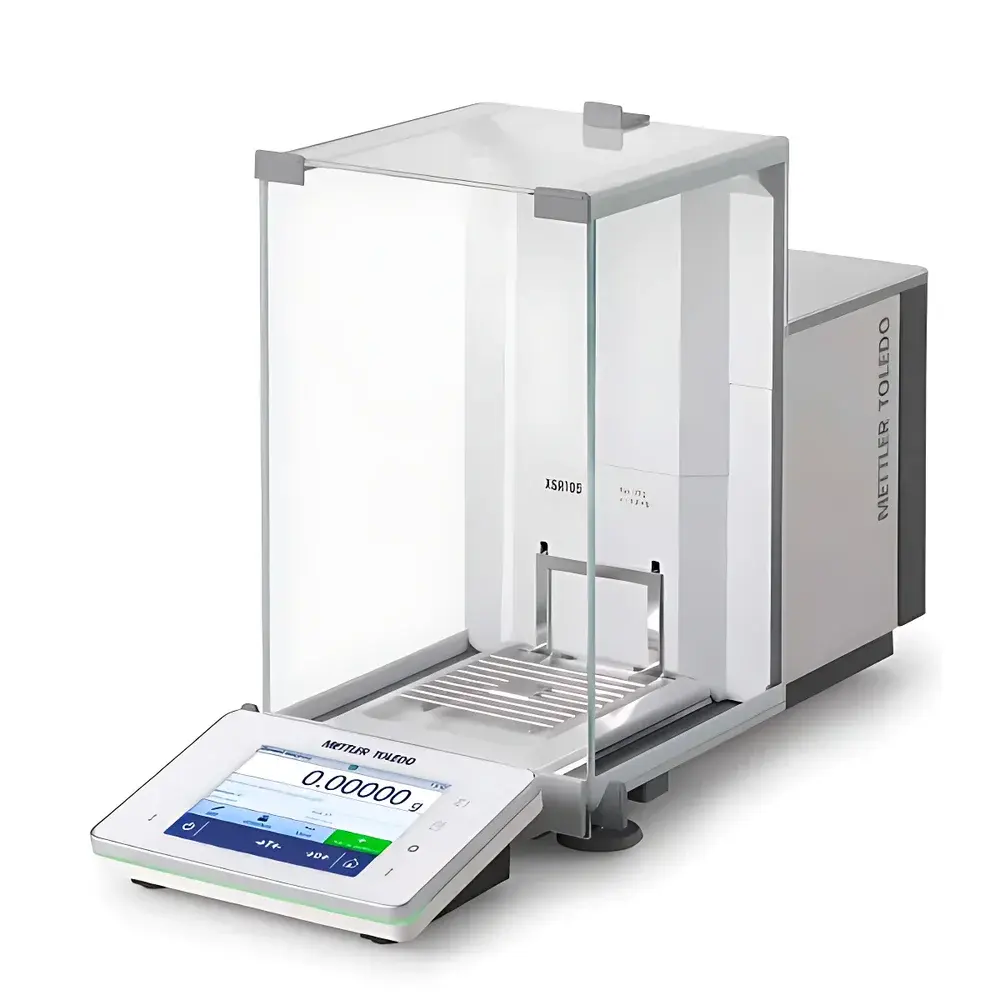
METTLER TOLEDO XSR Series Analytical Balances
| Brand | METTLER TOLEDO |
|---|---|
| Origin | Switzerland |
| Product Type | Analytical Balance |
| Model Range | XSR105, XSR105DU, XSR205DU, XSR64, XSR104, XSR204, XSR204DR, XSR304, XSR225DU |
| Maximum Capacity | 61–320 g (full range) |
| Readability | 0.01 mg (high-resolution models) to 1 mg |
| Repeatability (sd, 5% load) | 0.008–0.04 mg |
| Stabilization Time | 1.5–3 s |
| Minimum Weight (USP <41> compliant) | 16–82 mg |
| Calibration | proFACT — fully automatic, time- and temperature-triggered internal calibration |
| Display | Full-color touchscreen with multilingual UI (including English) |
| Connectivity | 4 × USB ports, 1 × Ethernet (LAN) port |
| Environmental Control | Active Temperature Control (ATC™), LevelControl™ leveling system, SmartGrid™ draft shield grid |
| Compliance | USP <41>, GWP® Verified, GLP/GMP-ready audit trail support |
Overview
The METTLER TOLEDO XSR Series Analytical Balances are high-precision laboratory instruments engineered for demanding quantitative weighing tasks in regulated and research environments. Based on electromagnetic force compensation (EMFC) technology, the XSR platform delivers exceptional stability, repeatability, and traceable accuracy across its full model range. Each balance integrates real-time environmental compensation—including active thermal regulation (ATC™) and dynamic leveling feedback (LevelControl™)—to mitigate drift caused by ambient temperature fluctuations and mechanical misalignment. Designed and manufactured in Switzerland, the XSR series meets the stringent metrological requirements of ISO/IEC 17025-accredited laboratories and supports compliance with pharmacopeial standards including USP , EP 2.1.6, and JP 2.03. Its modular architecture enables seamless integration into automated workflows, while its robust mechanical design ensures long-term performance consistency under daily QC, R&D, and quality assurance operations.
Key Features
- proFACT Automatic Calibration: Fully internal, time- and temperature-triggered calibration using built-in reference weights—eliminates manual intervention and ensures continuous traceability without interrupting workflow.
- SmartGrid™ Draft Shield: Patented perforated grid structure minimizes air turbulence effects and accelerates stabilization, especially critical for low-mass samples and volatile substances.
- Active Temperature Control (ATC™): Compensates for thermal gradients across the weighing cell, reducing sensitivity drift and improving measurement reproducibility over extended operating periods.
- LevelControl™ Visual Guidance: On-screen graphical level indicator provides immediate feedback during setup; automatic warning triggers if tilt exceeds ±0.5°, ensuring optimal sensor alignment.
- MinWeigh™ USP Compliance Monitoring: Dynamically calculates and enforces minimum sample weight thresholds per USP guidelines—alerts users when mass falls below the validated lower limit for acceptable uncertainty.
- ErgoClips™ Sample Handling System: Integrated clip mechanism enables hands-free tare operation and direct dosing—reducing operator-induced variability and contamination risk.
- Modular Data Export Architecture: Four USB-A ports support direct data transfer to USB storage devices or connection to barcode scanners, printers, and PCs; optional Ethernet interface enables networked data logging and remote configuration via LabX software.
Sample Compatibility & Compliance
The XSR series accommodates a broad spectrum of sample types—from hygroscopic powders and microgram-scale reference standards to viscous liquids and static-prone materials—thanks to configurable draft shield configurations, anti-static accessories, and customizable weighing protocols. All models comply with international regulatory frameworks governing analytical instrumentation: they support 21 CFR Part 11-compliant electronic records when paired with METTLER TOLEDO LabX software (audit trail, user authentication, electronic signatures). The balances are pre-validated for GWP® (Good Weighing Practice) and include embedded documentation templates aligned with ISO/IEC 17025 clause 6.4.1 (equipment verification) and ICH Q7 Annex 19 (analytical instrument qualification). Routine verification reports can be generated directly from the touchscreen interface or exported in PDF/CSV format.
Software & Data Management
No external software is required for basic operation or data export—the XSR’s embedded operating system supports direct USB file transfer, CSV-formatted report generation, and real-time data streaming to connected PCs. For advanced traceability and enterprise integration, LabX software provides centralized method management, multi-user permission hierarchies (administrator, operator, reviewer), and full audit trail functionality compliant with FDA 21 CFR Part 11 and EU Annex 11. All calibration events, user logins, parameter changes, and weighing results are timestamped, digitally signed, and immutably archived. Optional connectivity modules enable direct integration with LIMS, ERP, and ELN systems via OPC UA or RESTful APIs.
Applications
The XSR series serves as the primary weighing platform in pharmaceutical development labs (API potency assays, blend uniformity testing), contract manufacturing organizations (CMOs) performing content uniformity checks, academic research facilities conducting nanomaterial synthesis, and food safety laboratories executing heavy metal residue analysis. Specific use cases include gravimetric standard preparation for HPLC calibration, loss-on-drying (LOD) determinations per USP , tablet weight variation testing (USP ), and high-accuracy density measurements using pycnometry protocols. Its dual-range (DR) and dual-capacity (DU) variants further extend utility in hybrid workflows requiring both macro- and micro-weighing within a single instrument footprint.
FAQ
What is the minimum weight requirement for USP compliance on XSR balances?
The minimum weight is automatically calculated and enforced per USP criteria based on readability, repeatability, and desired uncertainty ratio (typically 2:1 or 3:1). Typical values range from 16 mg (XSR105) to 82 mg (XSR304), displayed dynamically on-screen during weighing.
Does the XSR support GLP/GMP audit trails without additional software?
Basic event logging (calibration, error codes, user login/logout) is stored internally. Full GLP/GMP-compliant audit trails—including editable field tracking and electronic signature support—require LabX software deployment.
Can the draft shield be fully disassembled for cleaning?
Yes—the entire glass draft shield assembly is tool-free and fully detachable, enabling thorough decontamination in accordance with ISO 14644 cleanroom maintenance protocols.
How does ATC™ improve long-term weighing stability?
ATC™ actively monitors and compensates for thermal expansion within the weighing cell housing, maintaining consistent electromagnetic coil geometry and thus minimizing zero-point drift over temperature gradients of ±5 °C/hour.
Is proFACT calibration traceable to national standards?
Yes—internal calibration weights are factory-certified against NIST-traceable references, and calibration certificates include uncertainty budgets compliant with ISO/IEC 17025 Annex A.3.