
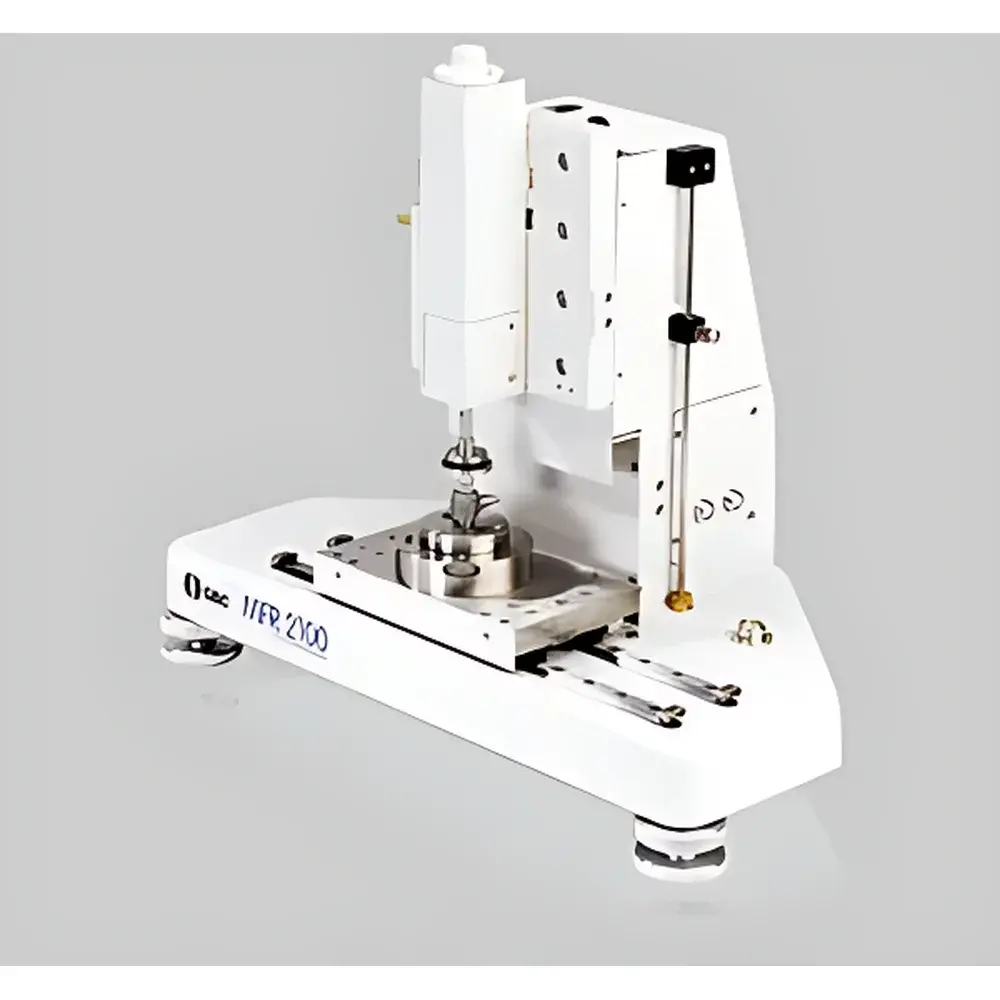
MFR 2100 Micro Fourier Transform Rheometer
| Brand | GBC |
|---|---|
| Origin | Australia |
| Model | MFR 2100 |
| Sample Volume Requirement | ≥100 µL |
| Frequency Range | 0–100 Hz |
| Gap Adjustment Range | 0.6–30 mm |
| Gap Resolution | 0.625 mm |
| Actuation Mode | Pseudo-Random Squeezing (Patented) |
| Data Acquisition | Real-Time Fourier Transform Analysis |
| Control | Fully Automated Computer-Controlled Gap & Sample Handling |
Overview
The MFR 2100 Micro Fourier Transform Rheometer, engineered by GBC (Australia), is a high-precision rotational rheological instrument designed for rapid, high-sensitivity characterization of viscoelastic materials under dynamic small-amplitude oscillatory conditions. Unlike conventional rheometers relying on single-frequency sinusoidal twisting or steady shear protocols, the MFR 2100 employs a patented pseudo-random squeezing motion—applied between parallel-plate geometries—to simultaneously excite a broad spectrum of mechanical responses across 0–100 Hz in a single, sub-second measurement cycle. This approach leverages real-time Fourier transform signal processing to deconvolve complex modulus spectra (G′, G″) and loss tangent (tan δ) with exceptional temporal resolution, enabling quantitative tracking of time-dependent structural evolution—such as gelation onset, thixotropic recovery, or polymer network relaxation—without requiring sequential frequency sweeps. Its micro-volume capability (as low as 100 µL) and fully automated gap control make it especially suitable for R&D laboratories working with scarce biological samples, novel formulations, or high-value specialty polymers.
Key Features
- Patented pseudo-random squeezing actuation mode—eliminates frequency sweep artifacts and captures broadband viscoelastic response in one acquisition
- Real-time Fourier transform data processing engine delivering instantaneous storage/loss modulus spectra with high signal-to-noise ratio
- Automated gap setting with 0.625 mm resolution over a 0.6–30 mm range—ensuring optimal normal force management and strain fidelity across viscosity ranges from 10⁶ mPa·s (molten polymers)
- Computer-controlled sample handling system enabling reproducible loading, measurement, and cleaning within seconds per test
- Parallel-plate geometry optimized for minimal edge effects and maximal thermal equilibration stability
- Integrated temperature control interface compatible with standard Peltier or liquid-circulated environmental chambers
Sample Compatibility & Compliance
The MFR 2100 supports a wide range of sample classes including hydrogels, protein solutions, colloidal dispersions, thermoplastic melts, curable resins, and pharmaceutical suspensions. Its low-volume requirement and non-destructive squeezing protocol minimize sample preparation artifacts and preserve native structure during testing. The instrument architecture conforms to ISO 6721-10 (Plastics — Determination of dynamic mechanical properties), ASTM D4065 (Standard Practice for Plastics: Dynamic Mechanical Properties), and supports GLP-compliant workflows through audit-trail-enabled software logging. All mechanical calibrations—including torque, gap, and temperature—are traceable to NIST-certified reference standards.
Software & Data Management
The proprietary MFR Control Suite provides intuitive experiment design, real-time spectral visualization, and export-ready data formatting (CSV, HDF5, MATLAB-compatible). It supports multi-step time sweeps, temperature ramps, and amplitude sweeps—all synchronized with Fourier-transformed output. Built-in compliance with FDA 21 CFR Part 11 includes electronic signatures, role-based access control, and immutable audit trails for raw data files, parameter logs, and user actions. Raw time-series waveforms and transformed moduli are stored with full metadata (temperature, gap, ambient humidity, calibration history), facilitating retrospective analysis and regulatory submission packages.
Applications
- Accelerated formulation screening of viscoelastic excipients in oral solid dosage development
- In situ monitoring of sol-gel transitions in biopolymer scaffolds during 3D bioprinting
- Quantification of thixotropic recovery kinetics in lithium battery slurries
- Time-resolved characterization of enzymatic crosslinking in tissue-engineered matrices
- Quality-by-Design (QbD) support for continuous manufacturing processes involving melt extrusion or hot-melt coating
- Stability assessment of nanoparticle dispersions under shear-rest cycles
FAQ
What distinguishes pseudo-random squeezing from traditional oscillatory rheometry?
It applies a non-periodic, broadband mechanical stimulus that excites multiple frequencies simultaneously—avoiding harmonic distortion and enabling true linear viscoelastic response extraction without phase lag assumptions.
Can the MFR 2100 perform temperature-controlled experiments?
Yes—via integrated interface with external temperature control units; all gap and torque calibrations remain valid across –10°C to 150°C when using certified environmental modules.
Is the instrument compliant with pharmaceutical regulatory requirements?
The system meets key elements of ICH Q5E, USP , and Annex 11 expectations for analytical instrument qualification (AIQ), including documented IQ/OQ/PQ protocols and electronic record integrity controls.
How is sample residue managed between tests?
The automated sample handling module includes programmable solvent rinse sequences and vacuum-assisted plate drying—validated for carryover reduction below 0.1% w/w for typical polymer and biomaterial systems.
Does the MFR 2100 support third-party data integration?
Yes—through RESTful API endpoints and OPC UA connectivity, enabling direct ingestion into LIMS, MES, or digital twin platforms for process analytics and predictive modeling.



