
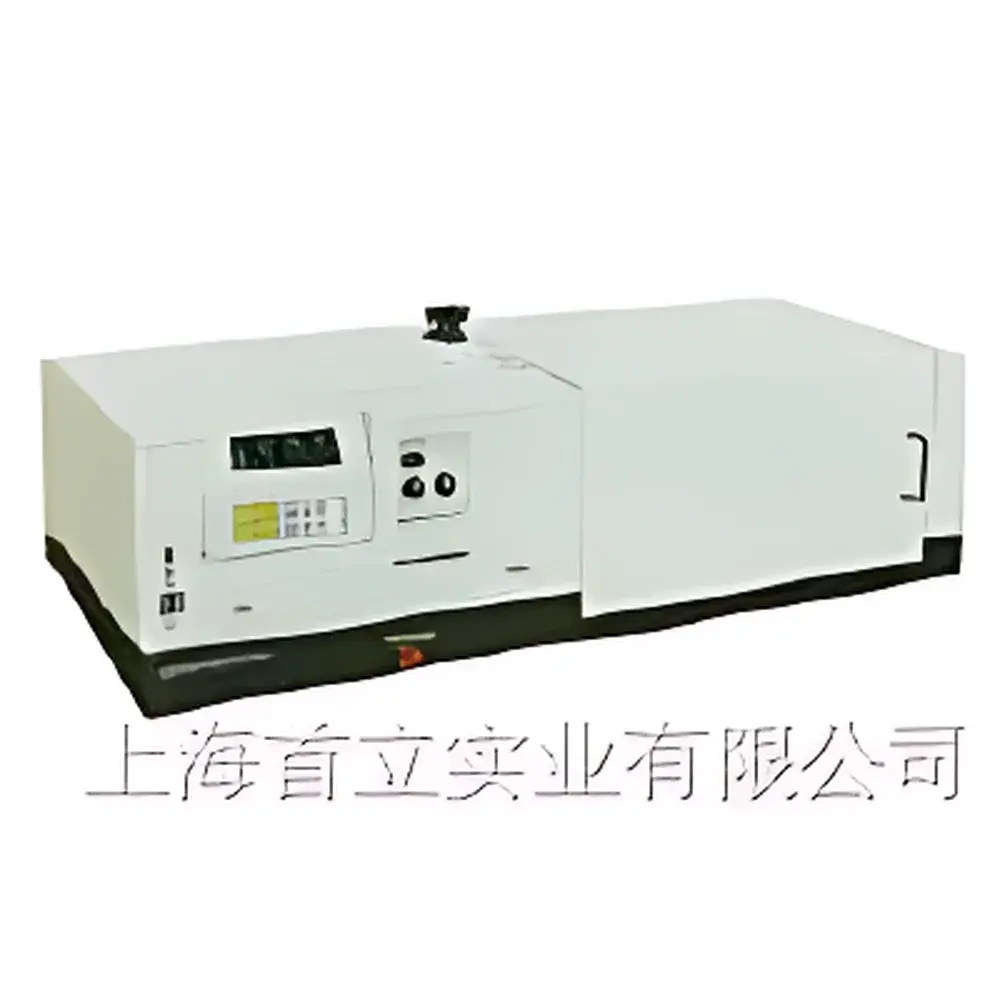
MG-III LCD Glass and Reflective Lens Transmittance & Reflectance Measurement System
| Origin | Japan |
|---|---|
| Manufacturer Type | Authorized Distributor |
| Origin Category | Imported |
| Model | MG-III |
| Pricing | Available Upon Request |
Overview
The MG-III LCD Glass and Reflective Lens Transmittance & Reflectance Measurement System is a precision optical characterization instrument engineered for quantitative spectral evaluation of transparent and semi-reflective substrates used in flat-panel display manufacturing. Designed specifically for the stringent requirements of LCD module production, the system employs double-beam spectrophotometric architecture with calibrated deuterium-halogen light sources and thermoelectrically stabilized silicon photodiode detectors. It measures absolute transmittance (T%) and reflectance (R%) across the visible spectrum (380–780 nm) at user-defined wavelengths or full-spectrum acquisition modes, supporting both normal-incidence and angularly resolved configurations per ISO 9050 and JIS R 3106 standards. The MG-III is not a refractometer — despite its classification in some distribution channels — but a dedicated photometric analyzer optimized for glass substrate homogeneity assessment, anti-reflection coating validation, and polarizer-integrated lens stack characterization in high-volume TFT-LCD and OLED backplane assembly lines.
Key Features
- Double-beam optical path design with real-time reference beam compensation to minimize drift during extended measurement cycles
- Automated sample stage with programmable X-Y positioning (±0.1 mm repeatability) and motorized tilt adjustment (±10°, 0.01° resolution) for angular reflectance profiling
- Integrated spectral calibration traceable to NIST-traceable standards; factory-certified wavelength accuracy ±0.3 nm, photometric accuracy ±0.5% T within 400–700 nm
- Dedicated firmware for LCD-specific metrics: luminance transmittance (Y10), CIE 1931 colorimetric coordinates (x, y), and haze-corrected clarity index per ASTM D1003
- Modular detector head compatible with optional UV-enhanced or NIR-extended photodiodes (up to 1100 nm) for R&D applications beyond standard display specifications
- Robust mechanical housing with ESD-safe anodized aluminum chassis and vibration-damped optical bench, rated for Class 1000 cleanroom operation
Sample Compatibility & Compliance
The MG-III accommodates rigid flat substrates up to 300 × 300 mm and thicknesses from 0.4 mm to 3.2 mm, including soda-lime float glass, aluminosilicate cover glass (e.g., Gorilla Glass variants), and laminated AR-coated lens assemblies. Sample clamping uses non-marring vacuum chucks with adjustable suction pressure (10–60 kPa) to prevent micro-scratching on coated surfaces. All measurement protocols comply with ISO/IEC 17025:2017 general requirements for testing laboratories, and data reporting supports audit-ready formats aligned with IATF 16949 automotive display supply chain mandates. Optional GLP-compliant software modules provide electronic signatures, 21 CFR Part 11 audit trails, and secure user role management for regulated environments.
Software & Data Management
The bundled SpectraView Pro v4.2 software provides intuitive workflow-driven operation via touchscreen or external keyboard/mouse interface. It enables batch measurement scripting, statistical process control (SPC) charting (X̄-R, Cpk), and automated pass/fail grading against user-defined specification limits (e.g., T ≥ 89.5% @ 550 nm, R ≤ 0.8% @ 45°). Raw spectral data exports in ASTM E2935-compliant .jdx format; CSV and XML outputs support integration with MES platforms such as Siemens Opcenter or Rockwell FactoryTalk. Calibration history, environmental logs (temperature/humidity), and operator ID are embedded in every dataset header, ensuring full traceability without post-processing annotation.
Applications
- Quality assurance of TFT array glass substrates prior to photoresist coating
- Verification of multi-layer dielectric AR coatings on touch sensor cover lenses
- Batch-to-batch consistency monitoring of color filter (CF) glass transmittance spectra
- Reflectance uniformity mapping of chrome-on-glass photomasks used in LCD photolithography
- Failure analysis of delamination-induced interference fringes in bonded lens stacks
- Supporting DOE studies for optimizing ITO sputtering parameters via correlation of sheet resistance with near-normal transmittance
FAQ
Is the MG-III suitable for measuring curved or flexible display substrates?
No — the system is mechanically constrained to planar, rigid samples with maximum warp ≤ 50 µm over 100 mm. Curved or polymer-based substrates (e.g., PI films) require alternative goniophotometric setups.
Can it measure polarization-dependent transmission (e.g., for circular polarizers)?
Yes — when equipped with the optional rotating polarizer module (PAX-1000 series), the MG-III supports extinction ratio and retardation-aware transmittance mapping at 0°/45°/90° linear polarization states.
Does the system include factory recalibration services?
Yes — annual NIST-traceable recalibration is available through authorized service centers in Tokyo, Singapore, and Munich, with certified reports issued per ISO/IEC 17025 Annex A.3.
What environmental conditions are required for stable operation?
Ambient temperature stability ±1°C/hour (18–25°C), relative humidity 30–60% RH non-condensing, and vibration isolation compliant with ISO 23827 Class B recommendations.





