
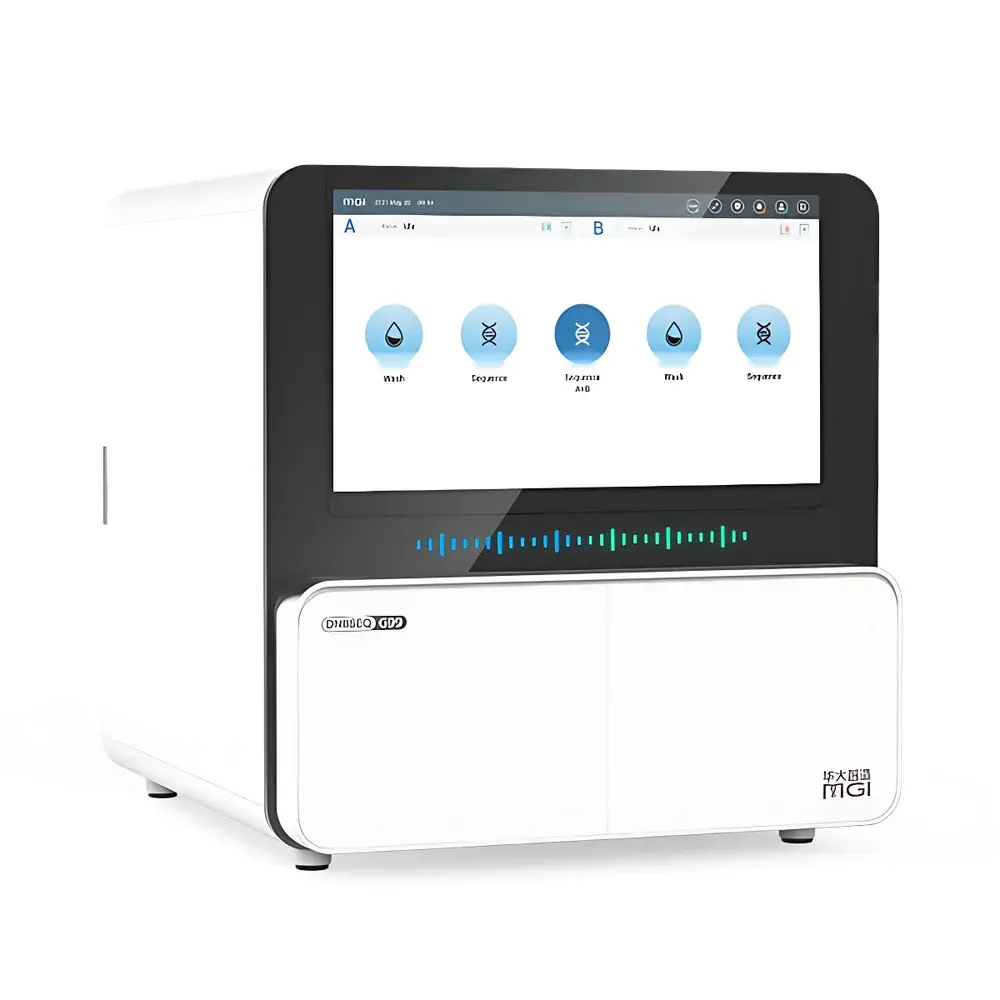
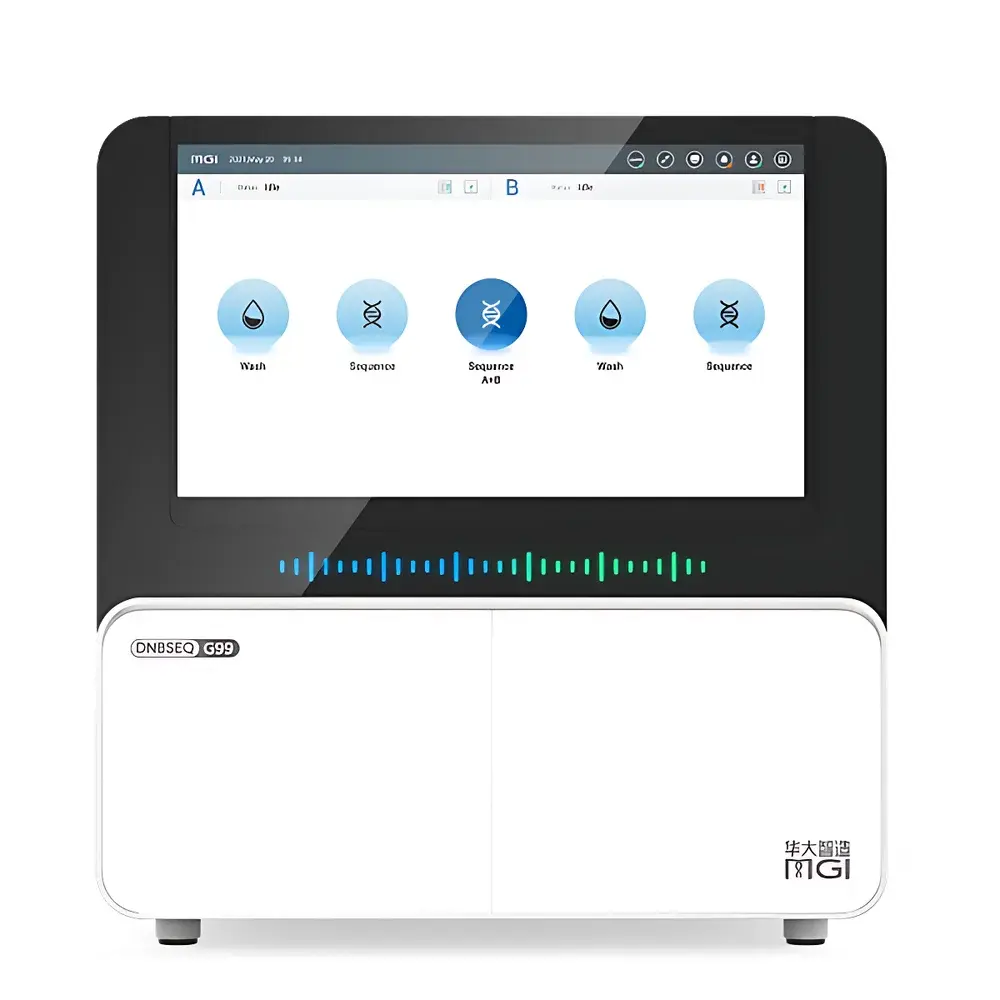
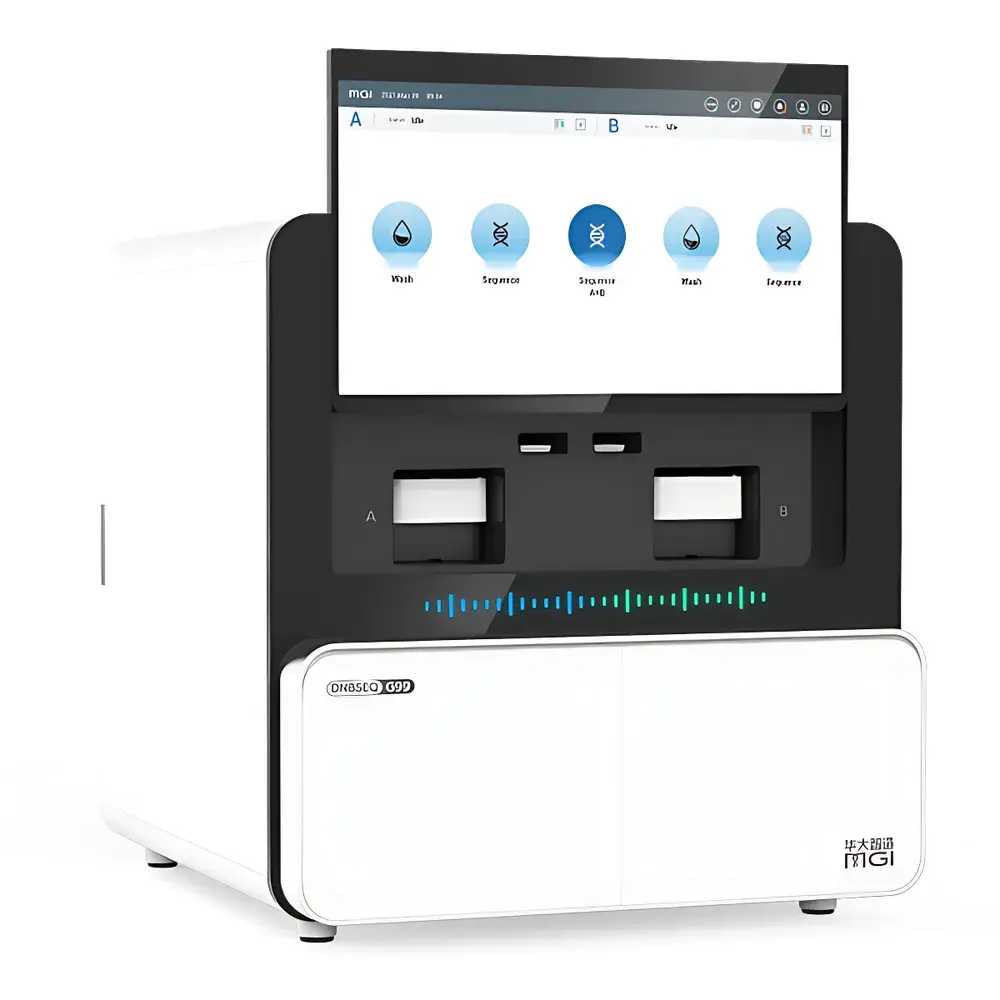
MGI DNBSEQ-G99 Benchtop Next-Generation Sequencer
| Brand | MGI |
|---|---|
| Origin | Guangdong, China |
| Instrument Type | Second-Generation Sequencer |
| Platform | DNBSEQ™ Technology |
| Form Factor | Benchtop |
| Regulatory Status | Medical Device |
| Read Lengths | SE100, PE50, PE150, PE300, SE400 |
| Throughput per Run | 8–96 Gb |
| Q30 Score | >85% (PE150) |
| Run Time | 12 h (PE150) |
| Compliance | CE-IVDR, NMPA Class II/III registered (as applicable), supports 21 CFR Part 11-compliant software modules |
Overview
The MGI DNBSEQ-G99 is a compact, high-speed benchtop next-generation sequencer engineered for laboratories requiring rapid, reliable, and scalable nucleic acid sequencing without compromising data quality. It implements MGI’s proprietary DNA Nanoball (DNB) sequencing-by-synthesis chemistry — a solid-phase, combinatorial probe-anchor synthesis (cPAS) method that eliminates PCR amplification bias and delivers uniform cluster density, high base-calling fidelity, and exceptional reproducibility across runs. Unlike conventional flow-cell-based platforms, the DNBSEQ-G99 utilizes patterned nanowell arrays to immobilize DNBs, enabling parallel imaging of millions of clonal DNA templates with minimal optical crosstalk. Its integrated onboard compute module accelerates primary data processing (base calling, BCL-to-FASTQ conversion), reducing dependency on external HPC infrastructure and shortening time-to-answer — critical for clinical applications such as tumor panel screening, forensic STR profiling, and rapid pathogen identification.
Key Features
- Ultra-fast turnaround: Complete PE150 sequencing in ≤12 hours, among the shortest run times in the benchtop NGS category.
- Flexible read configuration: Supports single-end (SE100, SE400) and paired-end (PE50, PE150, PE300) modes — optimized for diverse assay types from amplicon panels to low-pass whole-genome sequencing.
- On-instrument bioinformatics: Embedded FPGA-accelerated base caller and real-time QC metrics (e.g., cluster density, phasing/prephasing, Q30 distribution) enable immediate run assessment without post-hoc analysis delays.
- Robust thermal and fluidic architecture: Precision microfluidics with closed-loop temperature control (±0.1 °C) ensures consistent extension kinetics and minimizes run-to-run variability.
- Modular reagent handling: Pre-loaded cartridge-based chemistry delivery reduces manual intervention and contamination risk; compatible with multiple FDA-cleared and CE-IVDR-marked assay kits (e.g., OncoPanel, ATOPlex, WES, methylation panels).
- Regulatory-ready design: Built-in audit trail, electronic signature support, and configurable user access levels align with GLP, GCP, and ISO 15189 laboratory requirements.
Sample Compatibility & Compliance
The DNBSEQ-G99 accepts standard Illumina-compatible libraries (dual-indexed, adapter-ligated) prepared via MGI-validated or third-party library prep kits meeting input fragment size (150–800 bp) and molarity specifications. It is validated for human genomic DNA, FFPE-derived DNA, cfDNA, RNA (via converted cDNA), bacterial/viral nucleic acids, and forensic buccal swab extracts. The platform complies with ISO 13485:2016 for medical device manufacturing, and its associated software (ZTRON Suite v3.2+) meets FDA 21 CFR Part 11 requirements for electronic records and signatures when deployed in regulated environments. Clinical applications are supported under NMPA registration (Class II/III) and CE-IVDR (Class B), with documentation packages available for laboratory accreditation audits (CAP, CLIA, ISO/IEC 17025).
Software & Data Management
ZTRON Suite provides an integrated, browser-based interface for instrument control, run monitoring, and primary data analysis. It includes automated QC dashboards (intensity decay curves, tile-level Q30 heatmaps, read-length distribution histograms), configurable demultiplexing, and FASTQ generation with optional GPG encryption. Raw BCL files are stored in vendor-neutral formats compliant with the Global Alliance for Genomics and Health (GA4GH) standards. For secondary analysis, ZTRON exports BAM/CRAM and VCF outputs compatible with industry-standard pipelines (GATK, DRAGEN, Sentieon). Audit logs capture all user actions, parameter changes, and system events with timestamped, immutable records — essential for traceability in diagnostic labs.
Applications
- Tumor profiling: Targeted sequencing of oncology panels (e.g., 50–500-gene hotspots) at 500×–1000× coverage using PE150 reads.
- Low-pass whole-genome sequencing (lpWGS): Detection of CNVs and aneuploidies in NIPT and PGS workflows (SE50 mode, ~10 M reads/sample).
- Microbial genomics: 16S rRNA sequencing (PE300) for taxonomic resolution down to species level; shotgun metagenomics (PE150) for strain-level functional annotation.
- Forensic identification: High-resolution STR and SNP typing via SE400 reads to resolve complex mixtures and degraded samples.
- Epigenetics: Bisulfite-converted DNA sequencing for targeted methylation analysis (PE150, 5–10 Gb/run).
- Transcriptomics: Gene expression quantification (RNA-Seq) and fusion detection using PE150 or SE50 configurations.
FAQ
What regulatory certifications does the DNBSEQ-G99 hold for clinical use?
The system is registered with China’s NMPA as a Class II/III medical device and bears CE marking under IVDR Class B. Software modules supporting diagnostic reporting comply with 21 CFR Part 11 when configured with appropriate security settings.
Can the DNBSEQ-G99 process libraries prepared on non-MGI platforms?
Yes — it accepts standard Illumina TruSeq-style adapters and dual indexing schemes. Library quality must meet minimum cluster density (≥600 K/mm²) and insert size (150–800 bp) specifications outlined in the User Manual.
Is raw data export compatible with third-party analysis pipelines?
All primary outputs (BCL, FASTQ, BAM, VCF) adhere to open-format standards (SRA, GA4GH) and integrate seamlessly with GATK, Picard, and commercial LIMS systems via RESTful API.
How is instrument calibration and performance verification performed?
Each run includes built-in positive controls (PhiX spike-in) and real-time monitoring of key optical and thermal parameters. Annual PM service includes photometric calibration, fluidic pressure validation, and temperature uniformity mapping per ISO/IEC 17025 Annex A.3.
Does the system support multiplexing beyond 96 samples per run?
Yes — using MGI’s unique dual-indexing strategy (i5 + i7), up to 384 unique samples can be pooled per flow cell, subject to total loading concentration and desired coverage depth.




