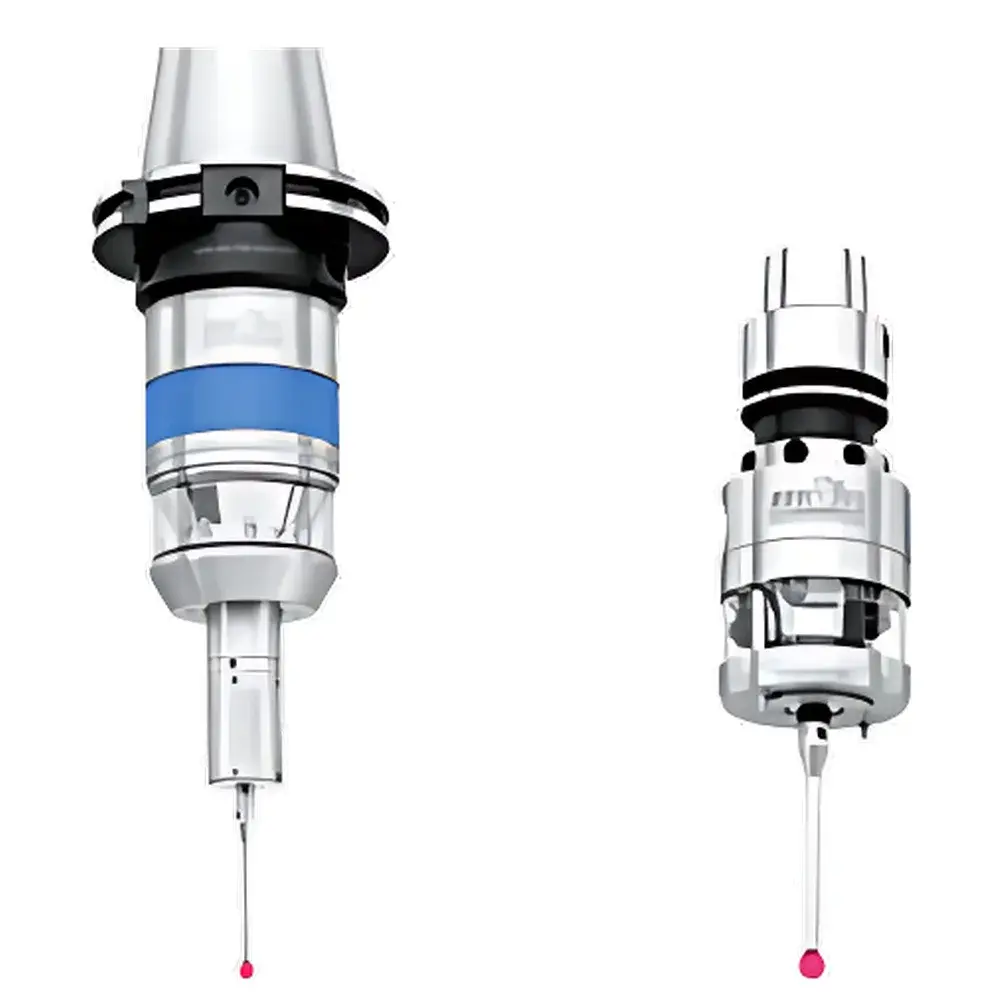
m&h IR-Triggered In-Machine Probe HDR40.00-RX/TX
| Brand | m&h |
|---|---|
| Origin | Imported (Non-Chinese) |
| Model | HDR40.00-RX/TX |
| Bidirectional Repeatability (2σ) | 1 µm |
| Recommended Trigger Speed | 254–2000 mm/min |
| Trigger Direction | ±X, ±Y, −Z |
| Maximum Overtravel | XY ±12.5°, Z −6 mm |
| Trigger Force (with 50 mm stylus) | XY = 0.4–1.8 N (adjustable), Z = 4–12 N (adjustable) |
| Power Supply | One 9 V battery or PX28 (6 V) / five LR44 (1.5 V each) |
| IP Rating | IP68 per EN 60529 |
| Weight (excl. toolholder) | 1350 g |
| Operating Temperature Range | 10–50 °C |
| Housing Material | Stainless steel |
| Signal Transmission Rate | 9600 pulses/sec |
| Angular Coverage | 130° (radial), 360° (axial) |
| Transmission Range | 4–10 m (adjustable) |
| Probe Diameter | Φ25–63 mm |
| Probe Length | 110–410 mm |
Overview
The m&h IR-Triggered In-Machine Probe HDR40.00-RX/TX is a high-precision, optically triggered measurement sensor engineered for real-time dimensional verification and tool setting directly within CNC machining environments. Unlike conventional mechanical or radio-frequency probes, this system employs infrared (IR) optical transmission to achieve robust, interference-free communication between probe and receiver—even in electrically noisy, metal-rich machine tool enclosures. Its core operating principle relies on pulsed IR signal generation upon stylus deflection, with precise timing resolution enabling sub-micron repeatability (2σ ≤ 1 µm) under dynamic trigger conditions. Designed for integration into milling, turning, and multi-axis machining centers, the HDR40.00-RX/TX supports both manual and automated probing routines without requiring machine downtime or part relocation—thereby reducing inspection cycle time and minimizing cumulative error from workpiece repositioning.
Key Features
- Optical IR triggering architecture eliminates RF interference and electromagnetic compatibility (EMC) constraints common in high-power machining cells.
- Bidirectional repeatability of ≤1 µm (2σ) verified per ISO 10360-5, ensuring metrological traceability for in-process quality control.
- Adjustable trigger force range (XY: 0.4–1.8 N; Z: 4–12 N) enables optimized contact behavior across diverse materials—from soft aluminum alloys to hardened steels—without stylus damage or surface marking.
- Full 360° axial and 130° radial angular coverage ensures reliable signal reception regardless of probe orientation relative to the receiver unit.
- IP68-rated stainless-steel housing (EN 60529) withstands coolant immersion, high-pressure washdown, and extended exposure to cutting fluids and metal chips.
- Modular length configuration (110–410 mm) and optional extension rods (Φ25 mm: 30/50/100/200 mm) accommodate deep-cavity, multi-level, and large-part applications.
- Configurable transmission range (4–10 m) supports flexible receiver placement—ideal for gantry mills, horizontal lathes, and composite manufacturing cells.
Sample Compatibility & Compliance
The HDR40.00-RX/TX is compatible with all standard ISO 26623-compliant toolholders (e.g., CAT, BT, HSK) and integrates seamlessly with Fanuc, Siemens, Heidenhain, and Mitsubishi CNC controllers via standardized G-code probing macros. It meets the mechanical and environmental requirements of ISO 230-2 (machine tool testing) and ISO 10360-5 (coordinate measuring machine acceptance testing). Its design adheres to EU Machinery Directive 2006/42/EC and EMC Directive 2014/30/EU. For regulated industries—including aerospace (AS9100), medical device manufacturing (ISO 13485), and automotive (IATF 16949)—the probe’s stable output and deterministic latency support compliance with statistical process control (SPC) and first-article inspection (FAI) protocols. While not inherently Part 11-compliant, its raw pulse data can be logged via third-party SPC software with audit-trail capability when paired with validated data acquisition systems.
Software & Data Management
The probe operates autonomously without embedded firmware or onboard processing—its output consists of TTL-compatible pulse trains synchronized to CNC motion commands. Data capture is handled externally by the machine’s controller or an external DAQ system supporting pulse counting and timestamping at ≥10 kHz resolution. m&h provides standardized macro libraries for major CNC platforms, including parameterized G-code routines for datum establishment, bore measurement, surface mapping, and tool offset compensation. Raw positional data may be exported in CSV or XML format for post-processing in metrology software such as PC-DMIS, Q-DAS, or custom Python-based analysis pipelines. No proprietary driver or cloud service is required; all calibration and configuration parameters are stored in the machine’s PLC memory or external HMI interface.
Applications
- In-cycle workpiece alignment and zero-point setting prior to roughing and finishing passes.
- Automated verification of critical GD&T features—including position, concentricity, flatness, and profile—without removing parts from the chuck or fixture.
- Tool wear monitoring via repeated touch-off measurements on reference artifacts mounted within the machine envelope.
- Adaptive machining feedback loops, where measured deviations update toolpath offsets in real time using CNC look-ahead interpolation.
- Large-part verification on bridge mills and龙门 (gantry) machines where coordinate frame stability degrades over travel distance—enabling localized recalibration without full CMM intervention.
- Composite layup verification in autoclave preparation cells, where non-contact-friendly environments demand ruggedized, EMI-immune sensing.
FAQ
Does the HDR40.00-RX/TX require line-of-sight between probe and receiver?
Yes—optical IR transmission necessitates unobstructed path alignment; however, the 130° radial field of view and 360° axial symmetry allow significant mounting flexibility, including side-mounted or overhead receiver configurations.
Can the probe be calibrated in-house without external metrology lab support?
Yes—repeatability validation follows ISO 10360-5 Annex D procedures using certified gauge blocks and reference spheres; no proprietary calibration kit is required.
Is battery life monitored or reported by the CNC controller?
No—the probe lacks telemetry; users must implement scheduled replacement (typically 6–12 months depending on duty cycle) or integrate external voltage sensing into the machine’s I/O system.
What stylus configurations are certified for use with this probe?
All m&h-certified ruby-tipped, tungsten-carbide shank styli compliant with ISO 8178-1 and rated for ≤50 mm length are supported; non-standard styli require force-range recalibration.
How does temperature drift affect performance between 10 °C and 50 °C?
Thermal expansion of the stainless-steel body is compensated in the CNC macro logic; empirical testing shows <0.3 µm/°C systematic deviation within the specified operating band—fully correctable via thermal offset tables.