
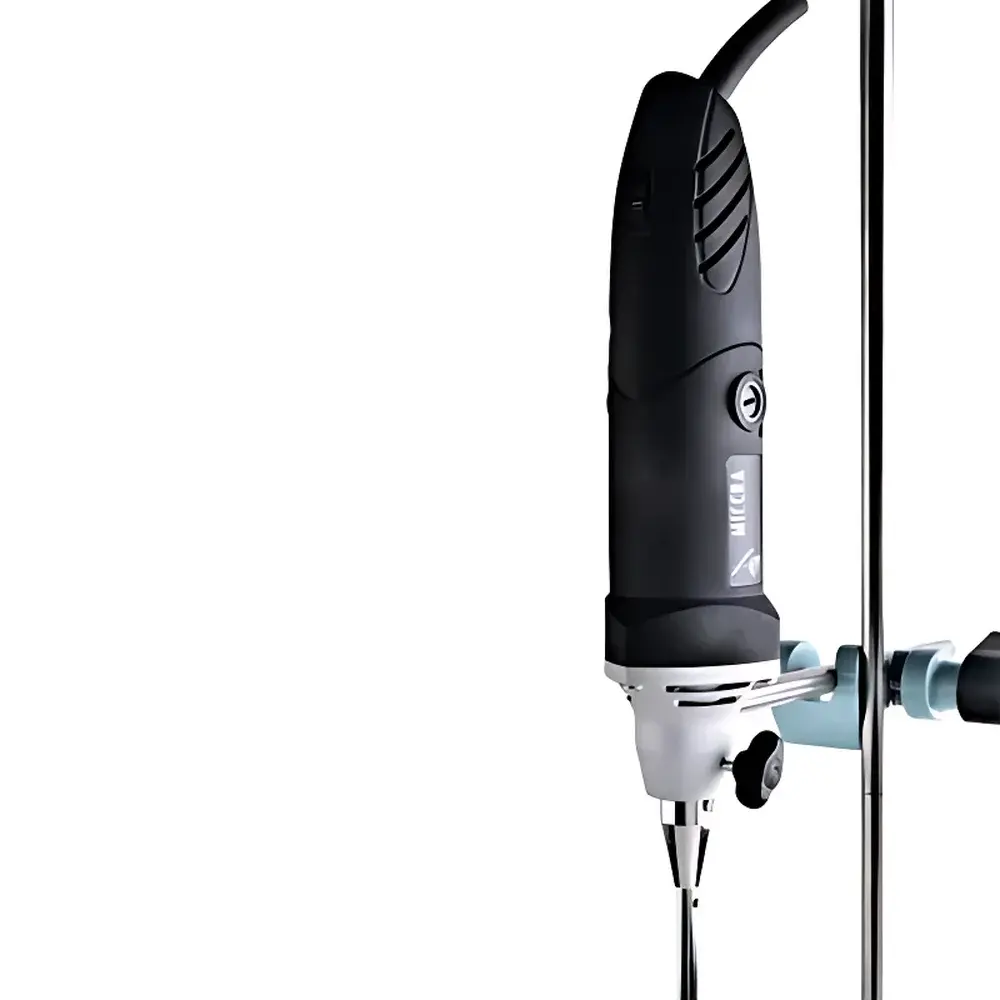
MICCRA D-1 Handheld Homogenizer (Formerly ART D-1)
| Brand | MICCRA |
|---|---|
| Origin | Germany |
| Instrument Type | Probe-type Rotor-Stator Homogenizer |
| Dimensions (W×D×H) | 50 × 245 mm |
| Processing Volume | 0.1–500 mL |
| Speed Range | 3,000–30,000 rpm |
| Input Power | 145 W |
| Output Power | 95 W |
| Weight | 900 g |
| Protection Rating | IP20 / Class II |
| Speed Control | Electronic, Stepless, and Stability-Regulated |
Overview
The MICCRA D-1 Handheld Homogenizer—formerly developed under the ART brand and now manufactured and distributed by MICCRA GmbH (Germany)—is an electronically speed-regulated, probe-based rotor-stator homogenizer engineered for precision and reproducibility in low-to-mid volume sample processing. It operates on the principle of high-shear mechanical homogenization: rotational energy from the motor is transmitted to a rotating stainless-steel probe tip, generating intense hydrodynamic forces—including cavitation, turbulence, and shear stress—that efficiently disrupt cellular structures, emulsify suspensions, and disperse particulates. Designed specifically for life science laboratories, the D-1 delivers consistent performance across volumes ranging from 0.1 mL (e.g., single-cell lysates or microRNA extractions) to 500 mL (e.g., tissue homogenates or microbial cultures), making it suitable for applications requiring both sensitivity and scalability. Its compact handheld form factor, combined with a robust Class II double-insulated housing and IP20 ingress protection, ensures safe, ergonomic operation in standard biosafety cabinets, cold rooms, and general laboratory environments.
Key Features
- Stepless electronic speed control (3,000–30,000 rpm) with real-time stabilization, minimizing speed drift under variable load conditions
- High-efficiency motor architecture delivering 95 W mechanical output from 145 W electrical input, optimized for thermal management during extended operation
- Interchangeable stainless-steel probes (standard Ø7 mm and optional Ø5 mm or Ø10 mm) compatible with autoclaving and chemical sterilization protocols
- Ergonomic, balanced design (900 g total mass) with non-slip textured grip and low center-of-gravity geometry to reduce operator fatigue during repetitive use
- Integrated overload and thermal cut-off protection to safeguard motor integrity during high-viscosity or dense-sample processing
- No external controller required—fully self-contained unit with intuitive rotary speed dial and LED status indicator
Sample Compatibility & Compliance
The MICCRA D-1 is validated for use with biological matrices including mammalian and plant tissues, bacterial and yeast cell pellets, blood-derived samples (e.g., whole blood, PBMCs), and soft food matrices. It supports protocols aligned with ISO 11290-2 (Listeria detection), ASTM D6300 (homogenization of environmental samples), and USP (dissolution testing preparation). While not intrinsically compliant with FDA 21 CFR Part 11, its analog speed interface and absence of onboard data logging make it suitable for GLP-compliant workflows when paired with external documentation systems. All wetted parts are constructed from 316L stainless steel and PTFE-free polymers, ensuring compatibility with common laboratory reagents (e.g., guanidine thiocyanate, RLT buffer, chloroform) and facilitating decontamination per IATA and CLSI guidelines.
Software & Data Management
The MICCRA D-1 operates as a standalone instrument without embedded firmware, software, or digital connectivity. Speed settings are manually selected and retained only during active operation; no parameter storage, audit trail, or timestamped event logging is provided. This analog architecture simplifies validation in regulated environments where deterministic behavior and minimal electronic complexity are prioritized—particularly in QC labs performing routine sample prep prior to HPLC, qPCR, or NGS workflows. For laboratories requiring traceability, integration with external lab information systems (LIMS) is achieved via manual entry or barcode-linked SOP execution logs.
Applications
- Cell lysis for genomic DNA, total RNA, and protein extraction from cultured cells and fresh/frozen tissues
- Preparation of homogeneous suspensions for flow cytometry, ELISA, and Western blot sample loading
- Homogenization of environmental swabs and food homogenates for microbiological analysis (ISO/IEC 17025-accredited labs)
- Dispersion of nanoparticles and liposomes in pharmaceutical formulation development
- Routine emulsification of oil-in-water or water-in-oil systems during method development in analytical chemistry
- Fragmentation of chromatin for ChIP-seq sample preparation (when used with optimized low-energy protocols)
FAQ
Is the MICCRA D-1 suitable for cryogenic homogenization?
Yes—when equipped with optional cryo-compatible probes and operated within ambient temperature ranges down to 4 °C; however, direct immersion in liquid nitrogen or dry ice slurry is not recommended due to thermal shock risk.
Can the D-1 be used with corrosive solvents such as phenol-chloroform?
Stainless-steel probes resist short-term exposure, but prolonged contact with strong oxidizers or halogenated solvents requires immediate post-use cleaning with ethanol and distilled water to prevent surface pitting.
What maintenance is required to ensure long-term accuracy?
Annual inspection of probe concentricity and bearing integrity is advised; calibration is not applicable as speed regulation is hardware-based and traceable to internal tachometric feedback.
Does MICCRA provide validation documentation (e.g., IQ/OQ)?
Factory-issued performance verification reports are available upon request; site-specific IQ/OQ protocols must be developed by the end user in accordance with GxP requirements.
Are replacement probes and spare parts readily available globally?
Yes—MICCRA maintains a centralized EU distribution hub with lead times under 5 business days for standard probes, drive shafts, and O-rings across EEA, North America, and APAC regions.



