
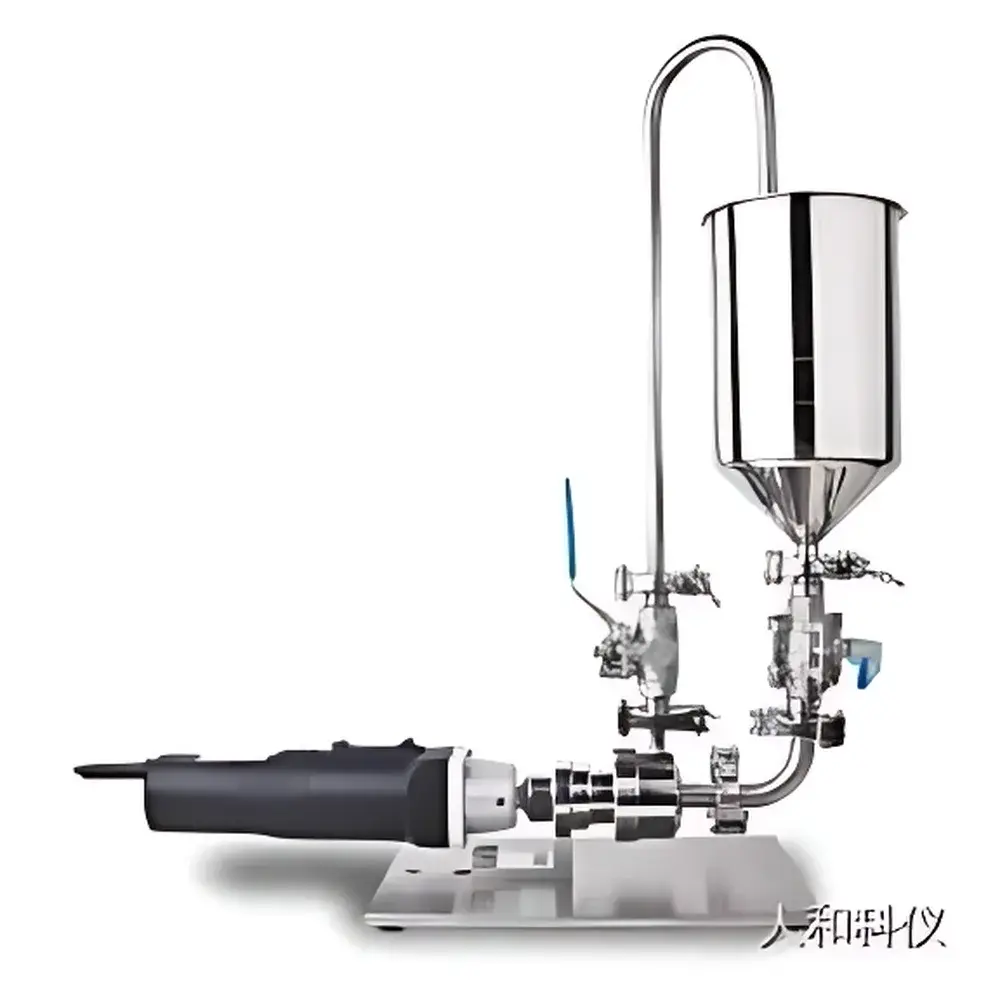
MICCRA DFK Inline Circulation Homogenization Chamber (Lab-Scale Continuous Processing System)
| Brand | MICCRA |
|---|---|
| Origin | Germany |
| Model | DFK |
| Type | Inline Circulation Homogenization Chamber |
| Compatible Hosts | MICCRA D-9, D-15, D-27 |
| Rotor/ Stator Configurations | DFK 1.0 (20/30 mm), DFK 1.4 (20/30/40 mm) |
| Max Flow Rate (Water) | 10–45 mL/min |
| Max Shear Velocity | 30–46 m/s |
| Max Operating Pressure | 8–16 bar |
| Vacuum Capability | ≤1 mbar |
| Seal Options | FDA-compliant lip seal or mechanical seal |
| CIP/SIP Ready | Yes |
| Material | Electropolished AISI 316L stainless steel |
| Hardness (Rotor/Stator) | ≤6 Mohs |
| Surface Finish | Ra ≤0.4 µm |
Overview
The MICCRA DFK Inline Circulation Homogenization Chamber is an engineered solution for scalable, continuous-flow processing in laboratory and pilot-scale environments. Based on high-shear rotor-stator hydrodynamic principle—where fluid is subjected to intense mechanical stress via controlled laminar-to-turbulent transition within a precisely dimensioned gap—the DFK system enables reproducible particle size reduction, emulsification, dispersion, and cell disruption. Unlike batch homogenizers, the DFK operates as a closed-loop circulation module, allowing real-time process parameter control and direct translation of lab-scale results to intermediate or industrial production. Its design integrates seamlessly with MICCRA’s modular drive platforms (D-9, D-15, D-27), supporting variable rotational speeds up to 36,000 rpm and delivering shear velocities exceeding 46 m/s—conditions sufficient to achieve sub-100 nm particle distributions in optimized formulations.
Key Features
- Modular rotor-stator interchangeability across MICCRA’s full batch-compatible series (DFK 1.0: 20 mm / 30 mm; DFK 1.4: 20 mm / 30 mm / 40 mm configurations)
- FDA-compliant lip seals housed in patented cartridge-style housings—enabling rapid, tool-free replacement and minimizing downtime during cleaning or maintenance
- Electropolished AISI 316L stainless steel construction with surface roughness ≤0.4 µm (Ra), ensuring corrosion resistance and compliance with pharmaceutical-grade surface finish requirements (e.g., ASME BPE, ISO 13485)
- Bearing-free torque transmission via direct-coupled flexible shaft—eliminating lubrication points, reducing contamination risk, and simplifying sterilization protocols
- Full CIP (Clean-in-Place) and SIP (Sterilize-in-Place) capability, validated under vacuum conditions down to 1 mbar and pressure-rated up to 16 bar
- Scalable flow performance: 10–45 mL/min water-equivalent throughput, adjustable via pump speed and system backpressure management
Sample Compatibility & Compliance
The DFK chamber accommodates diverse sample formats—including aqueous suspensions, oil-in-water emulsions, polymer dispersions, lipid nanoparticles, and biological lysates—across viscosity ranges from <1 to 5000 mPa·s. Its open architecture supports integration with single- or double-walled vessels (1 L, 3 L, 5 L), sanitary tubing, tri-clamp fittings, diaphragm valves, and temperature-controlled jackets. All wetted materials meet USP Class VI and FDA 21 CFR 177.2600 compliance for food contact and pharmaceutical use. The system conforms to ISO 22000 hygiene principles and supports GLP/GMP documentation workflows, including audit-trail-capable operation logs when paired with MICCRA’s optional digital controller.
Software & Data Management
While the DFK chamber itself is hardware-based, its operational data—flow rate, pressure differential, temperature (when integrated with external sensors), and runtime—is fully traceable when used with MICCRA D-27’s embedded controller or third-party SCADA systems. The host drive units support analog/digital I/O (0–10 V, 4–20 mA) for closed-loop feedback control and export timestamped CSV logs compliant with FDA 21 CFR Part 11 requirements for electronic records and signatures. Optional Ethernet/IP or Modbus TCP interfaces enable centralized monitoring within lab automation ecosystems.
Applications
- Nanoparticle formulation development (e.g., nanoemulsions, nanoliposomes, polymeric NPs) requiring consistent sub-100 nm D90
- Process validation studies bridging lab-scale discovery to pilot manufacturing under QbD (Quality by Design) frameworks
- Rapid screening of surfactant systems, stabilizer matrices, or pH-sensitive actives under controlled shear history
- Cell lysis and organelle isolation where mechanical integrity must be preserved without thermal degradation
- Stability testing of colloidal systems under accelerated shear aging protocols per ASTM D7721 and ISO 16283-2
- Viscosity-modified product development for cosmetics, agrochemicals, and functional foods
FAQ
Can the DFK chamber be used with non-MICCRA drive units?
Yes—provided the host motor delivers compatible shaft dimensions, torque output, and rotational speed range (up to 36,000 rpm), and includes appropriate safety interlocks and vibration damping.
What is the typical particle size reduction achievable with the DFK 1.4 at 36,000 rpm?
Under optimized conditions (e.g., aqueous silica suspension, 0.5% w/v, 20°C), D50 values of 40–60 nm are routinely attainable; final distribution depends on formulation rheology, energy input, and number of recirculation passes.
Is validation documentation available for GMP environments?
MICCRA provides IQ/OQ templates, material certifications (EN 10204 3.1), and surface finish test reports; full PQ must be performed by the end user per site-specific SOPs.
How often should lip seals be replaced during routine operation?
With proper CIP protocol and non-abrasive samples, FDA-compliant lip seals typically exceed 500 operational hours before scheduled replacement—verified via visual inspection and leak testing.
Does the DFK support temperature-controlled processing?
Yes—via integration with jacketed vessels or inline heat exchangers; the chamber body itself is rated for continuous operation between –20°C and +120°C.



