
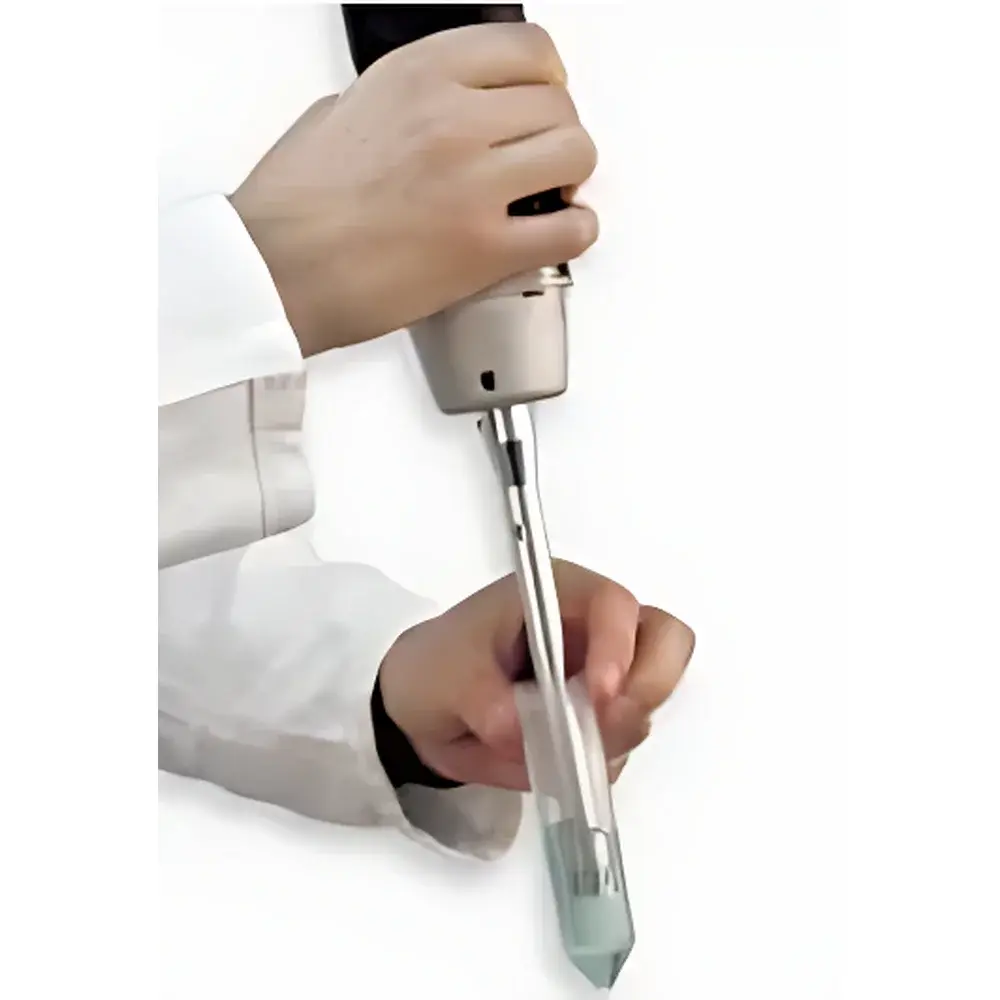
MICCRA Vario DS-40 High-Shear Dispersing Homogenizer Rotor-Stator Assembly
| Brand | MICCRA |
|---|---|
| Origin | Germany |
| Model | DS-40 (Stator Outer Diameter: 40 mm) |
| Rotor Outer Diameter | 31 mm |
| Maximum Tip Speed | 54.5 m/s |
| Total Length | 250 mm |
| Minimum Immersion Depth | 200 mm (standard) / 40 mm (with extension sleeve) |
| Recommended Volume Range (Water) | 1,000–20,000 mL |
| Rotor-Stator Configuration | Dual-stage shear-mixing design with interchangeable coarse/fine stators |
| Compatibility | PGDS-40, PFDS-40, PFSMIRSMIREMR variants |
Overview
The MICCRA Vario DS-40 is a precision-engineered rotor-stator dispersing homogenizer assembly designed for high-shear processing of heterogeneous and rheologically complex samples in laboratory and pilot-scale applications. Based on the Couette–Taylor flow principle and controlled hydrodynamic cavitation, the DS-40 generates intense localized shear gradients through precise radial clearance between its rotating rotor and fixed stator—enabling efficient particle size reduction, emulsification, cell disruption, and dispersion stabilization. Manufactured in Germany to DIN EN ISO 9001-certified production standards, this assembly integrates seamlessly with MICCRA’s Vario series drive units (e.g., D-1, D-2, D-4) and supports interchangeable stator geometries to accommodate varying sample viscosities and target outcomes—from coarse pre-homogenization to fine nano-emulsion formation.
Key Features
- Modular rotor-stator architecture supporting three validated configurations: PGDS-40 (coarse stator), PFDS-40 (fine stator), and PFSMIRSMIREMR (dual-stage micro-emulsifying stator)
- Optimized hydraulic geometry with 31 mm rotor OD and 40 mm stator OD, maintaining consistent tip speed (54.5 m/s at maximum drive unit RPM) across all variants
- 250 mm total probe length with dual immersion capability: standard 200 mm working depth or extended 40 mm immersion using optional sleeve adapters for low-volume vessels
- Stainless steel 1.4404 (AISI 316L) construction, electropolished to Ra ≤ 0.4 µm surface finish, compliant with FDA 21 CFR Part 11 requirements for material contact surfaces
- Interchangeable stators secured via ISO 228-1 G1/4 threaded interface, enabling rapid configuration changes without recalibration
- Validated performance across viscosity ranges from 1 to 50,000 mPa·s (water-equivalent reference), with reproducible energy input control via torque and rotational speed monitoring
Sample Compatibility & Compliance
The DS-40 assembly demonstrates broad compatibility with challenging sample matrices including fibrous plant tissues, polymer gels, high-solid-content slurries (>45% w/w), and thermosensitive biological suspensions. Its shear profile has been verified per ASTM D3418 (viscoelastic characterization) and ISO 13320 (laser diffraction particle sizing) protocols when coupled with inline particle analyzers. All wetted components conform to EU Regulation (EC) No. 1935/2004 for food-contact materials and USP for pharmaceutical-grade stainless steel. Documentation packages include full traceability certificates (EN 10204 3.1), dimensional inspection reports, and corrosion resistance validation per ASTM A967 (passivation testing).
Software & Data Management
When operated with MICCRA Vario D-series drives equipped with digital controllers (e.g., D-4 Touch), the DS-40 supports audit-trail-enabled operation under GLP/GMP environments. Software features include real-time torque logging, programmable ramp profiles (acceleration/deceleration rates configurable from 0.1 to 5 s), and automatic batch ID tagging synchronized with external LIMS systems via RS-485 or Ethernet/IP. Data export complies with ASTM E2500-13 for analytical instrument qualification, and electronic records meet FDA 21 CFR Part 11 requirements—including user authentication, electronic signatures, and immutable storage of parameter sets and runtime logs.
Applications
- Preparation of stable oil-in-water and water-in-oil emulsions for cosmetic and pharmaceutical formulations
- Homogenization of tissue lysates and microbial suspensions prior to nucleic acid extraction or protein purification
- Dispersion of carbon nanotubes, graphene oxide, and ceramic nanoparticles into polymer matrices
- Rheological conditioning of battery electrode slurries (NMC, LFP) prior to coating trials
- Deagglomeration of pigment concentrates in inkjet and automotive paint development
- Standardized sample preparation for ISO 17025-accredited testing laboratories requiring documented process repeatability
FAQ
What stator options are compatible with the DS-40 rotor?
The DS-40 rotor is mechanically and hydraulically optimized for use with PGDS-40 (coarse perforated stator), PFDS-40 (fine slit stator), and PFSMIRSMIREMR (dual-stage micro-emulsifying stator). Each stator shares identical mounting threads and thermal expansion coefficients to ensure interchangeability without recalibration.
Can the DS-40 be used with non-MICCRA drive units?
Mechanical coupling is only guaranteed with MICCRA Vario D-1, D-2, and D-4 series drives due to proprietary collet geometry and torque transmission specifications. Third-party adapters are not supported and may compromise safety interlocks or shear consistency.
Is sterilization possible for the DS-40 assembly?
Yes—full autoclaving at 121°C, 2 bar for 20 minutes is validated per ISO 17665-1. Post-sterilization verification requires visual inspection for thread integrity and surface pitting, as well as post-cycle torque calibration check using MICCRA’s certified test fixture.
What is the recommended maintenance interval?
Routine inspection (visual, thread integrity, stator bore wear) is required every 200 operating hours. Full stator replacement is advised after 1,000 hours of continuous operation or upon detection of >5 µm radial clearance increase measured with calibrated micrometers.



