
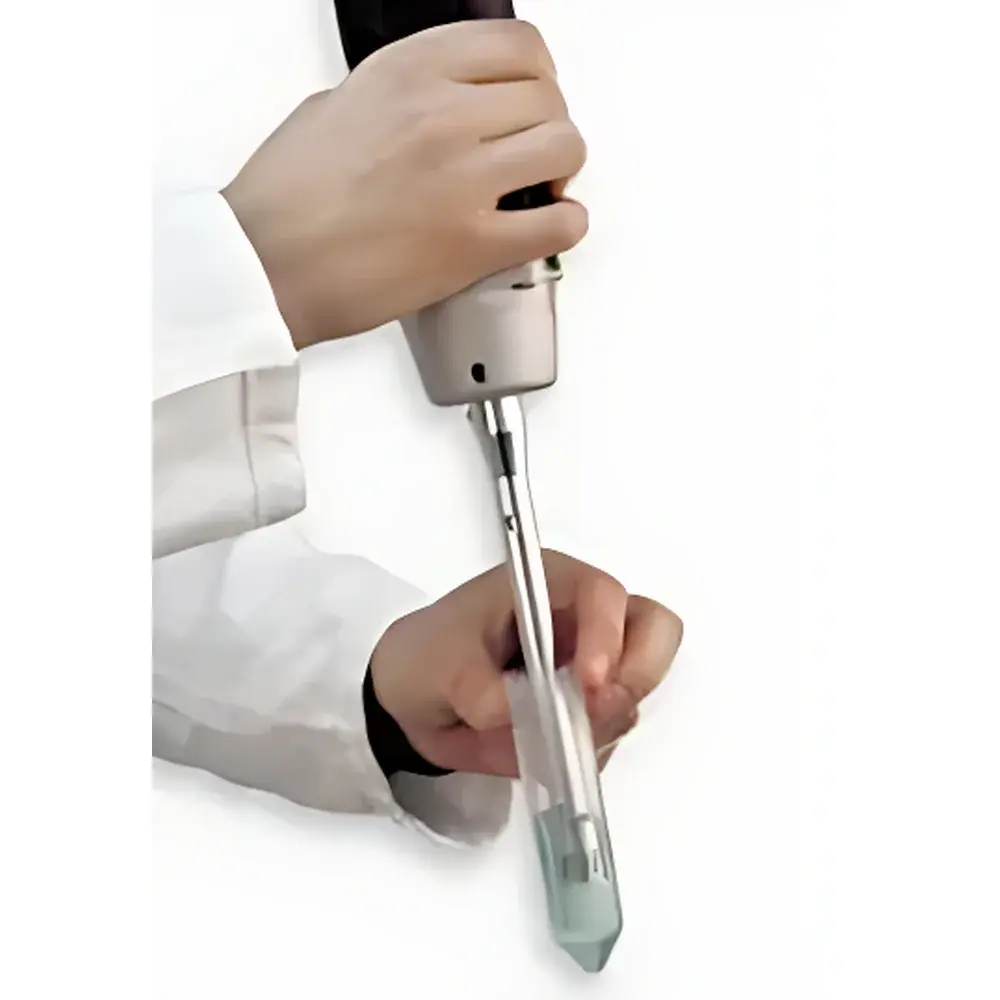
MICCRA Vario High-Performance Dispersing Homogenizer Rotor-Stator Head Set (DS-30 Series)
| Brand | MICCRA |
|---|---|
| Origin | Germany |
| Model | DS-30 (Stator Outer Diameter: 30 mm) |
| Rotor Outer Diameter | 23 mm |
| Maximum Tip Speed | 47 m/s |
| Standard Head Length | 250 mm |
| Minimum Immersion Depth | 200 mm (standard) / 40 mm (with extension sleeve) |
| Recommended Processing Volume (Water) | 500–10,000 mL |
| Material | Electropolished ASTM F138-certified AISI 316L Stainless Steel |
| Compatible Shaft Extensions | XL (327 mm), XLL (420 mm) |
| Rotor-Stator Configurations | Multi-purpose (PFDS-30), Emulsifying (PGDS-30), Fine-cutting Fibrous (PFDS-30/ZK), Microfine (SMIR/SMIRE/MIRE/MIR) |
Overview
The MICCRA Vario Dispersing Homogenizer Rotor-Stator Head Set (DS-30 Series) is a precision-engineered, modular component system designed for high-shear dispersion, homogenization, emulsification, and cell disruption in laboratory and pilot-scale applications. Built upon the Couette–Taylor flow principle, these heads generate intense hydrodynamic shear through controlled rotor-stator interaction—where the high-speed rotating rotor draws sample into the narrow annular gap and subjects it to radial acceleration, cavitation, and turbulent energy dissipation. Each DS-30 head features a fixed stator outer diameter of 30 mm and a matched rotor outer diameter of 23 mm, enabling consistent geometry-dependent shear rate profiles across interchangeable configurations. The system operates at tip speeds up to 47 m/s—sufficient to achieve submicron particle size reduction in viscous dispersions and stable oil-in-water emulsions. Designed for integration with MICCRA D-series drive units (e.g., D-1, D-5, D-9), the Vario heads support rapid tool-free interchange without recalibration, ensuring reproducibility across method transfers and multi-user environments.
Key Features
- Electropolished AISI 316L stainless steel construction compliant with ASTM F138 and ISO 5832-1 for implant-grade biocompatibility and corrosion resistance—critical for GMP-compliant pharmaceutical processing and cytology workflows.
- Modular rotor-stator architecture enabling on-the-fly configuration changes: PFDS-30 (multi-purpose coarse/fine dispersion), PGDS-30 (emulsification-optimized fine-tooth stator), PFDS-30/ZK (fibrous material cutting with reinforced stator pins), and SMIR-series microfine heads (for nano-emulsion and liposome preparation).
- Standardized 250 mm head length with optional XL (327 mm) and XLL (420 mm) shaft extensions—enabling compatibility with deep vessels, jacketed reactors, and overhead stirrer mounts while maintaining mechanical stability at full operational torque.
- Minimum immersion depth flexibility: 200 mm for standard batch processing; reduced to 40 mm when used with proprietary extension sleeves—ideal for low-volume screening (≥500 mL) without vortexing or splashing.
- Tool-free, three-point bayonet locking mechanism ensures repeatable axial alignment and gap consistency (±2 µm tolerance), directly impacting shear rate fidelity and inter-batch reproducibility.
Sample Compatibility & Compliance
The DS-30 series accommodates a broad rheological range—from low-viscosity aqueous solutions (1–10 mPa·s) to highly structured pastes and fiber suspensions (up to 50,000 mPa·s). Its optimized stator geometries mitigate clogging during processing of cellulose fibers, plant tissues, polymer gels, and protein aggregates. All wetted surfaces meet USP Class VI and FDA 21 CFR Part 11 requirements for electronic record integrity when paired with MICCRA’s validated software suite. The electropolished finish achieves Ra ≤ 0.4 µm surface roughness, satisfying ISO 13485 cleanability validation protocols and supporting automated CIP/SIP cycles in regulated bioprocessing environments.
Software & Data Management
When operated with MICCRA’s SmartControl™ v4.2 software (sold separately), the DS-30 heads support full audit trail generation—including operator ID, timestamped parameter logs (speed, duration, torque), and automatic head identification via embedded RFID tags. Software-defined SOP templates enforce method consistency across shifts and sites, while raw torque and speed data are exportable in CSV/Excel format for statistical process control (SPC) analysis per ISO 9001 and ICH Q5A guidelines. Electronic signatures and role-based access control align with ALCOA+ data integrity principles.
Applications
- Pharmaceutical: Nanosuspension formulation (e.g., poorly soluble APIs), lipid nanoparticle (LNP) synthesis, vaccine adjuvant dispersion.
- Food & Beverage: Stable mayonnaise and dressing emulsions, fruit pulp homogenization, plant-based dairy alternatives.
- Materials Science: Carbon nanotube dispersion in polymer matrices, graphene exfoliation, ceramic slurry deagglomeration.
- Academic Research: Subcellular organelle isolation, bacterial membrane disruption for proteomics, tissue homogenization for RNA extraction.
- Quality Control: Batch release testing of viscosity, particle size distribution (PSD), and phase stability per ASTM D445, ISO 13320, and USP .
FAQ
What is the maximum recommended viscosity for continuous operation with the DS-30 PFDS-30 head?
For sustained duty cycles (>5 min), viscosity should not exceed 25,000 mPa·s at 25°C. Higher viscosities require intermittent pulsing or use of the ZK-fiber variant.
Can DS-30 heads be sterilized in an autoclave?
Yes—full autoclaving at 121°C, 2 bar for 20 minutes is validated. Electropolishing prevents micro-pitting and maintains Ra < 0.4 µm post-sterilization.
Is rotor-stator gap adjustment possible on-site?
No—the gap is factory-set and non-adjustable to ensure geometric repeatability. Interchangeable stators provide discrete shear intensity tiers instead.
Does MICCRA provide IQ/OQ documentation for GMP installations?
Yes—fully customizable qualification packages (including traceable calibration certificates, material test reports, and FAT/SAT protocols) are available upon order.
How does the DS-30 compare to older ART-branded equivalents?
All DS-30 heads retain original ART mechanical specifications and dimensional tolerances but incorporate updated surface passivation, enhanced RFID tagging, and expanded compliance documentation per current EU MDR and FDA guidance.



