
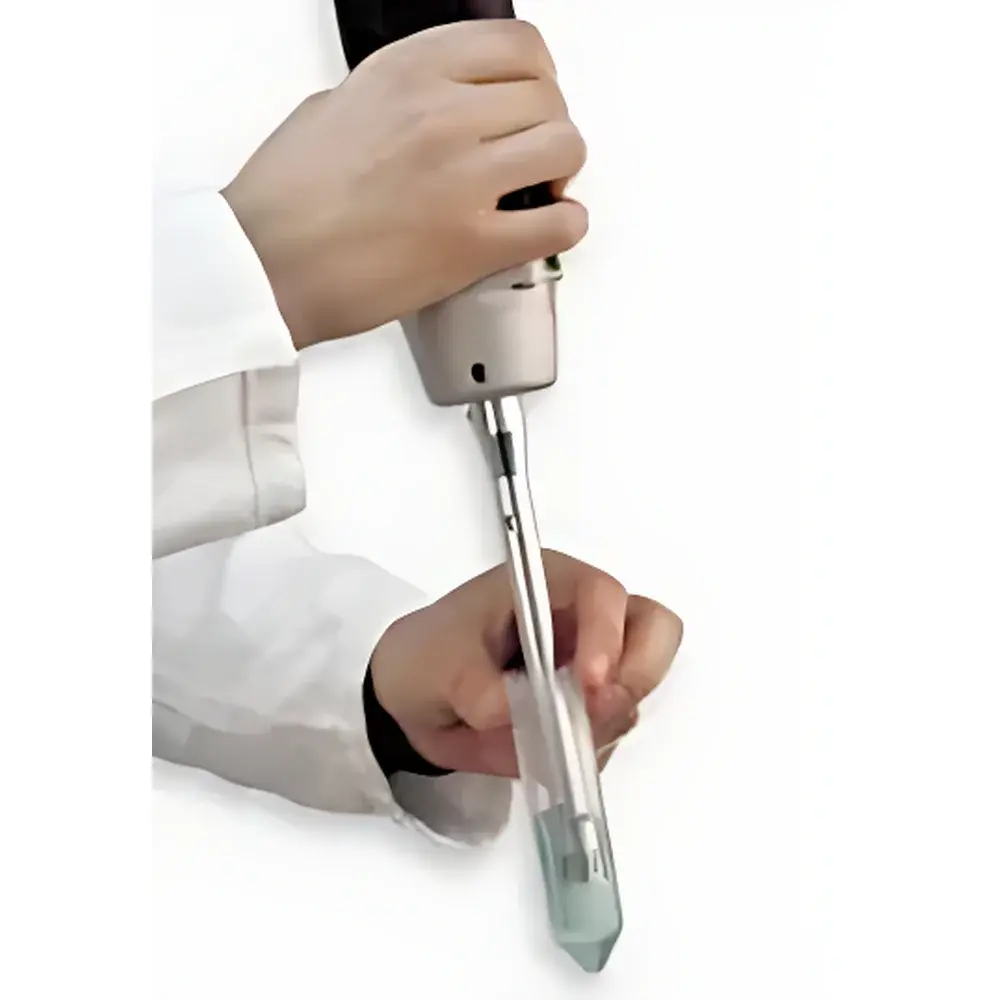
MicCRA VarioFlex DS-20/2P and DS-30/2P Dual-Stator Homogenizing Probes (2-in-1 Bundle)
| Brand | MicCRA |
|---|---|
| Origin | Germany |
| Model | DS-20/2P SMIR & DS-30/2P SMIR |
| Probe Type | Multi-Application Rotor-Stator Homogenizer Head |
| Stator Configuration | One Fine + One Coarse Stator per Kit |
| Rotor Type | Shear-Mixing Rotor |
| Stator Outer Diameter | 20 mm / 30 mm |
| Rotor Outer Diameter | 15 mm / 23 mm |
| Max Tip Speed | 30.6 m/s / 47 m/s |
| Probe Length | 250 mm |
| Minimum Immersion Depth | 200 mm (operational) / 40 mm (shaft-only clearance) |
| Recommended Sample Volume (Water) | DS-20/2P — 100–3,000 mL (coarse), 250–8,000 mL (fine) |
Overview
The MicCRA VarioFlex DS-20/2P and DS-30/2P dual-stator homogenizing probes are precision-engineered rotor-stator systems designed for scalable, reproducible high-shear dispersion, emulsification, and cell disruption in laboratory and pilot-scale applications. Based on the Couette flow principle, these probes generate intense hydrodynamic shear forces through the controlled radial gap between a rapidly rotating rotor and a stationary stator—enabling efficient particle size reduction, homogenization of heterogeneous suspensions, and mechanical lysis of biological tissues or microbial cultures. Unlike fixed-geometry probes, the VarioFlex 2-in-1 design integrates two interchangeable stators (coarse and fine) with a single shear-mixing rotor, allowing users to adjust processing intensity without replacing the entire probe assembly. This modular architecture supports method development across viscosity ranges—from low-viscosity aqueous solutions to high-viscosity pastes and fibrous slurries—while maintaining consistent fluid dynamics and minimizing heat generation during extended operation.
Key Features
- Modular dual-stator configuration: Each bundle includes one coarse and one fine stator, enabling rapid switching via MicCRA’s standardized quick-lock interface—no tools required.
- Optimized shear geometry: Precision-machined rotor-stator gaps ensure uniform energy distribution; tip speeds up to 47 m/s (DS-30/2P) deliver high-intensity shear while retaining structural integrity under continuous load.
- Multi-phase compatibility: Proven performance with viscous pastes (e.g., polymer gels, food matrices), fibrous plant tissues, and low-surface-tension liquids (e.g., oil-in-water emulsions).
- Robust stainless-steel construction: Fully autoclavable (121 °C, 2 bar), electropolished surfaces meet ISO 13485 and FDA-compliant material requirements for pharmaceutical and biotech use.
- Standardized shaft length (250 mm) and immersion depth specifications (200 mm minimum working depth; 40 mm shaft clearance) ensure compatibility with MicCRA D-Series dispersers and third-party drive units equipped with ISO 228/1 or DIN 29990-1 mounting interfaces.
Sample Compatibility & Compliance
The VarioFlex probes accommodate samples ranging from 100 mL to 10,000 mL (water-equivalent), with volume-specific recommendations based on stator selection and rotational speed. Coarse stators support higher throughput and robust particulate breakdown (e.g., tissue homogenization, pigment dispersion), while fine stators enable submicron emulsion stabilization and colloidal suspension refinement. All components comply with EU Regulation (EC) No. 1935/2004 for food-contact materials and conform to ISO 8502-12 for surface cleanliness validation. When used with MicCRA dispersers operating under validated SOPs, the system supports GLP and GMP documentation workflows—including audit-trail-capable parameter logging when paired with compatible controllers.
Software & Data Management
While the probes themselves are hardware components, their performance is fully integrated into MicCRA’s digital ecosystem. When mounted on D-1000, D-5000, or D-10000 dispersers, real-time torque, speed, and temperature data are transmitted via RS-485 or Ethernet to MicCRA LabControl software. This platform enables method storage, version-controlled protocol execution, and export of CSV-formatted process logs compliant with 21 CFR Part 11 requirements (electronic signatures, user access tiers, change history). Probe identification is auto-detected via embedded RFID tags, ensuring traceability across instrument platforms and batch records.
Applications
- Biopharmaceutical R&D: Mechanical lysis of E. coli, yeast, and mammalian cells; preparation of vaccine adjuvant emulsions.
- Materials science: Dispersion of carbon nanotubes, graphene oxide, and ceramic nanoparticles in polymer precursors.
- Food & beverage QA/QC: Homogenization of nut butters, dairy-based sauces, and fruit pulps for rheological consistency testing.
- Environmental analysis: Extraction of microplastics from sediment matrices; slurry homogenization prior to ICP-MS digestion.
- Academic research: Scalable model development for turbulent shear effects in non-Newtonian fluids.
FAQ
Can the DS-20/2P and DS-30/2P probes be used interchangeably on the same disperser unit?
Yes—both models share identical mounting threads (M14×1.5) and shaft diameters, making them mechanically compatible with all MicCRA D-Series dispersers rated ≥500 W.
Is sterilization possible without compromising probe performance?
Yes—full autoclaving at 121 °C for 20 minutes is validated; repeated cycles do not affect dimensional stability or surface finish due to electropolished 1.4404 (AISI 316L) stainless steel construction.
What is the recommended maintenance interval for rotor-stator alignment verification?
MicCRA recommends alignment inspection every 200 operational hours or after 500 stator swaps, using the included gap gauge tool (part no. GA-DS-01).
Do these probes support inline processing configurations?
No—VarioFlex probes are designed exclusively for batch-mode, dip-in homogenization; for continuous operation, MicCRA offers the S-Line series of sanitary inline homogenizers with comparable stator options.
How does stator selection affect energy input and temperature rise?
Fine stators increase shear rate at equivalent rpm, resulting in higher localized energy dissipation; temperature rise can be mitigated by active cooling jackets or pulsed operation protocols—validated in MicCRA Application Note AN-HM-07.



