
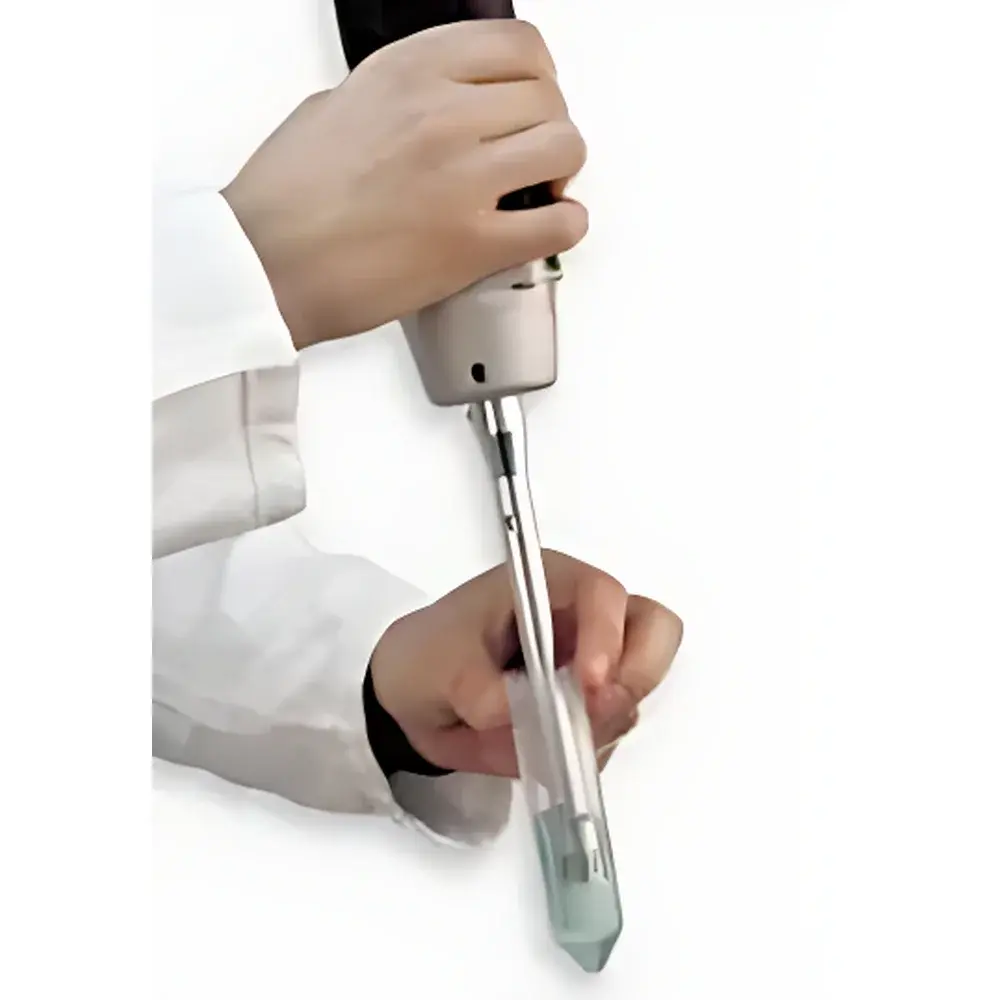
MICCRA VarioMax High-Speed Homogenizing Rotor Set (RW Series)
| Brand | MICCRA |
|---|---|
| Origin | Germany |
| Model | RW-30/P, RW-40/P, RW-70/3S |
| Stator Outer Diameter | 30 mm / 40 mm / 70 mm |
| Rotor Outer Diameter | 15 mm / 23 mm / 33 mm |
| Max Tip Speed | 30.6 m/s / 41 m/s / 58 m/s |
| Rotor Length | 250 mm / 250 mm / 420 mm |
| Minimum Immersion Depth | 200 mm (±40 mm) / 200 mm (±40 mm) / 300 mm (±100 mm) |
| Processing Volume (Water) | 1–20 L / 5–50 L / 10–100 L |
| Rotor Type | Shear-Mixing / Shear-Mixing / Turbine-Propeller |
| Stator Type | Coarse Mesh / Coarse Mesh / Fine Mesh |
Overview
The MICCRA VarioMax High-Speed Homogenizing Rotor Set (RW Series) is a modular, precision-engineered rotor-stator assembly designed for scalable high-shear homogenization, dispersion, and emulsification in laboratory and pilot-scale applications. Built upon Couette-flow and rotor-stator shear principles, the system delivers controlled mechanical energy input through optimized tip speed, gap geometry, and fluid dynamics—enabling reproducible particle size reduction, phase stabilization, and uniform suspension formation across viscous and non-Newtonian media. Each RW variant (RW-30/P, RW-40/P, RW-70/3S) is engineered to interface exclusively with the MICCRA D-15 drive unit, maintaining constant rotational speed under increasing torque load—a critical capability when processing shear-thinning or viscoelastic samples up to 100 L. The series complies with DIN EN ISO 13849-1 for functional safety integration and is constructed from electropolished 316L stainless steel for corrosion resistance and cleanability.
Key Features
- Three scalable rotor-stator configurations: RW-30/P (30 mm stator, 15 mm rotor), RW-40/P (40 mm stator, 23 mm rotor), and RW-70/3S (70 mm stator, 33 mm rotor) — enabling seamless transition from benchtop optimization to process development.
- Maximum tip speeds of 30.6 m/s, 41 m/s, and 58 m/s respectively — calibrated to achieve defined shear rates without cavitation onset in aqueous and low-to-medium viscosity systems.
- Modular stator design: coarse mesh (RW-30/P and RW-40/P) for aggressive macro-mixing and solids incorporation; fine mesh (RW-70/3S) for high-resolution emulsification and submicron dispersion.
- Precision-machined rotor geometry: shear-mixing profile (RW-30/P, RW-40/P) for simultaneous radial ejection and axial recirculation; turbine-propeller hybrid (RW-70/3S) for enhanced bulk flow and bottom-scraping action in tall vessels.
- Fixed immersion depth tolerances (±40 mm for RW-30/P and RW-40/P; ±100 mm for RW-70/3S) ensure consistent hydrodynamic boundary conditions during GLP-compliant method transfer.
- Autoclavable up to 134 °C (EN 285), validated for repeated sterilization cycles without dimensional drift or surface degradation.
Sample Compatibility & Compliance
The VarioMax RW rotors accommodate aqueous, organic, and semi-solid matrices—including polymer solutions (up to 10,000 mPa·s), protein suspensions, ceramic slurries, and pharmaceutical ointments. All wetted surfaces meet USP Class VI biocompatibility requirements and FDA 21 CFR 177.2600 for food-contact compliance. The system supports ASTM D3418 (viscoelastic characterization), ISO 1628-1 (polymer solution viscosity), and USP (emulsion droplet size distribution) test protocols when coupled with inline particle sizing or offline laser diffraction analysis. Documentation packages include material traceability (EN 10204 3.1), surface roughness certification (Ra ≤ 0.4 µm), and calibration certificates traceable to PTB (Physikalisch-Technische Bundesanstalt).
Software & Data Management
When operated with the MICCRA D-15 control unit, the VarioMax RW system logs real-time torque, rotational speed, and runtime to internal flash memory (16 GB). Export formats include CSV and XML, compatible with LIMS platforms supporting ASTM E1384 and ISO/IEC 17025 data integrity requirements. Audit trails comply with FDA 21 CFR Part 11 for electronic records and signatures, including user authentication, timestamped event logging, and immutable parameter history. Optional Ethernet/IP interface enables integration into MES environments for batch record linkage and automated SOP execution.
Applications
- Pharmaceutical: Pre-formulation of nanoemulsions and nanosuspensions; homogenization of injectable lipid-based formulations (LBFs); granule wet massing validation.
- Materials Science: Dispersion of carbon nanotubes and graphene in polymer matrices; deagglomeration of metal oxide nanoparticles for inkjet inks.
- Food & Beverage: Stabilization of dairy-based dressings and plant-protein beverages; reduction of fat globule size in UHT cream alternatives.
- Academic Research: Controlled study of shear-induced crystallization kinetics; rheological mapping of transient network structures in hydrogels.
- Chemical Engineering: Scale-down modeling of industrial rotor-stator homogenizers (e.g., Silverson, IKA); CFD validation using experimentally derived power number and flow number datasets.
FAQ
Can the RW-70/3S rotor be used with the D-15 drive at full rated speed under 100 L load?
Yes—provided the vessel geometry ensures minimum immersion depth (300 mm) and adequate cooling; torque compensation algorithms maintain ±0.5% speed stability up to 12 N·m.
Is rotor balancing required before each use?
No—each RW rotor undergoes dynamic balancing to G2.5 per ISO 1940-1 and is serialized with balance certificate; re-balancing is only necessary after impact damage or surface machining.
What cleaning validation protocols are recommended?
We recommend ATP bioluminescence testing post-CIP with 1% NaOH/0.5% HNO₃, verified against ISO 14644-1 Class 5 cleanroom residue limits (≤10 ng/cm² residual protein).
Are spare stators available as individual components?
Yes—stators are sold separately (P/N: ST-RW30-CM, ST-RW40-CM, ST-RW70-FM) with lot-specific dimensional inspection reports.
Does MICCRA provide IQ/OQ documentation for GMP facilities?
Yes—fully customizable qualification packages compliant with EU Annex 15 and ASTM E2500-07 are available upon order, including sensor calibration, mechanical stress testing, and performance verification runs.



