
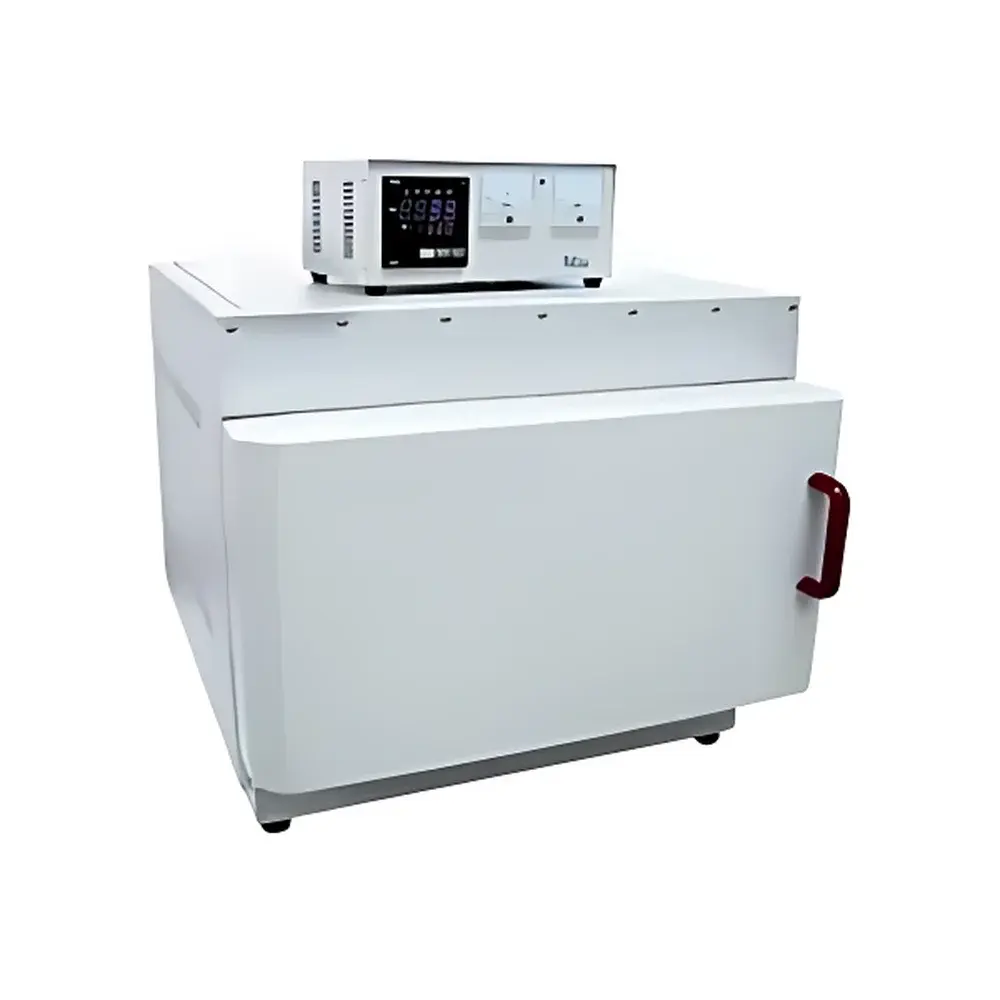
MICHEM TM-Series 1000°C Ceramic Fiber Muffle Furnace
| Brand | MICHEM |
|---|---|
| Origin | Beijing, China |
| Type | Box-Type Muffle Furnace |
| Max Temperature | 1000°C |
| Temperature Uniformity | ±1°C |
| Power Rating | 2 kW (6 L) / 3 kW (9 L) / 5 kW (20 L) / 6 kW (30 L) |
| Heating Rate to Max Temp | ≤30 min (6 L, 9 L, 20 L) / ≤40 min (30 L) |
| Heating Element | HRE High-Temperature Alloy Wire |
| Internal Chamber Dimensions | 200×250×120 mm (6 L) / 200×300×150 mm (9 L) / 250×400×200 mm (20 L) / 300×400×250 mm (30 L) |
| External Dimensions & Weight | 550×530×430 mm / 52 kg (6 L) |
| Power Supply | 220 V / 16 A (6 L, 9 L) or 380 V / 16 A (20 L, 30 L) |
| Insulation | Ceramic Fiber (80–130 mm thickness) |
| Thermocouple Type | K-type (≤1200°C) or S-type (≤1400°C) |
Overview
The MICHEM TM-Series 1000°C Ceramic Fiber Muffle Furnace is a precision-engineered box-type laboratory furnace designed for applications requiring stable, repeatable high-temperature thermal processing in analytical, metallurgical, materials science, and quality control laboratories. Utilizing advanced ceramic fiber insulation and HRE (High Resistance Element) alloy heating elements, this furnace achieves rapid, energy-efficient heating with exceptional thermal stability and minimal external heat dissipation. Its maximum operating temperature of 1000°C complies with ASTM E1142 (Standard Specification for Laboratory Muffle Furnaces), ISO 8573-1 (for thermal stability classification), and relevant sections of USP and for ash content and loss-on-ignition (LOI) testing. The furnace operates under atmospheric conditions with no internal gas atmosphere control — making it suitable for open-air calcination, ashing, annealing, and pre-treatment of inorganic samples prior to elemental analysis (e.g., ICP-OES, AAS). Its lightweight construction, low thermal mass, and optimized chamber geometry enable fast ramp rates and high reproducibility across repeated thermal cycles.
Key Features
- Rapid heating capability: Reaches 1000°C from ambient in ≤30 minutes for 6 L, 9 L, and 20 L models; ≤40 minutes for the 30 L configuration — significantly reducing turnaround time for routine ashing and thermal decomposition protocols.
- Precision temperature control: Equipped with PID-based programmable controllers supporting up to 30 segmented heating profiles, with temperature stability of ±1°C across the full working range and repeatability better than 0.2% of full scale (FS).
- Energy-efficient design: Optimized ceramic fiber insulation (80–130 mm thick) reduces surface temperature to ≤60°C after one hour at 1000°C — minimizing lab ambient heating and improving operator safety per OSHA 1910.147 and IEC 61000-6-3 EMC requirements.
- Robust mechanical architecture: All models feature reinforced stainless-steel outer casings, double-layer insulated doors with high-temp gaskets, and automatic power cutoff upon door opening — meeting EN 61000-6-2 immunity standards and supporting GLP-compliant operation.
- Flexible electrical integration: 6 L and 9 L variants operate on standard 220 V / 16 A single-phase supply; 20 L and 30 L models support industrial 380 V / 16 A three-phase input — enabling seamless integration into diverse laboratory power infrastructures without dedicated transformers.
- Modular chamber configurations: Four internal volume options (6 L, 9 L, 20 L, 30 L) accommodate varied sample throughput demands — from small crucibles (e.g., Pt, Al₂O₃, quartz) to large ceramic boats used in cement or coal analysis per ASTM D3174 and ISO 1171.
Sample Compatibility & Compliance
The TM-Series furnace accommodates standard laboratory crucibles (diameter ≤80 mm), porcelain boats, and refractory trays compatible with temperatures up to 1000°C. It supports standardized gravimetric procedures including ash content determination (ASTM D2974, ISO 1171), volatile matter analysis (ASTM D3175), and residue-on-ignition assays (USP ). The furnace’s uniform temperature distribution (±1°C zone verified per ASTM E220 calibration methodology) ensures compliance with regulatory requirements for method validation under FDA 21 CFR Part 11 when paired with audit-trail-enabled controllers (optional PP3-30 segment controller with data logging). All units are CE-marked and conform to IEC 61010-1:2010 for electrical safety in laboratory equipment.
Software & Data Management
The optional PP3-series programmable temperature controller provides 30-step ramp-soak programming, real-time temperature logging, and USB/RS485 interface for PC connectivity. When configured with compliant firmware, it supports electronic signature, user access levels, and audit trail generation — fulfilling ALCOA+ principles for data integrity in regulated environments. Raw temperature/time datasets export in CSV format for post-processing in MATLAB, Python (NumPy/Pandas), or LIMS platforms. No proprietary software installation is required; configuration is performed via intuitive front-panel navigation or industry-standard Modbus RTU protocol.
Applications
- Gravimetric analysis: Ash content, fixed carbon, and LOI testing in environmental, food, pharmaceutical, and geological laboratories.
- Metallurgical pre-treatment: Oxidation roasting of ores, sintering of powder metallurgy compacts, and thermal conditioning of refractory test specimens.
- Materials research: Heat treatment of ceramics, polymers, and composites; catalyst activation; and thermal stability screening per ISO 11358.
- Quality assurance: Routine calibration of thermocouples (as secondary reference source), validation of TGA instruments, and inter-laboratory proficiency testing.
- Educational use: Demonstrating kinetic principles of solid-state reactions, phase transitions, and Arrhenius behavior in undergraduate and graduate curricula.
FAQ
What is the recommended maintenance schedule for the HRE heating elements?
HRE alloy elements require no scheduled replacement under normal operation; however, visual inspection every 200 operational hours is advised. Avoid thermal shock by limiting ramp rates to ≤10°C/min during initial commissioning.
Can this furnace be used for inert-atmosphere processing?
No — the TM-Series is designed for air-atmosphere operation only. For controlled or reducing atmospheres, consider MICHEM’s separate tube furnace line with flange-mounted gas inlets and vacuum compatibility.
Is NIST-traceable calibration documentation available?
Yes — factory calibration certificates (per ISO/IEC 17025) with uncertainty budgets are provided upon request; on-site verification using Class I platinum resistance thermometers (PRTs) is supported.
How does the ceramic fiber insulation compare to traditional brick-lined furnaces?
Ceramic fiber offers ~75% lower thermal mass, resulting in faster heat-up/cool-down cycles and reduced energy consumption — validated against IEC 60068-2-2 for thermal cycling endurance.
Does the furnace meet requirements for GMP/GLP-regulated laboratories?
When equipped with the PP3 controller and operated under documented SOPs, it satisfies Annex 11 (EU GMP) and 21 CFR Part 11 data integrity provisions — including electronic records, audit trails, and role-based access control.



