
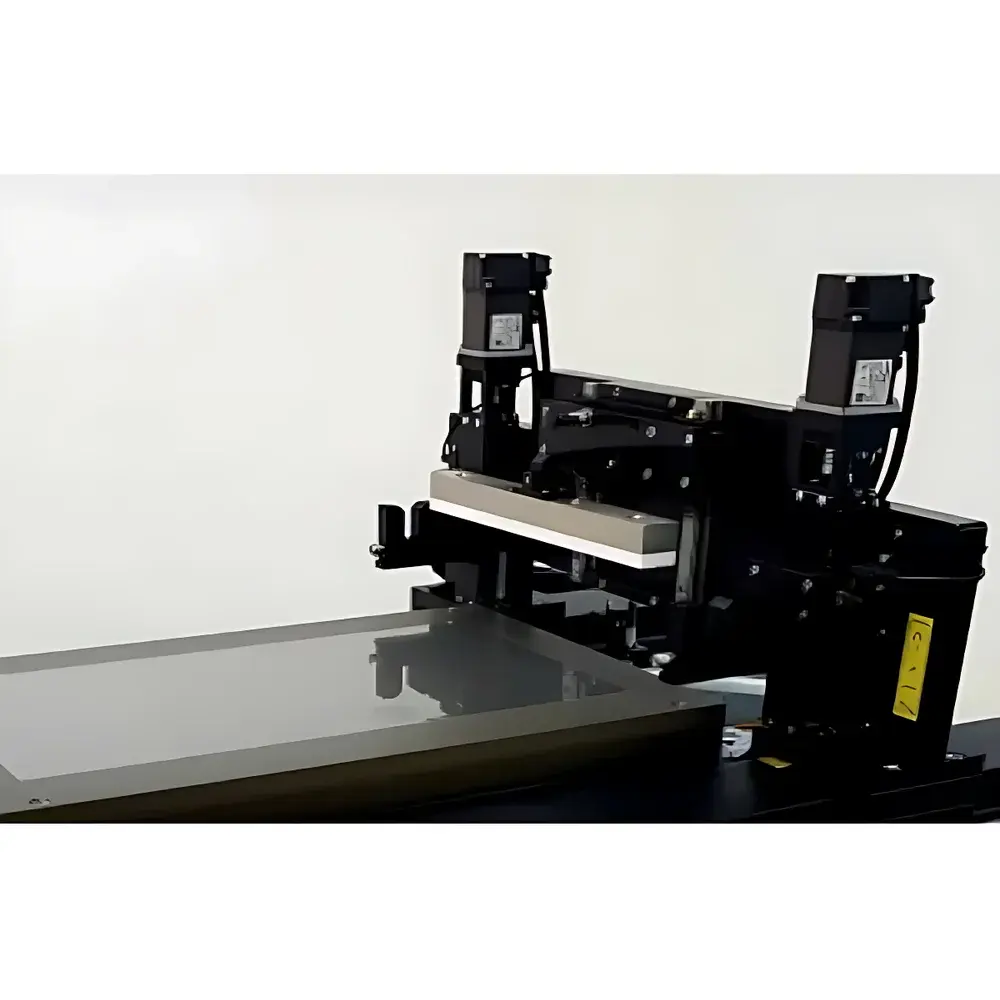
Micro Coater BSDX – Precision Blade Coating System for R&D and Pilot-Scale Thin-Film Deposition
| Origin | Imported |
|---|---|
| Manufacturer Type | Authorized Distributor |
| Model | BSDX |
| Pricing | Available Upon Request |
Overview
The Micro Coater BSDX is a precision-engineered blade-based thin-film coating system designed for reproducible, controllable deposition of functional layers in research laboratories and pilot-scale development environments. Operating on the principle of doctor-blade (knife-over-edge) coating, it utilizes a precisely adjustable gap between a rigid stainless-steel blade and a flat substrate to meter solution flow and define wet-film thickness. This method enables shear-controlled, solvent-evaporation-driven film formation with high spatial uniformity and minimal material waste—critical for cost-sensitive, low-volume formulations such as perovskite precursors, conductive polymer dispersions, and hydrogel precursors. Unlike spin coating, the BSDX accommodates substrates up to 300 × 300 mm without centrifugal force constraints, supports non-circular geometries, and delivers consistent thickness across large-area or flexible substrates—making it indispensable for next-generation optoelectronic, energy, and biomedical device prototyping.
Key Features
- Adjustable coating gap: Micrometer-actuated blade height control (range: 10–500 µm) with digital readout for repeatable wet-film thickness definition.
- Programmable coating speed: Motorized stage with linear motion control (0.1–100 mm/s), enabling precise shear rate modulation for rheologically complex fluids.
- Modular substrate holder: Vacuum chuck and clamping options compatible with rigid glass, silicon wafers, flexible PET/PEN foils, and textured metal foils.
- Integrated solvent management: Optional heated stage (RT–120 °C) and enclosed chamber with nitrogen purge port to control drying kinetics and suppress crystallization defects.
- Tool-free blade interchange: Quick-release mechanism supporting stainless-steel, ceramic, and polymer-coated blades for corrosion resistance or low-surface-energy applications.
- Compact footprint & CE-compliant safety architecture: Designed for Class 1000 cleanroom integration and benchtop deployment in university labs and corporate R&D centers.
Sample Compatibility & Compliance
The BSDX handles Newtonian and non-Newtonian solutions across a broad viscosity range (1–10,000 mPa·s), including precursor inks for metal halide perovskites, PEDOT:PSS dispersions, Li-ion cathode slurries, aqueous hydrogel monomers, and quantum dot nanocrystal suspensions. It supports substrates from 25 × 25 mm to 300 × 300 mm, accommodating rigid, semi-rigid, and roll-compatible flexible formats. The system conforms to ISO 9001 manufacturing traceability standards; its mechanical design aligns with ISO 14644-1 cleanroom compatibility guidelines. For regulated pharmaceutical development, optional audit-trail-enabled firmware complies with ALCOA+ data integrity principles and supports 21 CFR Part 11 electronic signature readiness when paired with validated LIMS integration.
Software & Data Management
The BSDX operates via a dedicated Windows-based control interface with real-time parameter logging (coating speed, gap setting, stage temperature, ambient RH). All operational parameters—including timestamped recipe files, motor encoder position traces, and manual calibration logs—are stored in encrypted SQLite databases with configurable export (CSV, XML) and network backup options. Version-controlled firmware updates ensure long-term protocol reproducibility. Raw data files include embedded metadata compliant with FAIR principles (Findable, Accessible, Interoperable, Reusable), facilitating integration into institutional ELN platforms (e.g., LabArchives, Benchling) and automated analysis pipelines using Python or MATLAB.
Applications
- Perovskite photovoltaics: Uniform deposition of MAPbI₃, CsPbBr₃, and mixed-cation precursor layers for high-efficiency solar cells.
- Micro/Mini-LED and OLED display R&D: Pixel-defined emissive layer patterning on TFT backplanes and encapsulation barrier films.
- Flexible electronics: Conductive AgNW or graphene oxide coatings on stretchable substrates for transparent electrodes.
- Energy storage: Slurry coating of NMC, LFP, or sulfur composite cathodes onto aluminum foil current collectors.
- Biomaterials: Controlled deposition of thermoresponsive hydrogels (e.g., PNIPAM) and drug-loaded polymer films for controlled-release implants.
- Optical interference coatings: Layer-by-layer assembly of TiO₂/SiO₂ stacks for anti-reflective and spectral-selective filters.
FAQ
What substrate materials are compatible with the BSDX?
Glass, silicon, stainless steel, aluminum foil, PET, PEN, PI, and PDMS-based flexible substrates—all with surface roughness < 1 µm Ra.
Can the BSDX be integrated into a glovebox environment?
Yes—its modular electrical interface, low-outgassing housing, and optional feedthrough ports support seamless integration into inert-atmosphere gloveboxes (N₂ or Ar) for air-sensitive perovskite or lithium-metal battery processing.
Is blade wear monitored or compensated automatically?
No real-time wear compensation is built-in; however, the system includes a standardized blade calibration procedure documented in the SOP manual, and wear thresholds are defined per blade material (e.g., ≤ 2 µm edge radius change for stainless steel before replacement).
Does the BSDX support multi-layer sequential coating without breaking vacuum or atmosphere?
Sequential wet-on-wet coating is supported via programmable pause intervals; for solvent-sensitive multilayers, an optional inline IR dryer module enables partial solvent removal between passes while maintaining environmental control.
What level of thickness uniformity can be achieved across a 150 × 150 mm substrate?
Typical thickness variation is ≤ ±3.5% (1σ) for optimized inks and substrates, verified by profilometry and ellipsometry—consistent with ASTM D1212 and ISO 2808 measurement protocols.



