
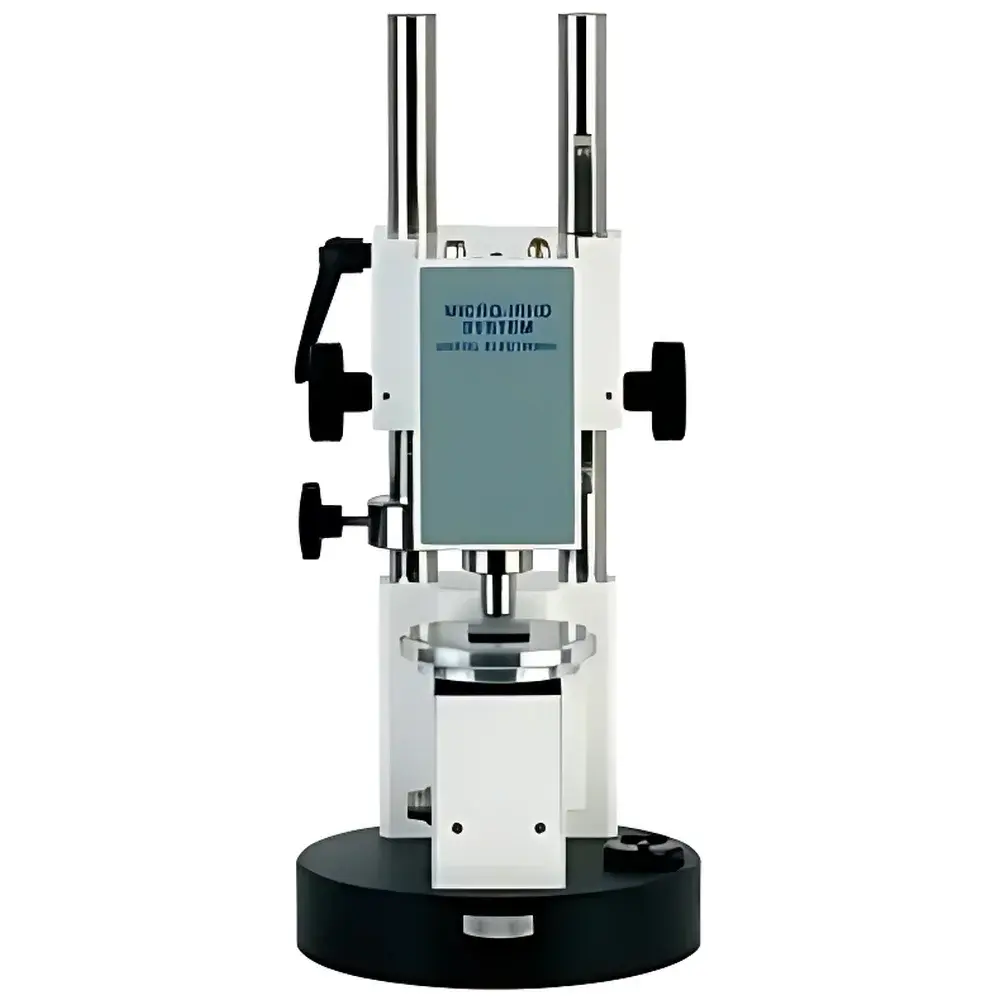
Micro IRHD Hardness Tester by Kägi
| Brand | Kägi |
|---|---|
| Origin | Germany |
| Model | Micro IRHD |
| Instrument Type | Microindentation Hardness Tester for Elastomers |
| Standards Compliance | DIN ISO 48, ISO 48:2018, ASTM D1415-19, BS 903-A26 |
| Sample Thickness Range | 1–5 mm (recommended), up to 90 mm (with optional fixtures) |
| Resolution | 0.1 Micro IRHD |
| Dimensions (Tester) | Ø200 mm × 470 mm |
| Dimensions (Controller) | 290 mm × 260 mm × 75 mm |
| Weight | 17.5 kg |
| Control Interface | RS232 serial communication with Windows PC |
| Automation | Motorized Z-stage, programmable dual-weight actuation, auto-positioning sample stage |
| Software Platform | Native MS Windows application with real-time data acquisition, statistical analysis, hysteresis calculation, report generation (PDF/CSV), label printing, and ASCII export |
Overview
The Kägi Micro IRHD Hardness Tester is a precision-engineered microindentation system designed specifically for the quantitative assessment of hardness in soft elastomeric materials—particularly vulcanized rubber, thermoplastic elastomers (TPEs), silicone gels, and low-modulus polymeric foams. Unlike conventional Shore or durometer methods, the Micro IRHD method employs a standardized spherical indenter (0.395 mm radius) under precisely controlled static loads, measuring indentation depth after a defined dwell time (30 s) to calculate hardness on the Micro IRHD scale (0–100). This principle adheres strictly to the physical definition of hardness as resistance to localized plastic deformation under quasi-static loading, making it highly reproducible across laboratories and suitable for R&D, quality control, and regulatory documentation in industries governed by ISO, ASTM, and BS standards.
Key Features
- Fully automated test sequence: motorized sample stage positioning, dual-weight actuation (light load for zero-reference, heavy load for measurement), and synchronized dwell timing—all executed without manual intervention.
- High-resolution displacement sensing with 0.1 Micro IRHD resolution, traceable to national metrology institutes via calibrated load cells and linear encoders.
- Modular architecture supports field-upgradable configurations—including O-ring centering fixtures, X-Y motorized stages with digital readout, and custom sample holders for irregular geometries.
- Integrated self-diagnostic routines verify mechanical integrity, load accuracy, and sensor linearity prior to each test series—ensuring GLP-compliant audit readiness.
- RS232 interface enables deterministic, low-latency communication between the controller and host PC; compatible with industrial SCADA environments and LIMS integration via ASCII protocol.
Sample Compatibility & Compliance
The system accommodates flat or gently curved elastomer specimens ranging from 1 mm to 90 mm in thickness, with optimal repeatability achieved within the 1–5 mm range recommended by ISO 48:2018 Annex B. Specimen surface flatness must meet ≤0.02 mm deviation over the 6 mm test zone. The tester is certified compliant with DIN ISO 48 (all parts), ASTM D1415-19 (Standard Test Method for Rubber Property—International Hardness), and BS 903-A26 (Methods of Testing Vulcanized Rubber—Hardness). Its design satisfies essential requirements for ISO/IEC 17025-accredited testing laboratories, including documented uncertainty budgets, calibration traceability, and environmental stability monitoring (temperature drift compensation built into firmware).
Software & Data Management
The native Windows-based software provides full instrument control, real-time force-displacement curve visualization, and post-test analytics—including hysteresis quantification (recovery ratio), batch-wise statistical summaries (mean, SD, Cp/Cpk), and customizable reporting templates compliant with FDA 21 CFR Part 11 (electronic signatures, audit trail logging, and user access controls available upon configuration). All raw data are stored in timestamped ASCII format for third-party statistical processing (e.g., JMP, Minitab). Reports support PDF export with embedded metadata (operator ID, calibration certificate number, environmental conditions), and label printing integrates directly with industrial barcode printers for specimen traceability in GMP manufacturing workflows.
Applications
- Development and validation of low-hardness elastomer compounds for medical device seals, pharmaceutical stoppers, and wearable sensor substrates.
- Batch release testing of silicone tubing and gasket materials per USP and ISO 10993-18 biocompatibility protocols.
- Long-term aging studies tracking hardness drift in automotive NVH components exposed to thermal cycling and ozone.
- Correlation modeling between Micro IRHD values and tensile set, compression set (ISO 815), and dynamic mechanical properties (DMA).
- Root cause analysis of surface bloom or plasticizer migration in extruded TPE profiles.
FAQ
What distinguishes Micro IRHD from Shore A or IRHD measurements?
Micro IRHD uses a smaller indenter radius (0.395 mm vs. 1.6 mm for standard IRHD) and lower applied forces, enabling reliable measurement of very soft materials (<30 IRHD) where Shore A lacks sensitivity and exhibits high variability.
Is calibration verification required before each test session?
Yes—the built-in diagnostic routine performs automatic verification of load cell output, indenter alignment, and stage repeatability at startup and can be scheduled between test batches per ISO/IEC 17025 Clause 6.5.2.
Can the system be integrated into an automated production line?
With optional I/O expansion modules and Modbus RTU support (via RS485 adapter), the controller accepts external trigger signals and outputs pass/fail status codes compatible with PLC-based sorting systems.
Does the software support multi-language UI and electronic signature compliance?
The core interface is English-only; however, 21 CFR Part 11 functionality—including role-based permissions, biometric or token-based e-signatures, and immutable audit logs—is enabled through validated software configuration packages supplied with IQ/OQ documentation.
What maintenance intervals are recommended for long-term accuracy?
Annual recalibration of load cells and displacement sensors is advised; quarterly verification using NIST-traceable reference blocks (certified at 20, 50, and 80 Micro IRHD) is required for ISO 17025 accreditation.



