
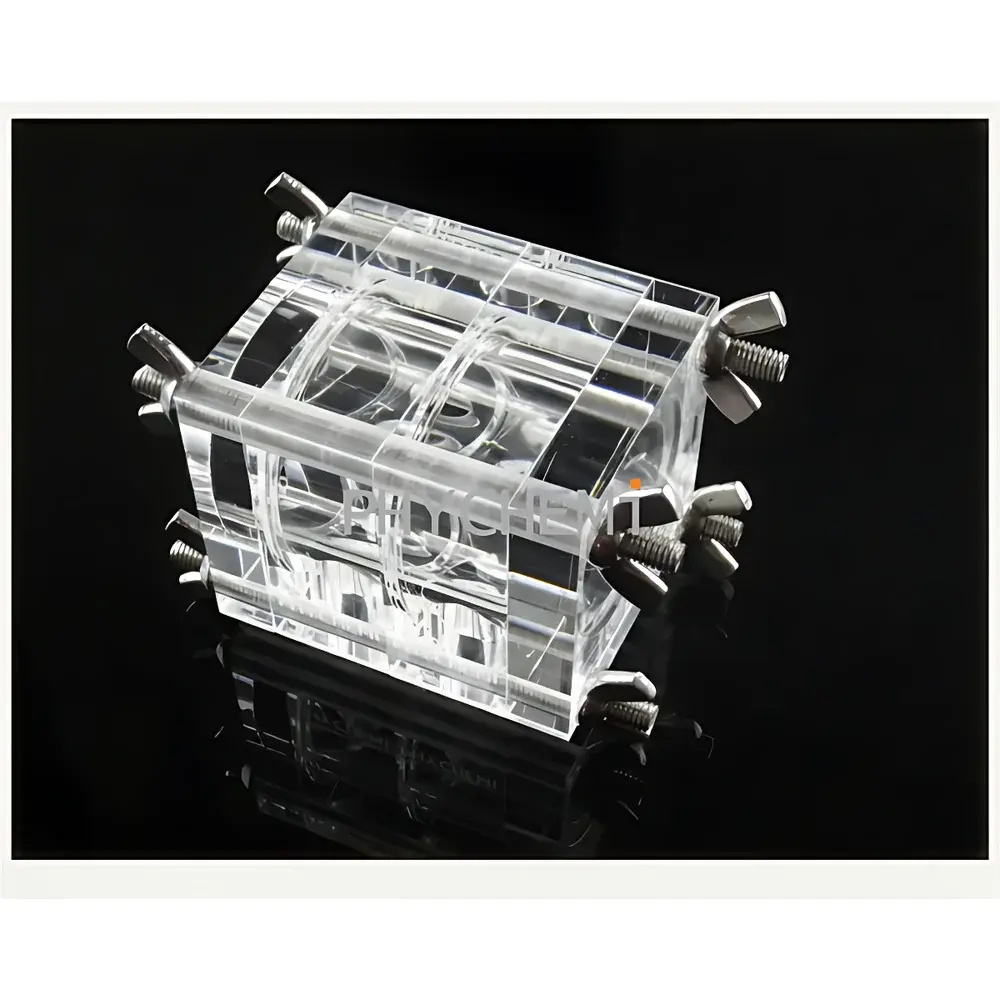
Microbial Fuel Cell (MFC) Reactor – El-Mul Technologies MFC Series
| Brand | El-Mul Technologies |
|---|---|
| Origin | Hubei, China |
| Manufacturer Type | Authorized Distributor |
| Country of Origin | China |
| Model | MFC |
| Volume Capacity | Micro-scale (customizable) |
| Construction Material | Chemically resistant polymer & borosilicate glass components |
| Operating Pressure | Low-pressure (ambient to 0.2 bar gauge) |
| Compliance | Designed for laboratory-scale electrochemical and bioelectrochemical research |
Overview
The El-Mul Technologies MFC Series Microbial Fuel Cell Reactor is a purpose-built, benchtop electrochemical bioreactor engineered for controlled investigation of extracellular electron transfer (EET) mechanisms, anode-respiring bacteria kinetics, and bioelectrocatalytic performance under defined anaerobic or microaerophilic conditions. Based on the fundamental principle of microbial electrosynthesis and exoelectrogenesis, this reactor enables quantitative measurement of current density, Coulombic efficiency, substrate degradation rates, and biofilm development dynamics in single-chamber or dual-chamber configurations. Its design adheres to core requirements for reproducible bioelectrochemical experimentation—including gas-tight sealing, electrode alignment precision, minimal dead volume, and compatibility with standard three-electrode potentiostat interfacing (working, counter, and reference electrodes). The system supports both batch and continuous-flow operation modes, making it suitable for fundamental studies in environmental microbiology, wastewater-based energy recovery, biosensor development, and synthetic biology–integrated electroactive consortia.
Key Features
- Modular, disassembly-friendly architecture with standardized flange interfaces (e.g., ISO-KF 16 or SS-4mm compression fittings) for rapid electrode exchange and chamber reconfiguration
- High-integrity sealing system utilizing FDA-compliant silicone or EPDM gaskets, validated for leak rates <1×10⁻⁶ mbar·L/s under static low-pressure conditions
- Customizable internal volume ranging from 5 mL to 250 mL—optimized for micro-scale substrate consumption and high signal-to-noise electrochemical readouts
- Electrode mounting ports with precise axial alignment tolerance (±0.1 mm), ensuring repeatable inter-electrode distance and uniform current distribution
- Chemically inert construction combining borosilicate glass body sections (for optical monitoring and pH/DO probe integration) and reinforced polymer end caps (for mechanical stability and electrical insulation)
- Integrated gas venting and sampling ports compatible with syringe-based headspace analysis (e.g., CH₄, CO₂, H₂ quantification via GC-TCD)
Sample Compatibility & Compliance
The MFC reactor accommodates diverse inocula—including activated sludge, sediment-derived consortia, pure cultures (e.g., Shewanella oneidensis, Geobacter sulfurreducens), and engineered synthetic communities. It supports liquid-phase substrates (acetate, lactate, glucose, wastewater effluents) and solid-phase anodes (carbon cloth, graphite granules, 3D-printed porous scaffolds). All wetted materials comply with USP Class VI biocompatibility standards and exhibit negligible leachables in aqueous electrolytes (tested per ASTM D4292). While not certified for GMP manufacturing, the reactor meets essential GLP documentation requirements for academic and preclinical bioelectrochemical studies, including traceable component lot numbers and calibration-ready geometry specifications.
Software & Data Management
The reactor is fully interoperable with industry-standard potentiostats (e.g., BioLogic SP-300, PalmSens EmStat GO) and data acquisition platforms (LabVIEW, Python-based PyMCA, or MATLAB Instrument Control Toolbox). Raw current/voltage time-series data are timestamped and stored in HDF5 or CSV formats supporting metadata tagging (e.g., temperature, pH, hydraulic retention time). When used with compliant electrochemical software, the system supports audit-trail-enabled operation aligned with FDA 21 CFR Part 11 principles—including user access logs, electronic signatures for protocol execution, and immutable data archiving. Optional API integration allows synchronization with LIMS environments for sample tracking and experiment lineage mapping.
Applications
- Quantitative assessment of electron transfer pathways in electroactive biofilms using cyclic voltammetry and chronoamperometry
- Long-term stability testing of novel anode/cathode materials under continuous polarization
- Real-time monitoring of organic load removal efficiency coupled with power output in synthetic wastewater matrices
- Development and validation of microbial biosensors for BOD, toxicity, or nutrient detection
- Investigation of syntrophic interactions in multi-species MFC consortia under controlled redox gradients
- Training platform for undergraduate and graduate courses in environmental engineering, bioelectrochemistry, and sustainable energy systems
FAQ
Can the reactor be operated in dual-chamber configuration?
Yes—optional Nafion® 117 or custom ion-exchange membrane inserts are available for physically separated anode and cathode compartments.
Is sterilization supported?
All glass and polymer components are autoclavable at 121°C, 2 bar for 20 minutes; electrode assemblies require separate chemical sterilization (e.g., 70% ethanol immersion).
What electrode types are compatible?
Standard configurations support carbon-based working electrodes (cloth, felt, rod), platinum wire counter electrodes, and Ag/AgCl (3 M KCl) reference electrodes—custom mounts accommodate rotating disk electrodes or printed flexible electrodes.
Does the system include electrochemical control hardware?
No—the MFC reactor is a passive cell; users must supply a compatible potentiostat/galvanostat and associated cabling.
How is customization initiated?
Volume, port layout, material grade (e.g., quartz instead of borosilicate), and electrode geometry modifications are coordinated directly with El-Mul Technologies’ technical sales team via formal inquiry with experimental use-case documentation.



