
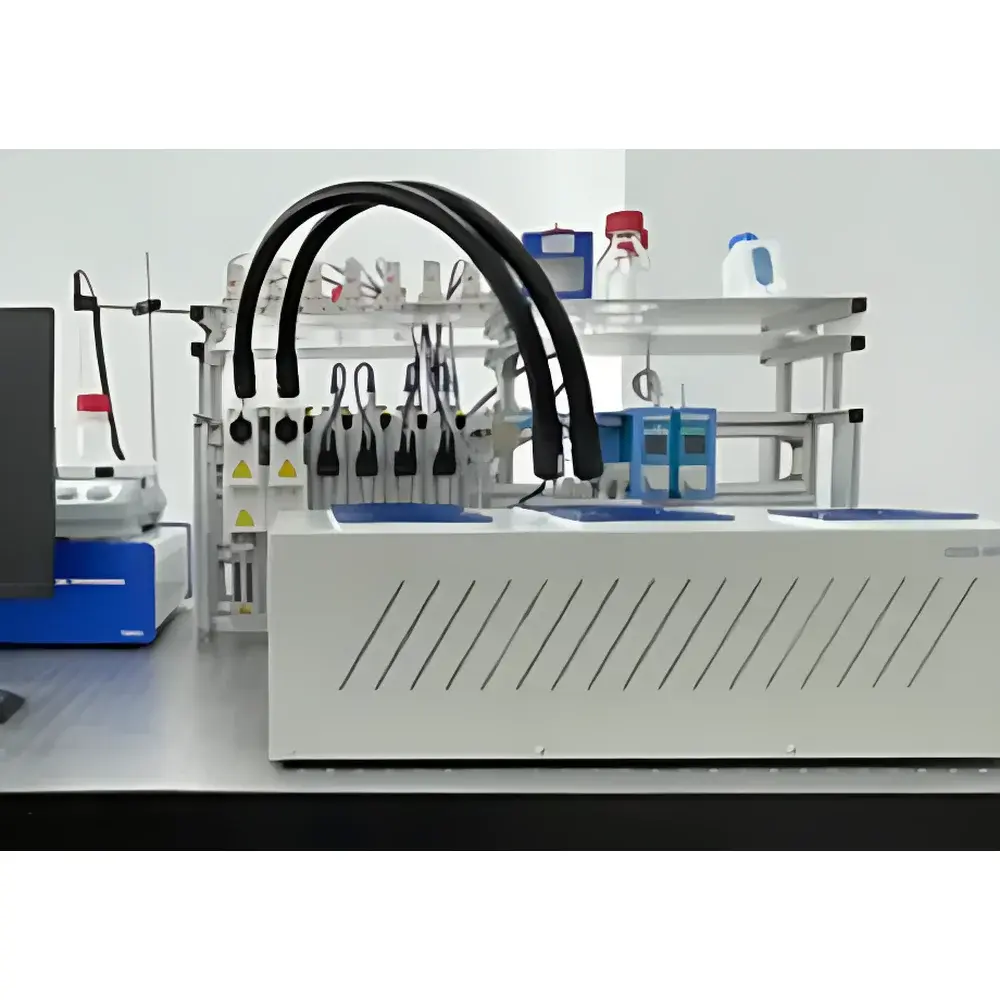
Microblox Microfluidic Chemical Synthesis System (Complex Fluid Manipulation)
| Brand | Microblox |
|---|---|
| Origin | Germany |
| Manufacturer Type | Authorized Distributor |
| Product Origin | Imported |
| Model | Microblox-Complex |
| Temperature Range | Customizable |
| Temperature Control Accuracy | Customizable |
| Reaction Units | Customizable |
| Reaction Volume | Customizable |
Overview
The Microblox Microfluidic Chemical Synthesis System (Complex Fluid Manipulation) is an engineered platform for precision-controlled, multi-parameter chemical synthesis under continuous or segmented flow conditions. Built upon laminar-flow microfluidics principles and Couette-type fluidic actuation, the system enables reproducible reagent delivery, thermal management across extreme ranges, on-chip mixing, and real-time optical characterization—without manual intervention. Designed for laboratories requiring stringent process control in synthetic chemistry, materials science, and pharmaceutical process development, it supports reaction environments from –5 °C to 320 °C, accommodates aggressive organic solvents and corrosive reagents, and maintains full compatibility with GLP-compliant workflow documentation requirements.
Key Features
- Modular architecture with four independently controlled functional units: high-precision fluidic drive, multi-zone temperature regulation, glass-based microreactor chip, and integrated UV-Vis spectroscopic monitoring.
- Non-contact, chemically inert pressure-driven actuation: standard positive-pressure mode up to 7000 mbar; dual-range version operates from –800 mbar to +1000 mbar—enabling vacuum-assisted priming, backflushing, and gas-phase handling.
- Thermally isolated heating zones with independent PID control; capable of sustained operation at 320 °C on reactor segments and 150 °C on syringe holders; uses fluoropolymer-coated stainless-steel or PEEK/FEP capillary tubing (up to 1/8″ OD) with replaceable internal microchannels.
- Borosilicate glass microfluidic chips featuring 3D passive mixing structures (internal volume 0.5–4 mL); optimized for rapid diffusive homogenization (<100 ms mixing time) and compatible with acidic, basic, and halogenated organic media.
- Real-time optical detection via compact fiber-coupled spectrometer (200–800 nm range); includes 365 nm LED excitation source and flow-through cuvette for inline absorbance, fluorescence, or colorimetric monitoring during synthesis.
Sample Compatibility & Compliance
The system handles a broad spectrum of liquid-phase chemistries—including organometallic catalysis, nanoparticle synthesis (e.g., quantum dots), peptide coupling, and photochemical transformations—while maintaining integrity of sensitive intermediates. All wetted materials comply with USP Class VI and ISO 10993 biocompatibility standards. Capillary and chip surfaces resist leaching and adsorption, ensuring minimal carryover between runs. The platform supports audit-ready operation per FDA 21 CFR Part 11 when paired with validated software configurations, and meets mechanical safety requirements outlined in EN 61000-6-2 (EMC) and EN 61010-1 (electrical safety). Reaction modules are certified for use under ASME B31.3 process piping guidelines when integrated into pilot-scale hybrid setups.
Software & Data Management
The native Microblox FlowControl Suite provides graphical programming via drag-and-drop interface for sequence definition—including timed valve actuation, gradient pumping profiles, thermal ramping, and synchronized spectral acquisition. All operational parameters—including mass flow rates, pressure transducer outputs, thermocouple readings, and spectrometer intensity traces—are logged at user-defined intervals (down to 100 ms resolution) with UTC timestamps and operator ID tagging. Export formats include CSV, HDF5, and MDF4 for downstream analysis in MATLAB, Python (Pandas/NumPy), or commercial LIMS platforms. Audit trails record configuration changes, user logins, and calibration events—fully traceable for GMP/GLP validation protocols.
Applications
- Quantum dot and perovskite nanocrystal synthesis with narrow size distribution (CV <8%) via precisely controlled nucleation-growth kinetics.
- High-temperature heterogeneous catalysis screening (e.g., Fischer–Tropsch analogs) using heated stainless-steel microreactors with integrated pressure sensors.
- Multi-step continuous-flow organic synthesis involving cryogenic lithiation, low-T addition, and subsequent thermal cyclization—all within a single integrated platform.
- Automated library generation for medicinal chemistry: parallelized reagent injection across eight independent channels with real-time UV endpoint detection.
- In-process reaction monitoring for API manufacturing: tracking imine formation, Suzuki coupling conversion, or hydrolysis kinetics via time-resolved absorbance at characteristic λmax.
FAQ
Can the system operate under inert atmosphere or elevated pressure?
Yes—the pressure module supports sealed-loop operation up to 70 bar absolute; optional gas-tight connectors and purge-capable manifolds enable Schlenk-line integration.
Is chip-to-chip reproducibility validated across production batches?
Each borosilicate chip undergoes dimensional metrology (±0.5 µm channel tolerance) and hydraulic resistance verification; batch certificates include flow-rate deviation data at 100–1000 µL/min.
How is temperature uniformity maintained across extended reaction zones?
Zonal heaters employ distributed thermistor feedback with spatial compensation algorithms; thermal gradients are ≤0.3 °C over 50 mm active length at steady state.
Does the software support remote access and integration with third-party PLCs?
Yes—OPC UA server implementation allows bidirectional communication with Siemens S7, Rockwell ControlLogix, and Beckhoff TwinCAT systems; secure HTTPS web interface enables off-site monitoring.
What validation documentation is provided for regulated environments?
IQ/OQ protocols, calibration records for all transducers, and material compliance dossiers (including RoHS, REACH, and SVHC declarations) are supplied as part of the installation qualification package.



