
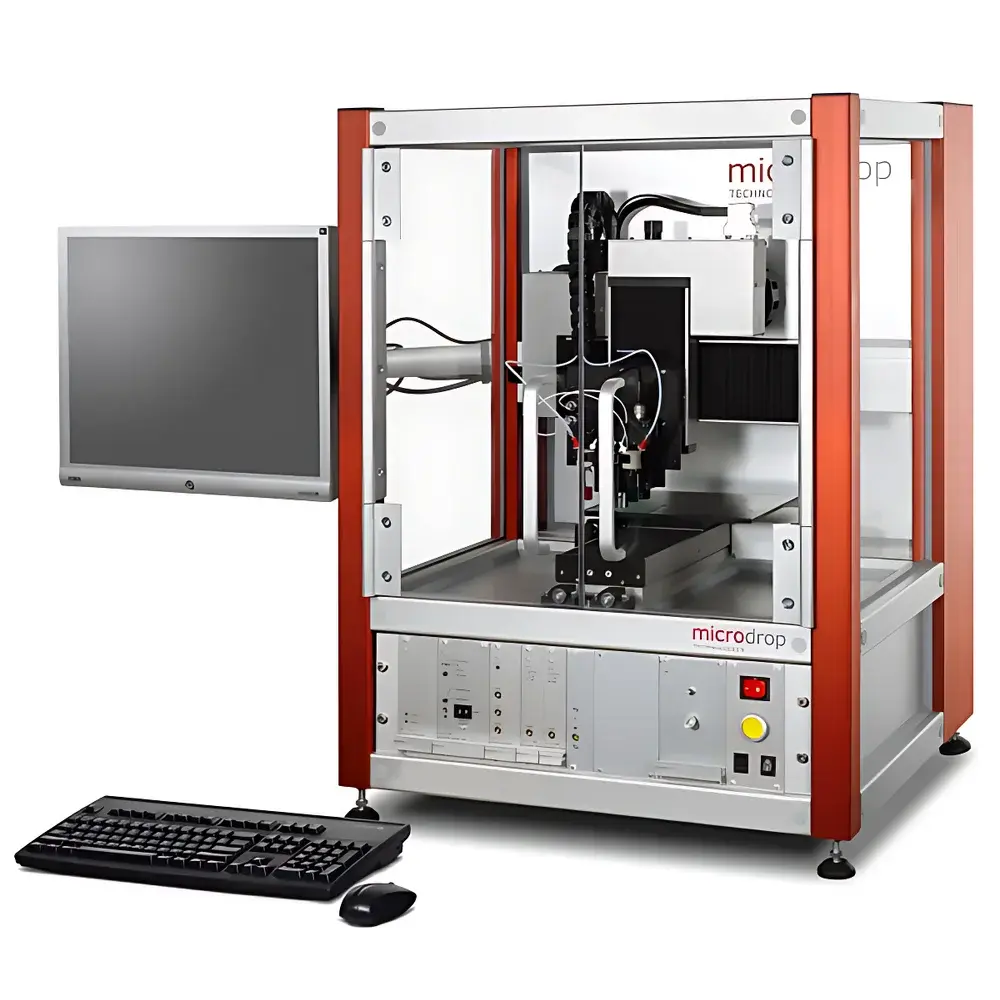
Microdrop Autodrop Gantry ECO High-Precision Non-Contact Microarray Spotting Instrument
| Brand | Microdrop |
|---|---|
| Origin | Germany |
| Model | Autodrop Gantry ECO |
| Spotting Type | Non-contact piezoelectric inkjet |
| Minimum Spot Size | <5 µm |
| Spotting Throughput | 2000 spots/sec |
| Substrate Capacity | Up to 384-well microplates or standard microscope slides |
| Repeatability & Positioning Accuracy | ±5 µm |
| Compatible Fluid Viscosity Range | 20–10,000 mPa·s (heated operation supported) |
| Drive Technology | Piezoelectric actuation with inert fluidic path (glass/PTFE/PEEK) |
| System Architecture | Modular gantry-based platform with integrated liquid handling and real-time motion compensation |
Overview
The Microdrop Autodrop Gantry ECO is a high-precision, non-contact microarray spotting instrument engineered for reproducible, sub-5-µm deposition of picoliter-to-microliter volumes across life science, materials science, and industrial R&D applications. Built upon Microdrop’s proprietary piezoelectric inkjet dispensing technology—refined over nearly three decades in Germany—the system delivers deterministic droplet ejection without nozzle clogging or mechanical wear. Each droplet is generated via controlled piezoelectric deformation of a ceramic actuator, inducing pressure waves that eject fluid at ~2 m/s from an inert, chemically resistant fluid path composed exclusively of glass, PTFE, and PEEK. This architecture ensures compatibility with aqueous buffers, organic solvents, polymer melts, conductive inks, and viscous bioconjugates (20–10,000 mPa·s), with optional integrated heating enabling temperature-controlled dispensing of thermally sensitive or high-melting-point formulations.
Key Features
- Non-contact piezoelectric microdispensing with <5 µm spot resolution and ±5 µm positional repeatability across full travel range
- Gantry-based XYZ motion system with high-resolution linear encoders and active motion compensation during dispensing
- Automated liquid handling integration: simultaneous aspiration, spotting, and wash/recovery cycles from 96- or 384-well plates
- Modular head design supporting interchangeable Microdrop MD-K series printheads—each featuring zero-moving-parts fluidics and field-replaceable nozzles
- On-the-fly spotting mode: synchronized droplet ejection during continuous stage movement, eliminating dwell time and maximizing throughput (up to 2000 spots/sec)
- Thermally stabilized printhead options available for viscosity modulation and temperature-sensitive biomolecule preservation
- Fully programmable dispensing parameters per well—including volume, frequency, waveform shape, and number of shots—enabling multi-component array fabrication
Sample Compatibility & Compliance
The Autodrop Gantry ECO accommodates standard microscope slides (25 × 75 mm, 1–1.2 mm thickness), silicon wafers, polymer substrates, and ANSI/SLAS-compliant microplates (96-, 384-, and 1536-well formats). Its inert fluidic pathway meets ISO 13485 requirements for medical device manufacturing environments and supports GLP-compliant workflows when paired with audit-trail-enabled software configurations. The system is routinely deployed in laboratories adhering to ISO/IEC 17025, ASTM E2539 (microarray performance standards), and USP <1058> guidelines for analytical instrument qualification. All hardware components are CE-marked and RoHS-compliant; optional IQ/OQ documentation packages are available for regulated biopharma and diagnostics facilities.
Software & Data Management
Controlled via Microdrop’s AD-Soft suite—a Windows-based application supporting intuitive graphical layout design, plate mapping, and script-driven protocol automation—the instrument enables full traceability of every dispense event. Raw data logs include timestamped coordinates, volume per spot, pulse count, environmental conditions (optional sensor integration), and error flags. Export formats include CSV, XML, and HDF5 for downstream analysis in MATLAB, Python (NumPy/Pandas), or commercial LIMS platforms. For regulated environments, optional 21 CFR Part 11-compliant modules provide electronic signatures, role-based access control, and immutable audit trails—fully validated per GAMP 5 principles. Remote monitoring and firmware updates are supported via secure HTTPS API endpoints.
Applications
- Life Sciences: High-density DNA/RNA/protein microarrays, antibody validation chips, cell patterning substrates, CRISPR guide RNA libraries, and spatial transcriptomics slide preparation
- Diagnostics Development: Multiplexed immunoassay surfaces, biosensor electrode functionalization (e.g., CGM electrodes), and point-of-care test strip printing
- Materials Science: Printed flexible electronics, OLED/QLED pixel definition, perovskite solar cell precursor patterning, and gradient library synthesis for catalyst screening
- Industrial R&D: Precision lubricant deposition on MEMS components, conductive trace printing on conformal surfaces, and functional coating of optical waveguides
- Academic Research: High-throughput formulation screening, combinatorial polymer synthesis, and single-cell microenvironment engineering
FAQ
What types of liquids can be dispensed with the Autodrop Gantry ECO?
Aqueous buffers, glycerol-based reagents, DMSO solutions, polymer melts (e.g., PMMA, PVP), conductive nanoparticle inks, and viscous hydrogels—provided viscosity falls within 20–10,000 mPa·s at dispensing temperature.
Is the system compatible with robotic liquid handlers or LIMS integration?
Yes—via TCP/IP and RS-232 interfaces, the Autodrop Gantry ECO supports bidirectional communication with third-party automation systems (e.g., Hamilton STAR, Tecan Freedom EVO) and LIMS through standardized protocols including ASTM E1578 and HL7.
How is calibration maintained over long-term operation?
The system employs factory-calibrated linear encoders and periodic self-diagnostic routines; optional NIST-traceable verification kits enable user-performed accuracy validation per ISO/IEC 17025 Annex A.2.
Can the instrument perform multi-material spotting on a single substrate?
Yes—by integrating up to four independently controlled MD-K printheads, each with dedicated fluid reservoirs and pressure regulation, enabling sequential or co-deposition of distinct reagents without cross-contamination.
What service and support options are available globally?
Microdrop provides on-site installation, application-specific training, annual preventive maintenance contracts, and 24/7 remote diagnostics support—with regional service centers in Europe, North America, and Asia Pacific.




