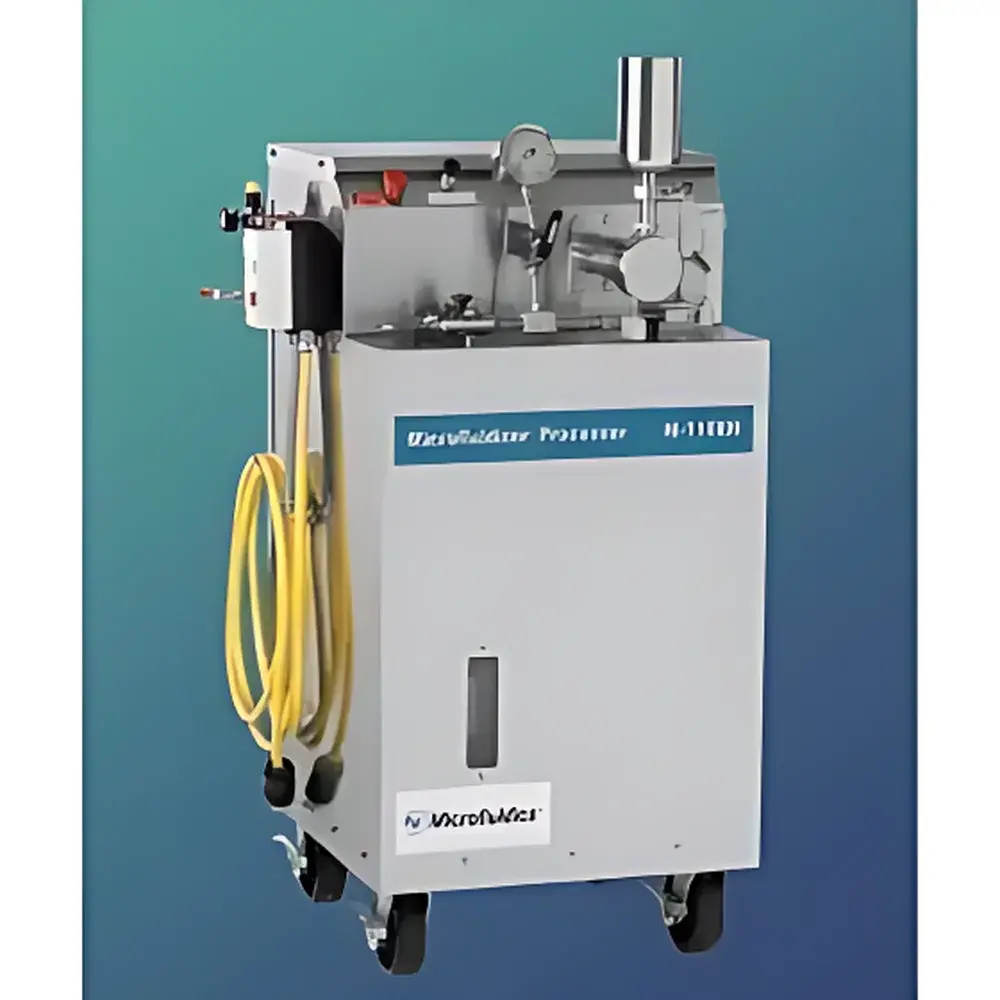
Microfluidics M-110EH High-Pressure Microfluidizer Nanoscale Homogenizer
| Origin | USA |
|---|---|
| Manufacturer Type | Authorized Distributor |
| Origin Category | Imported |
| Model | M-110EH |
| Instrument Type | High-Pressure Cell Disruptor |
| Max Operating Pressure | 30,000 psi (207 MPa) |
| Max Flow Rate | 450 mL/min |
| Inlet Temp. Range | ≤75°C |
| Power Supply | 3-Phase, 380 V, 5 HP (3.7 kW) |
| Fluid Path Volume | 100 mL |
| Compressed Air Requirement | 35–150 psi |
| Dew Point | 0–35°F |
| Minimum Sample Volume | 120 mL |
| Dimensions | 73 × 87 × 148 cm |
| Weight | 205 kg |
| IXC Chamber Material | Synthetic Diamond |
| Regulatory Compliance | CE Certified |
| Cleaning | CIP-Compatible |
| Sterilization | SIP-Capable (Steam or Hot Water) |
Overview
The Microfluidics M-110EH High-Pressure Microfluidizer Nanoscale Homogenizer is an engineered solution for high-integrity, scalable nano-processing in life science and pharmaceutical manufacturing environments. Based on the principle of controlled microfluidic interaction under ultra-high hydraulic pressure, the system forces sample streams through precisely dimensioned, fixed-geometry Interaction Chambers (IXC), generating intense shear, cavitation, and impact forces within a reproducible laminar flow regime. Unlike conventional valve-based homogenizers, the M-110EH employs a patented synthetic diamond IXC architecture—ensuring dimensional stability, chemical inertness, and resistance to erosion across thousands of operational cycles. This enables consistent sub-100 nm particle size reduction, narrow polydispersity index (PDI), and high-efficiency cell lysis without thermal degradation or metal leaching. Designed for GMP-aligned workflows, the M-110EH supports seamless transition from discovery-scale experiments (≥120 mL minimum volume) through pilot production (up to 450 mL/min), with linear scalability validated across multiple biopharmaceutical applications.
Key Features
- Synthetic diamond Interaction Chamber (IXC) — US-patented geometry ensuring zero drift in chamber dimensions, long-term wear resistance, and compatibility with aggressive solvents, acids, and biological matrices.
- Stable pressure control from 2,500 to 30,000 psi (17–207 MPa), enabling precise tuning of energy input per unit volume for targeted nanostructural outcomes.
- Integrated automatic temperature management system — monitors and regulates inlet/outlet temperatures to maintain sample integrity below 75°C, critical for thermolabile proteins, mRNA, and liposomal formulations.
- CIP/SIP-ready fluid path — full in-line cleaning and sterilization capability using steam (≥121°C) or hot water (≥80°C); no disassembly required, minimizing cross-contamination risk and downtime.
- Robust industrial-grade construction — CE-certified frame with 205 kg mass damping vibration, 3-phase 380 V / 3.7 kW drive system, and compressed air interface compliant with ISO 8573-1 Class 2 purity standards.
Sample Compatibility & Compliance
The M-110EH accommodates diverse feedstocks including mammalian and microbial cell suspensions, lipid dispersions, polymer nanoparticle precursors, and highly viscous or heterogeneous suspensions (e.g., >30% w/v solids). Its non-contact, all-fluid-path design eliminates rotor-stator abrasion, preventing metallic contamination and preserving native biomolecular conformation. The system conforms to ISO 13485 design controls for medical device manufacturing and supports FDA 21 CFR Part 11-compliant data governance when integrated with validated LIMS or MES platforms. All wetted surfaces meet USP Class VI biocompatibility requirements; IXC certification includes ASTM F2477 cytotoxicity testing and ISO 10993-5 extractables profiling.
Software & Data Management
While the M-110EH operates via analog pressure/flow instrumentation with manual setpoint control, it features calibrated analog outputs (4–20 mA) for integration into centralized SCADA or DCS systems. Optional digital retrofit kits provide real-time logging of pressure, temperature, flow rate, and cycle count with timestamped audit trails. Data files comply with ALCOA+ principles (Attributable, Legible, Contemporaneous, Original, Accurate, Complete, Consistent, Enduring, Available) and support retrospective validation per ICH Q5C and Q5E guidelines. Electronic records are exportable in CSV or XML format for statistical process control (SPC) analysis and regulatory submission packages.
Applications
- High-yield, single-pass microbial and mammalian cell disruption (>95% lysis efficiency) with preserved intracellular enzyme activity and minimal nucleic acid shearing.
- Nanoprecipitation and homogenization of liposomes, exosomes, polymeric nanoparticles, and siRNA/mRNA-LNPs for preclinical and clinical formulation development.
- Production of stable nanoemulsions for topical, oral, and parenteral delivery systems — achieving D90 < 100 nm and PDI < 0.15 under controlled adiabatic conditions.
- Particle size reduction of insoluble APIs and nanocrystal suspension stabilization per USP light obscuration and laser diffraction protocols.
- Process characterization and DoE studies supporting QbD implementation in biomanufacturing, aligned with ICH Q8(R2) and Q9 frameworks.
FAQ
What is the minimum sample volume required for reliable operation?
The M-110EH requires a minimum working volume of 120 mL to ensure stable pressure build-up and avoid cavitation-induced pulsation in the fluid path.
Can the system be used for sterile processing of therapeutic biologics?
Yes — the fully SIP-capable design permits terminal sterilization with saturated steam at 121°C for ≥15 minutes, validated per ISO 17665-1 and EU Annex 1 requirements.
How does the diamond IXC compare to ceramic or tungsten-carbide alternatives?
Synthetic diamond exhibits superior hardness (HV 10,000), zero porosity, and negligible ion leaching — eliminating batch-to-batch variability associated with microcrack propagation in sintered ceramics.
Is pressure calibration traceable to NIST standards?
All factory-installed pressure transducers are calibrated against NIST-traceable deadweight testers, with certificates provided per ISO/IEC 17025 accredited procedures.
Does the system support continuous operation for extended production runs?
Rated for continuous duty at ≤80% of maximum pressure (24,000 psi), with thermal management sustaining ≤75°C inlet temperature over 8-hour shifts under GMP environmental monitoring.
Related Products